You buy a shelf, load it up, and step back. Something feels off. The books lean, the little objects are scattered everywhere, and the whole thing looks like a yard sale on a wall. Sound familiar?
Here’s the good news. Great shelf arrangement ideas aren’t about having expensive stuff or a designer’s eye. They’re about knowing what order to work in. Designers follow a handful of repeatable rules for balance, spacing, and grouping, and you can borrow every one of them today. By the end of this guide, you’ll know how to style a bookshelf, a floating shelf, and a kitchen shelf without buying a single new thing.
Shelf Arrangement Ideas Start With an Empty Shelf
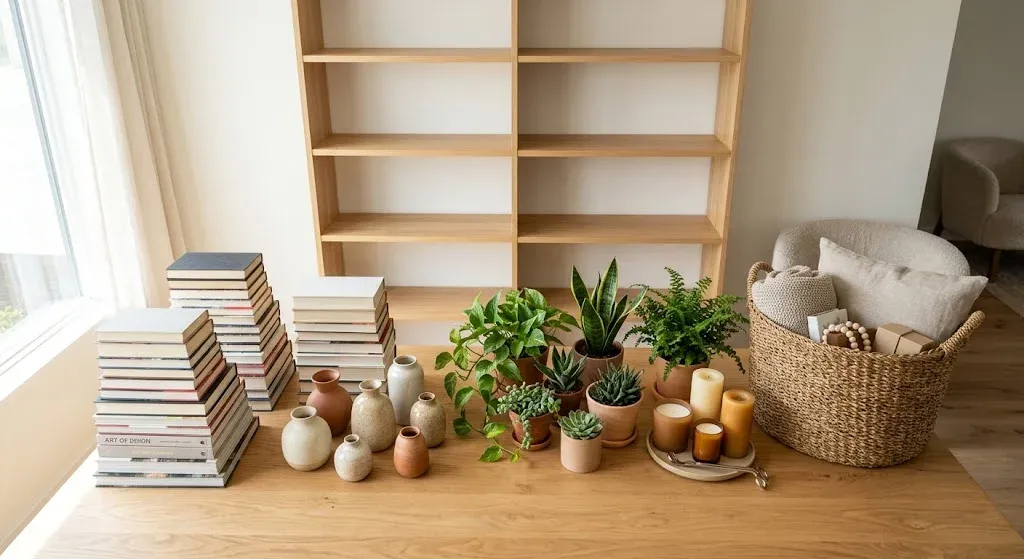
Here’s the step almost everyone skips: take everything off the shelf. All of it.
The best shelf arrangement ideas begin with a blank surface, because you can’t judge what belongs when everything is already crammed in. Wipe the shelf down, set your items on a table or the floor, and sort them into piles. Books go in one pile, decor in another, plants in a third. Then there’s the pile of things that never belonged on display in the first place, like chargers, old mail, and that mystery box of cables.
Now look at what’s left. Pick the pieces you actually love or use. A wedding photo, a ceramic bowl from a trip, a stack of cookbooks you open every week. That’s a shelf with a point of view. A shelf full of random fillers is just storage with a nicer name.
Here’s a quick sorting test:
- Keep: things you love, use, or can tell a story about.
- Move: things that belong in a drawer, a closet, or another room.
- Swap out: pieces that would look better in another season.
One more thing before you start building. If your bookcase has a solid back panel, think about giving it a coat of paint. A deep green or soft charcoal makes everything on the shelf stand out. Just tie the color to something already in the room, like a rug or a cushion, so it looks planned rather than random.
Get Visual Balance Before You Add Anything Decorative
Think of a shelf like a tiny room. If all the furniture crowds into one corner, it feels wrong, even if each piece is gorgeous.
Visual balance simply means the weight of your items is spread out, so the eye can travel across the whole shelf. It doesn’t have to be symmetrical. Honestly, perfect symmetry can look stiff. What you want is a rough balance, where a heavy item on the left gets an answer from something with similar weight on the right.
The rule of three
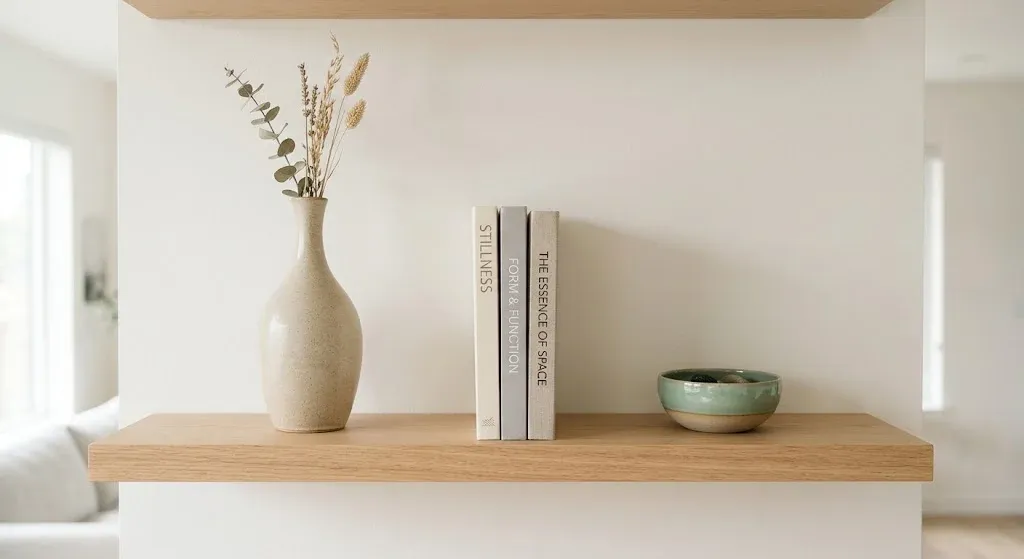
Group items in threes, ideally with varying heights: one tall, one medium, one low. A tall vase, a short stack of books, and a small bowl make a classic trio. Odd numbers feel more natural than pairs, which is why designers lean on them. The same goes for the number of shelves on a wall. Three or five usually looks better than four.
Aim for about 60% full
Here’s a rule of thumb that works well: fill roughly 60 percent of each shelf and leave the rest empty. That empty space is breathing room, and it’s what makes your items look chosen instead of stored. If a shelf feels busy, remove one thing and look again. Still busy? Remove another.
Put the heavy stuff low
Larger, heavier items belong near the bottom or in the middle. Keep lighter, smaller pieces on the upper shelves. This is partly about looks, because a top-heavy shelf feels like it’s leaning forward. But it’s also about safety, especially with wall-mounted units.
Bookshelf Styling: Stacked Books and Color Groups
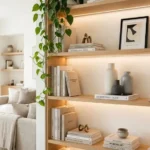
Books are the backbone of most shelves, and how you place them changes the whole look. Most shelf arrangement ideas for bookcases come down to just three moves: vary the direction, group by color, and leave gaps. If you want more inspiration beyond this guide, Homes & Gardens has a big gallery of real shelf photos worth scrolling through.
Mix upright rows with stacked books
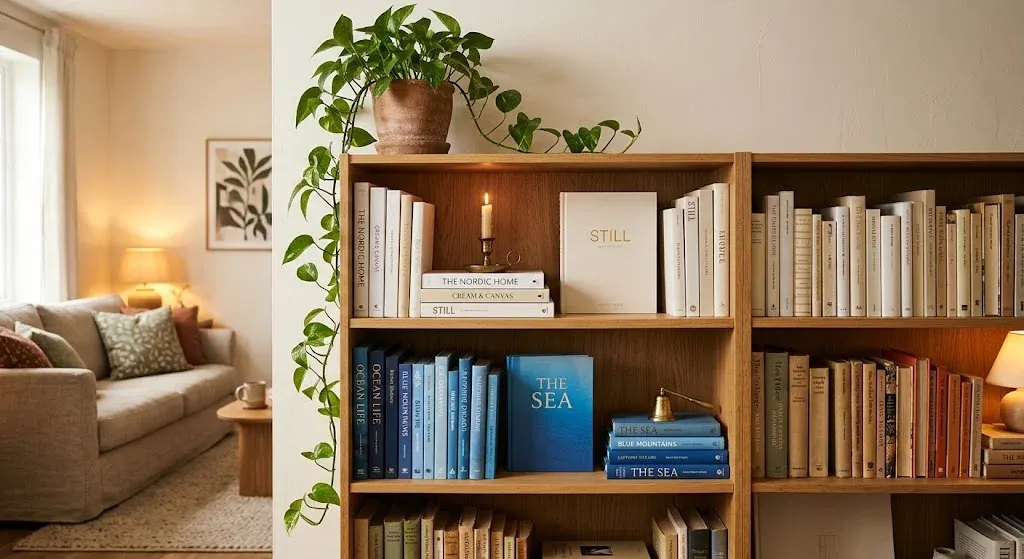
A row of upright books looks like a library. That’s lovely, but it can feel flat after a while. Break it up by laying a small pile on its side next to the upright row. Stack them from large to small, with the smallest on top, and set a little object on the pile, like a candle or a small sculpture. Suddenly your stack becomes a pedestal.
Here’s a detail people forget. In a stack, only the top cover shows, and what everyone sees on the lower books is the spine. So choose spines you like looking at.
Group by color
Color grouping is one of the easiest ways to calm a busy shelf. You don’t need a full rainbow gradient. Even gathering your whites and creams together, then your blues, then your blacks, gives the eye a place to rest. For a quieter look, take the dust jackets off your hardcovers to show the plain cloth covers underneath. Or turn paperbacks around so the pale page edges face the room.
Show off a cover or two
Turn one or two books so the front cover faces out. A great cover works like a small piece of art. Do this sparingly, maybe once every shelf or two, or the whole thing starts to look like a bookstore display.
What if you don’t have many books?
No problem. Plenty of homes have more shelf space than books now, since so many of us read on screens. Fill the gap with framed prints, baskets, plants, and bowls. You can also use Homemade Lovely’s step-by-step bookshelf guide as a template, then swap in objects you already own.
Use Vignettes and Layering for a Curated Look
A big shelf can feel like homework. So break it into small zones called vignettes. Each one is a mini scene of two to four objects that belong together.
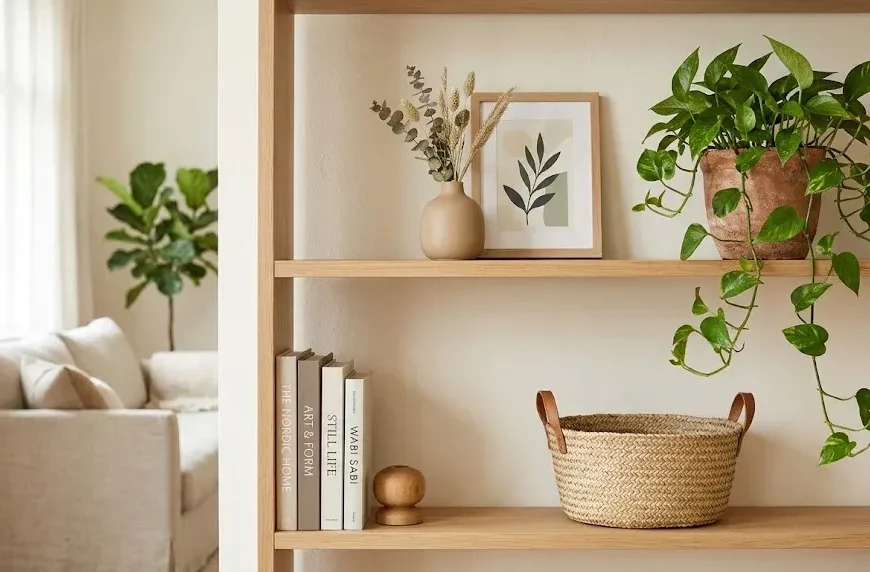
Here’s how to build one. Start with an anchor, something with some size, like a framed print, a big vase, or a stack of books. Add a middle layer with an object of a different height. Then finish with something small, like a trinket, a candle, or a tiny plant. That’s it. Move on to the next section of the shelf and repeat.
Layering is the other trick. It means placing items in front of and behind each other instead of lining everything up along the front edge. Lean a framed print against the back, then set a small bowl in front of it. This one move makes a plain shelf look far more expensive, and it works on any budget.
On top of that, mix a few textures. A glossy ceramic vase sits nicely beside a woven basket. A matte black frame looks great next to a warm wood bowl. Even in an all-neutral palette, a mix of textures gives a shelf depth, which is exactly why so many shelf arrangement ideas from designers lean on it.
A few easy vignette combos to try:
- Two books, a small plant, and a brass candleholder.
- A framed photo, a ceramic bowl, and a bud vase.
- A woven basket, a trailing plant, and a stack of magazines.
And please, use trays. Small objects scattered across a shelf look messy. Corral those same objects on a decorative tray, and suddenly they look intentional.
Don’t forget plants
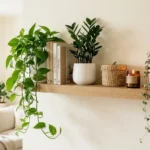
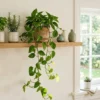
A trailing plant on the top shelf adds softness and movement, and the vines break up all those straight lines. Pothos and ivy are popular because they’re forgiving. If your shelf sits in a dark corner, a good-quality faux plant does the job just fine.
Floating Shelf Arrangement Ideas for 2026
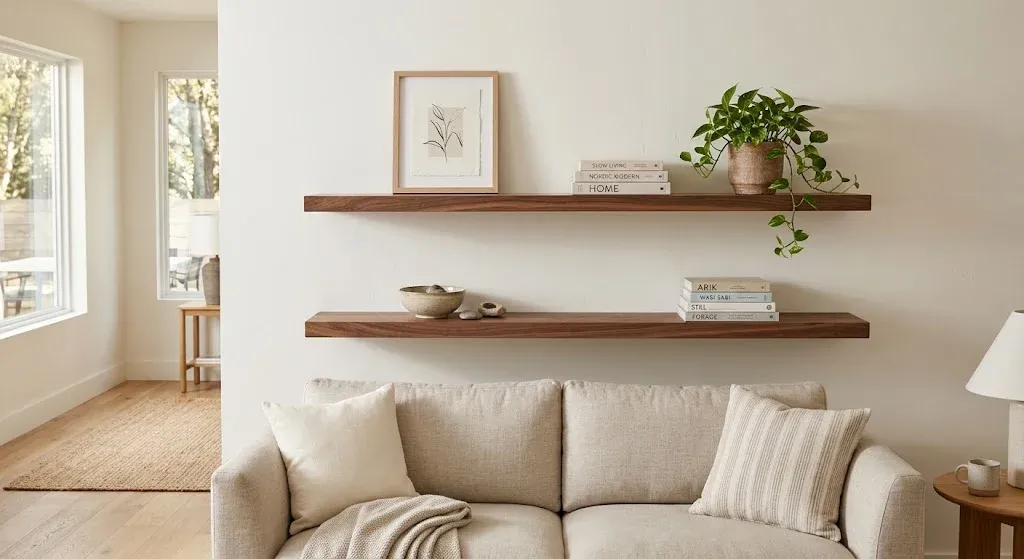
Floating shelves are having a moment, and the 2026 look is different from a few years ago. If you’re planning new shelf arrangement ideas for a wall-mounted setup, start here. Designers are leaning toward fewer, thicker shelves instead of a bunch of skinny ones. Styling is calmer too, with fewer items and more space around each one. Warmer and darker wood tones are also replacing the pale woods and stark whites that dominated earlier.
Choose fewer shelves with more impact
Instead of five small shelves, try two long ones. A single thick shelf above a sofa or console can hold a row of art, a plant, and a couple of books, and it still looks clean. One strong shelf beats a cluster of tiny ones almost every time.
Space them for your tallest item
Measure the tallest object you plan to display, then add two or three inches. That’s your minimum gap between shelves. When floating shelves are hung too close together, you’re stuck with small objects only, and the wall ends up looking busy.
Stagger lengths, keep the finish
Vary the lengths or heights a little so the arrangement doesn’t look like a ladder. But keep the same wood tone or paint color across them. That way, the shelves read as one family instead of random leftovers.
Mind the weight
Books add up fast. Anchor floating shelves into studs or use wall anchors rated for the load. If you’re not sure, ask at your local hardware shop. It’s far cheaper than replacing a shattered vase and a patch of wall.
Room-by-Room Shelf Arrangement Ideas
The same rules apply everywhere, but each room has its own quirks. Here’s how shelf arrangement ideas shift depending on where the shelf lives.
Living room
This is where your shelf gets to be the focal point. Mix books, art, plants, and one or two personal pieces. Lean a large print against the back instead of hanging it, which means you can swap it out whenever you want. If the shelf sits in a dim spot, an LED strip tucked under the shelf edge gives even, soft lighting.
Kitchen
Open shelving in a kitchen works best when most things are things you actually use. Stack matching white plates, line up glass jars, and keep a few pretty pieces, like a wooden board or a favorite bowl, within sight. Put the glassware you rarely use on the highest shelf. Keep colors tight, two or three at most, so the shelf doesn’t turn into visual noise next to your cooking mess.
Bathroom
A woven basket is your best friend here. It hides everyday toiletries in plain sight. Roll up a few towels, add a small candle, and finish with one humidity-friendly plant. That’s a bathroom shelf that looks like a spa corner.
Entryway
Think function first. A small tray holds keys and sunglasses, a bowl catches loose change, and a single plant or candle keeps it from looking like a drop zone. Put a mirror or a framed print above it to finish the look.
Kids’ rooms
Use low shelves so little hands can reach the books. Turn picture books cover-out, since kids pick by cover. Keep fragile objects on the highest shelf, and group toys in labeled baskets.
Common Mistakes That Make Shelves Look Cluttered
Even good shelf arrangement ideas fall flat when a few bad habits sneak in. Most cluttered shelves come down to the same handful of habits, so check yours against this list:
- Filling every inch. Empty space isn’t wasted space. It’s what lets the good stuff shine.
- Everything the same height. A line of identical items looks like a shelf in a store, not a home.
- Too many tiny objects. Lots of small things read as noise. Group them or move them.
- Too many colors. Pick a palette of two or three and stick with it.
- Never editing. A shelf should change. Swap pieces with the seasons or when you get bored.
- Skipping the step back. You can’t judge a shelf from two feet away.
On that last point, here’s a trick designers swear by. Take a photo of your shelf and look at it on your phone. A photo flattens everything, so it’s much easier to spot what’s too much or what’s missing.
Also, don’t panic if your first try looks off. Styling is a bit like cooking. You taste, adjust, and try again. Move one thing, look again, and keep going until it feels right.
FAQs: Shelf Arrangement Ideas
What are the best shelf arrangement ideas for beginners?
Start by clearing the shelf, then build in layers: books first, a larger object next, a plant, then one or two small pieces. Group items in threes and leave about 40 percent of the shelf empty. That simple formula works on almost any shelf.
How many items should go on a shelf?
There’s no fixed number, but aim for about 60 percent full. On a standard 30-inch shelf, that usually means two or three groupings, each made of two or three objects. If it feels busy, take one thing off. Less almost always looks better, which is true for nearly every one of the shelf arrangement ideas in this guide.
How do I arrange a shelf without many books?
Use baskets, framed prints, bowls, and plants to fill the space. Lean art against the back, group small objects on a tray, and vary heights. These shelf arrangement ideas work even with zero books, because balance and spacing matter more than the items themselves.
Should I arrange books by color?
It’s a popular way to make a shelf look calm and cohesive, but it’s optional. If you hunt for books by title, try grouping color within a category instead. You can also mix color blocks with a few cover-out displays so it still feels personal.
How far apart should floating shelves be?
Measure your tallest item and add two or three inches. For books and everyday decor, 10 to 12 inches between shelves usually works. Hang them wider apart if you plan to display tall vases, framed art, or anything with real height.
Conclusion
You don’t need a full home makeover to get this right. You need one shelf, an hour, and a willingness to take everything off first.
Start with the empty shelf, sort what you love, and build in this order: books, then larger objects, then small pieces, then a plant. Leave breathing room. Use threes. Step back, take a photo, and remove one thing. If you remember nothing else about shelf arrangement ideas, remember that editing matters more than adding.
Pick the shelf that bugs you most and try it this weekend. Once you’ve done one, the rest get easier, because you’ll start to see the pattern: anchor, middle, small, space. After that, every shelf in your home is just a variation on the same recipe.