The Entryway Problem Nobody Talks About Enough
You come home after a long day, push open the front door, and immediately stumble over a heap of shoes. It happens in almost every household — and yet most people keep ignoring it.
The entryway is the first space guests notice when they walk in, but it’s often the last space homeowners actually think to organize. It sets the tone for everything beyond it. A messy doorway adds friction to your morning routine and quiet stress to your evenings — while a thoughtfully designed entryway shoe storage system can make the whole home feel more put-together, starting the moment you walk in.
This guide covers real solutions for real homes — from quick fixes for tight apartments to full mudroom-style setups for large families. If shoes are taking over your entry space, something here will work for you.
Why Entryway Shoe Storage Matters More Than You Think
Most people treat this as a minor inconvenience. It isn’t.
Research in environmental psychology consistently links physical clutter to higher cortisol levels — the body’s primary stress hormone. Your entry zone is among the most frequently used areas in the entire home, and shoes are almost always the source of the disorder.
The practical consequences go beyond stress:
- Dirt and bacteria from shoe soles travel deeper into the home each time footwear isn’t stored near the door.
- Time loss from hunting for matching pairs before work or school genuinely adds up over weeks and months.
- Safety risks — scattered shoes create real tripping hazards, particularly for young children and older adults.
- First impressions — real estate professionals consistently point out that organized entryways influence how buyers perceive the rest of a property.
Good entryway shoe storage solves more than a visual problem. It’s a practical improvement that touches daily life in ways people often don’t realize until they experience it.
Types of Entryway Shoe Storage: What Works Where
The right solution depends almost entirely on your space, your household size, and how much visibility you’re comfortable with. Here’s an honest look at each major type.
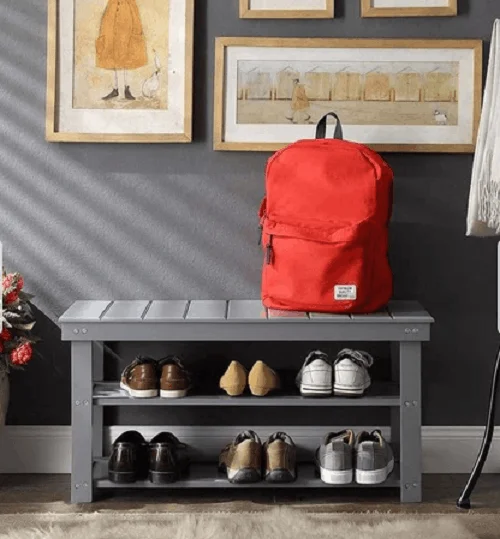
1. Hallway Shoe Rack
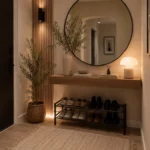
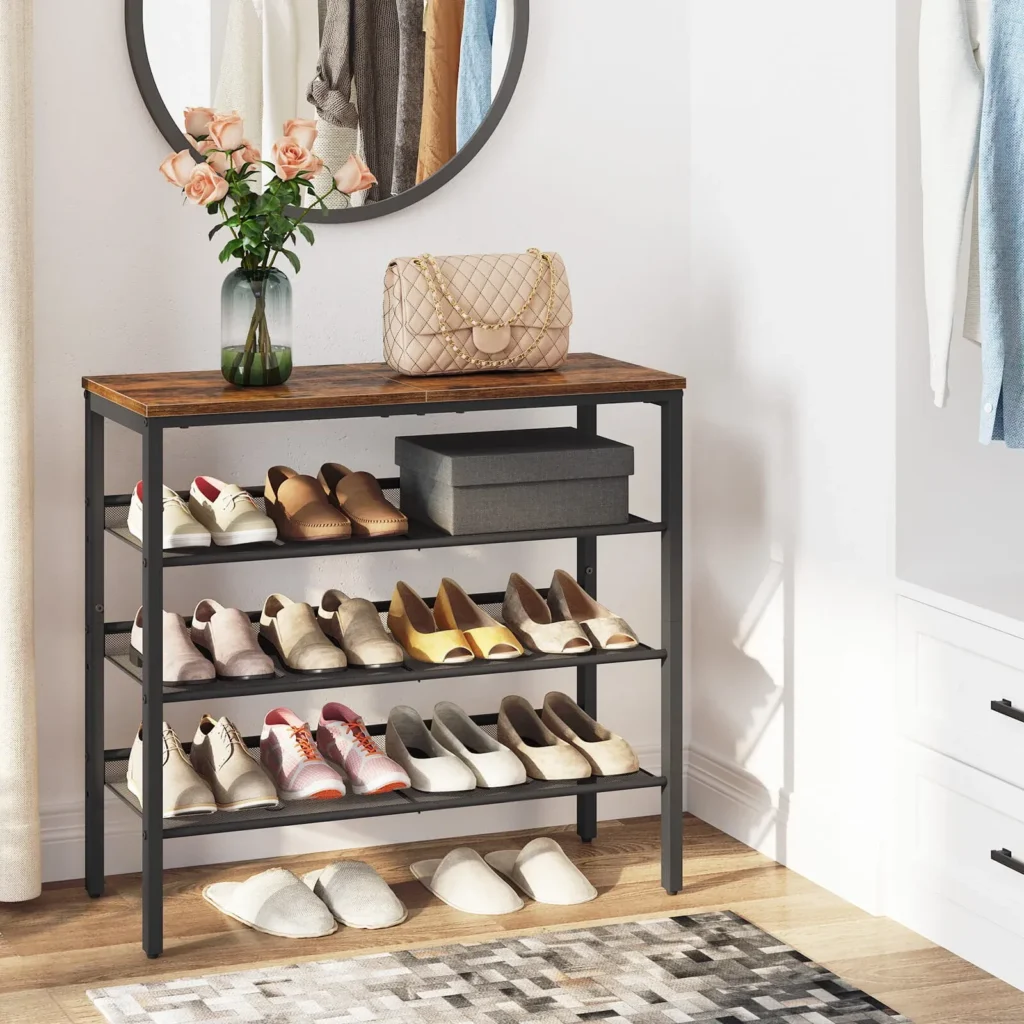
The hallway shoe rack is the simplest starting point — affordable, widely available, and easy to set up without any tools. Open-frame racks in metal or wood typically hold between six and twenty pairs, depending on configuration.
Best for: Renters, smaller households, those working with a tight budget.
Drawback: Shoes stay visible, which can feel cluttered in open-plan interiors.
Tiered racks use vertical space well, which matters a lot in narrow hallways. A two or three-tier unit can hold a reasonable number of pairs without dominating the floor. One thing worth checking before you buy: adjustable shelves. Boot heights vary considerably, and a rack with fixed shelves becomes limiting the moment you need to store taller footwear.
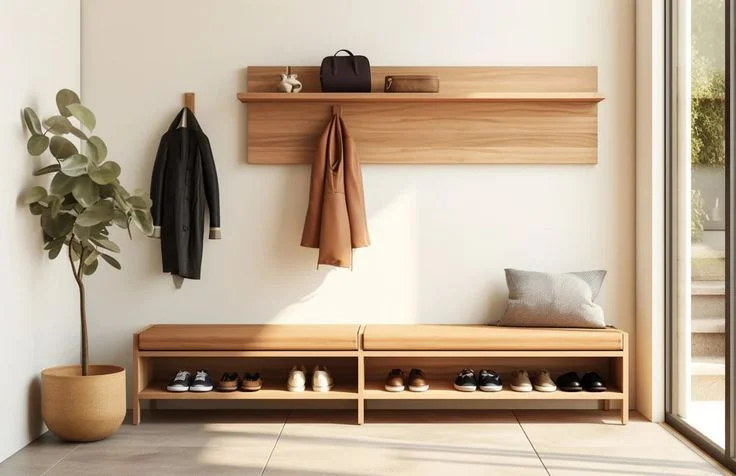
2. Foyer Shoe Bench with Cubby
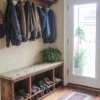
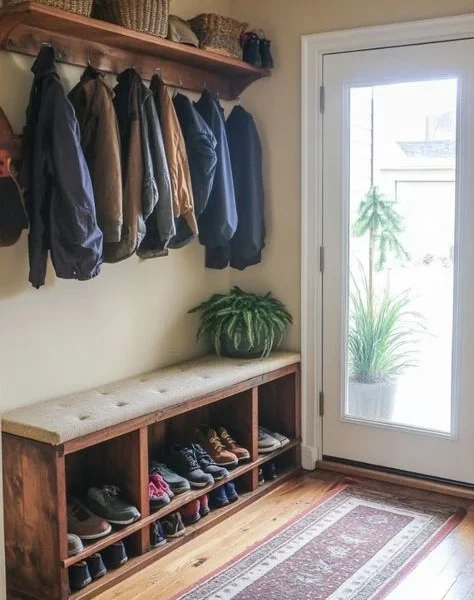
This is where storage becomes furniture. A foyer shoe bench with cubby offers something a simple rack never can — a place to actually sit while putting shoes on or taking them off. That sounds minor until you have a four-year-old who won’t stand still long enough to tie their laces.
Best for: Families, covered entryways, those wanting a polished look.
Drawback: Needs more floor space than a basic rack.
The cubby structure keeps individual pairs separated and contained, which is especially useful when multiple people share the same entryway. Many designs use fabric bins that slot into each cubby — easy to pull out, easy to put back, and they keep things from looking chaotic even when they’re not perfectly arranged.
Some bench models include a hinged seat with storage underneath — an efficient way to hide overflow pairs while maintaining a clean, furniture-quality appearance.
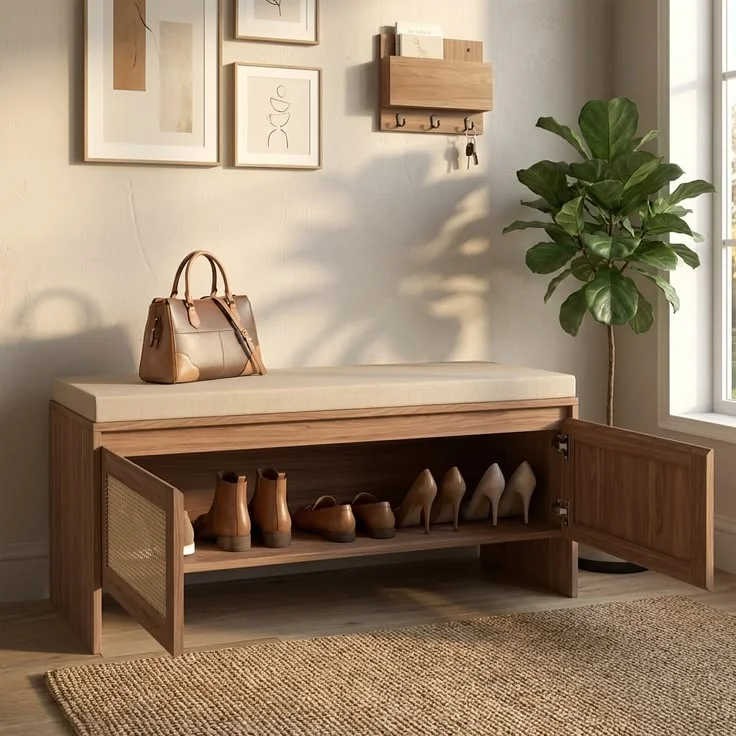
3. Front Door Shoe Cabinet
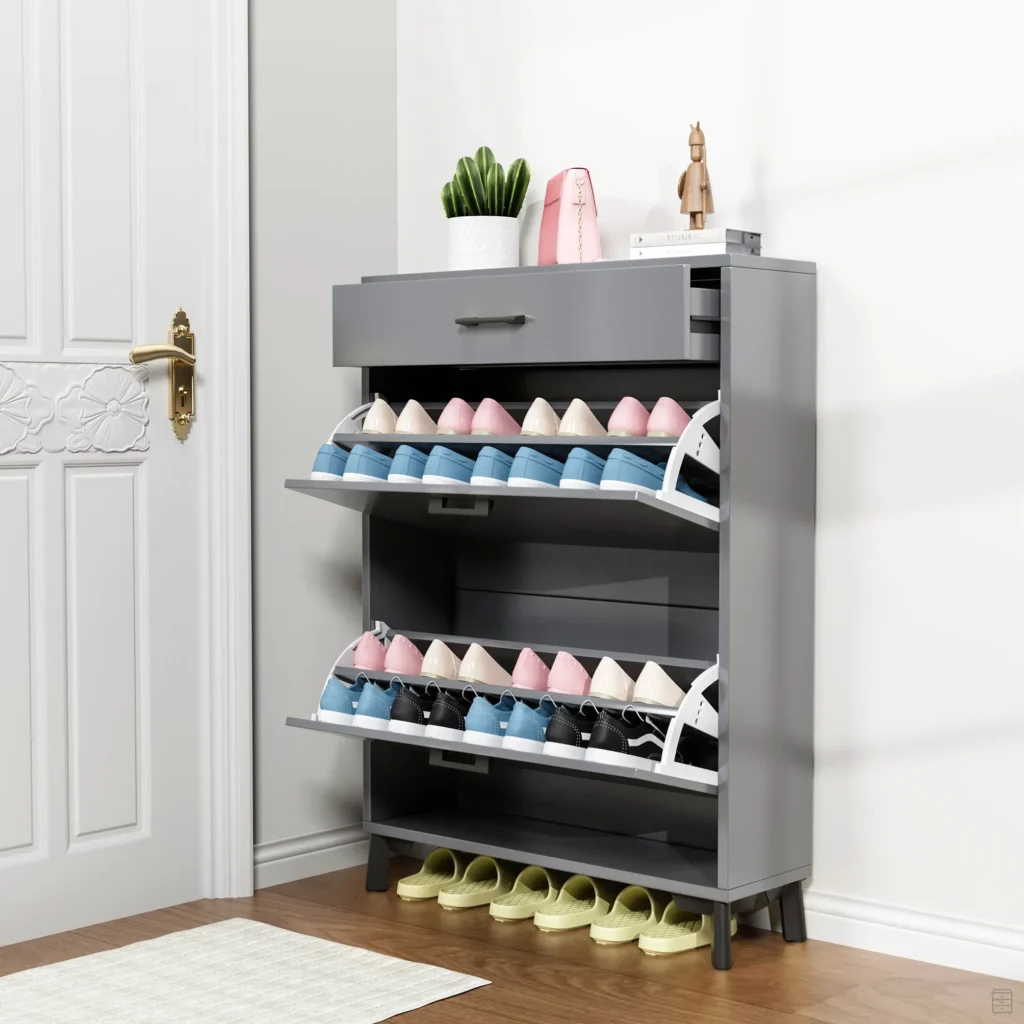
For those who want the entryway to look like nothing is stored there at all, a front door shoe cabinet is the right choice. These are enclosed units — some resemble a narrow sideboard, others a tall vertical panel — that keep all footwear completely out of sight behind closed doors.
Best for: Minimalists, design-conscious homes, households with smaller shoe collections.
Drawback: Slightly less convenient — you need to open a door every time.
Two configurations dominate the market:
- Vertical flip-door panels: Shoes sit at an angle inside tilting panels. Space-efficient and clean-looking.
- Drawer or traditional door style: Standard shelves behind cabinet doors. More familiar and easier to sort by person or shoe type.
If your entryway connects directly to a living area without a visual break, an enclosed cabinet keeps the space looking intentional rather than functional-but-messy.
4. Mudroom Shoe Organizer
A mudroom shoe organizer operates at a completely different scale than anything else on this list. Mudrooms — dedicated spaces that sit between the outdoors and the main living area — are built specifically to absorb the mess that active households generate.
Best for: Larger homes, families with children, people with outdoor hobbies.
Drawback: Requires dedicated floor space — not every home has it.
In a proper mudroom setup, shoe storage is rarely a standalone element. It integrates with coat hooks, cubbies assigned to each family member, bench seating, and sometimes individual lockers. The result is a complete drop-zone system rather than a single piece of furniture.
Brands like IKEA — particularly their KALLAX shelving and HEMNES shoe cabinet lines — make it possible to build a modular mudroom-style system even without a dedicated room. With some planning, a corner of a hallway or garage entry can function almost as well.
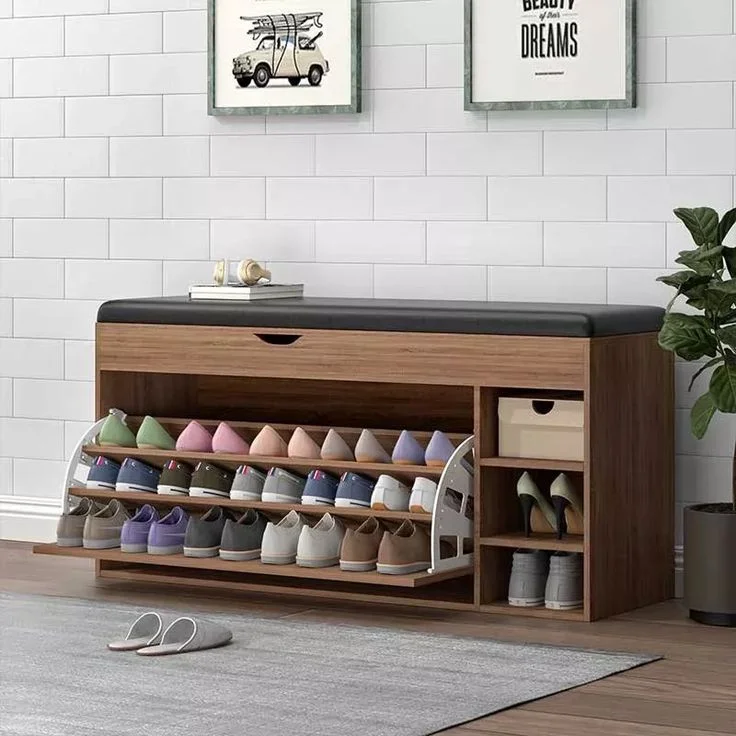
5. Entryway Furniture with Hidden Shoe Storage
This category has expanded considerably over the past several years, and it’s easy to see why. Furniture designers have found clever ways to build shoe storage into pieces that don’t look like storage at all — console tables, upholstered ottomans, decorative benches with concealed compartments.
Best for: Design-forward homeowners, apartments, smaller shoe collections.
Drawback: Capacity tends to be limited compared to dedicated storage units.
The appeal is straightforward: you get functional entryway shoe storage without the visual reminder that you’re solving a storage problem. A console table with an angled lower shelf, or a tufted bench that opens to reveal pairs underneath — these solutions work particularly well in open-plan homes where visual flow carries through multiple spaces.
6. Stackable Shoe Shelves for Entryway
Modular stackable shelving gives you the ability to grow storage as the need grows. Two units today, a third added later when a new family member arrives or a shoe collection expands.
Best for: Flexible households, those who prefer scalable solutions.
Drawback: Can look visually busy if the styling isn’t considered.
Clear stackable shoe boxes have become especially popular — each pair is stored in its own labeled container, making it simple to find exactly what you’re looking for without disturbing the rest. This approach suits sneaker collectors and anyone who rotates footwear frequently across seasons.
Comparison Table: Entryway Shoe Storage Types at a Glance
–$$–$$–$
| Storage Type | Space Required | Capacity | Visual Look | Price Range |
|---|---|---|---|---|
| Hallway Shoe Rack | Low | Medium | Open/Visible | $ |
| Foyer Bench with Cubby | Medium | Medium-High | Furniture-style | $$ |
| Front Door Shoe Cabinet | Low-Medium | Medium | Clean/Hidden | |
| Mudroom Organizer | High | Very High | Integrated System | |
| Hidden Storage Furniture | Low-Medium | Low | Minimal/Decorative | |
| Stackable Shelves | Flexible | Scalable | Modular | –$ |
Entryway Shoe Storage for Families: Solving the Real Chaos
A family household is a different situation entirely. When you’re managing shoes for five people — including a mix of school sneakers, rain boots, sports cleats, and adult work shoes — standard solutions either fill up too quickly or fall apart within a week.
Here’s what actually holds up in real family life:
Assign zones, not just general space. Give each person their own dedicated area — a specific cubby, a labeled basket, an assigned shelf section. When everyone knows where their shoes go and where to find them, the system runs on its own without constant reminders.
Account for boot storage specifically. Entryway boot storage is one of the most overlooked elements of family shoe organization. Tall boots need vertical clearance that standard racks simply don’t offer. Look for units with removable or adjustable shelves, or reserve a dedicated floor area for taller footwear.
Use photo labels for young children. Text labels work for older kids, but for younger ones, a small photo of the shoe type on each cubby makes the expectation instantly clear. It builds the habit without requiring reading ability.
Prioritize easy-clean surfaces. Shoes bring in mud, water, and grit — especially in wet seasons. Entryway furniture in family homes needs to be wipe-clean. Fabric-heavy designs look appealing in photos but become frustrating within weeks of real use.
Pair shoe storage with coat hooks. A shoe storage with coat hooks combination creates a proper drop-zone — one spot where everything from backpacks to coats to muddy boots gets contained the moment someone walks in. For families, that kind of systemic thinking makes all the difference.
Small Entryway Shoe Organizer: Big Solutions for Tight Spaces
Apartments, older homes, and condos frequently offer nothing more than a narrow strip of floor at the front door. There’s no mudroom, no hallway width to spare, and sometimes not even a closet nearby. A small entryway shoe organizer has to work harder in less space.
These approaches make the most of limited square footage:
Go vertical before going wide. A tall, narrow shoe cabinet trades floor width for wall height. Units that are 12–15 inches deep but extend to 60 inches or more can hold 15–20 pairs while occupying only a small footprint.
Mount shelves directly to the wall. Floating shelves keep the floor entirely clear, which makes a narrow entry feel significantly more open. Even one or two shelves positioned near the door handle the most frequently worn pairs without crowding the space.
Use the back of the front door. It’s one of the most underused surfaces in any home. Over-door fabric or metal organizers hold flats, sandals, and children’s shoes without using any floor or wall space at all.
Keep only current-rotation shoes at the door. A small entryway shoe storage solution only stays manageable when it’s not being asked to hold everything. Seasonal shoes, formal footwear, and occasional pairs belong elsewhere — in a closet, under a bed, or in another storage area.
Materials Matter: What to Look for in Entryway Shoe Storage
What a storage unit is made from directly affects how long it lasts, how easy it is to maintain, and how well it holds up under daily use near a front door.
Wood and MDF offer a classic, furniture-quality look and solid construction — but both can warp or swell with repeated moisture exposure. Sealed or painted finishes extend their lifespan significantly near entryways that see wet weather.
Metal is the most durable option for high-use spaces. Industrial-style metal frames clean easily, resist moisture, and hold up to heavy footwear without bending or shifting.
Bamboo has gained traction as a sustainable alternative. It’s naturally more moisture-resistant than standard wood and suits eco-conscious interiors well.
Rattan and wicker look beautiful but perform best in dry climates. If shoes regularly arrive wet, these materials absorb moisture and deteriorate over time.
Plastic and resin are waterproof and affordable — practical for utility-focused spaces like garages or mudrooms where appearance is secondary to function.
How to Style Entryway Shoe Storage Without It Looking Messy
A well-chosen storage unit doesn’t have to look like a storage unit. A few straightforward principles make a real difference in how the whole entry feels.
Don’t fill it to capacity. Open shelving looks intentional when it’s at about 70–80% full. A crammed rack reads as disorganized even if everything on it technically has a place.
Anchor it with a rug. A runner or entry mat placed in front of the storage area grounds the piece visually and catches dirt before it spreads further into the home.
Use baskets or bins on open shelves. Shoes placed directly on open shelving look messier than the same shoes placed inside a basket. The container creates visual order without requiring everything to be arranged perfectly.
Match the material to your interior style. A rattan bench fits naturally in coastal or Bohemian spaces. A matte black metal frame suits modern or industrial interiors. When the storage piece looks like it belongs, the whole entry feels more cohesive.
Add one small finishing touch. A small potted plant, a simple framed print, or a hook for keys near the storage area shifts the space from purely functional to genuinely welcoming.
Entryway Shoe Storage Solutions That Solve Specific Problems
| Problem | Best Solution |
|---|---|
| Too many boots | Dedicated boot zone with tall clearance or boot clips |
| Kids leaving shoes everywhere | Cubby bench with assigned sections per child |
| No floor space at all | Wall-mounted floating shelves or over-door organizer |
| Shoes looking messy on open rack | Shoe boxes or enclosed cabinet |
| Multiple family members | Mudroom-style system with individual cubbies |
| Wet or muddy shoes | Drip tray under rack, waterproof storage materials |
| Renting — can’t drill walls | Freestanding units or over-door organizers |
Building Your Own Entryway Shoe Storage: Is It Worth It?
DIY entryway shoe storage has found a large audience in recent years, largely through project-sharing on platforms like Pinterest and YouTube. The appeal makes sense — custom builds let you fit exact dimensions, choose specific finishes, and add features that no off-the-shelf product offers.
A basic DIY bench with cubby storage can be assembled with:
- Plywood or MDF boards cut to size.
- Wood screws and corner brackets.
- Paint or wood stain in your chosen finish.
- Fabric or wicker bins for the cubby sections (optional but useful).
Cost savings typically run 40–60% compared to a comparable ready-made unit. The honest trade-off is the time and basic woodworking skills required.
For those who want something in between — more flexibility than standard furniture but without the build-from-scratch commitment — IKEA’s HEMNES shoe cabinet and STÄLL shoe bench are worth considering. Both offer modular, adaptable configurations and require nothing more than an Allen key to assemble.
FAQ: Entryway Shoe Storage
How many pairs of shoes should an entryway hold?
A sensible starting point is 3–5 pairs per household member — the shoes worn most regularly. Everything else is better stored in a bedroom closet or secondary storage area. Keeping that limit in mind is what allows an entryway shoe storage system to stay functional rather than becoming a dumping ground.
What is the best entryway shoe storage for small spaces?
A vertical front door shoe cabinet or wall-mounted floating shelves are the most space-efficient choices for tight entryways. Over-door organizers are a strong backup option for apartments where floor space simply isn’t available.
How do I keep entryway shoe storage from smelling?
Ventilation matters most. Open racks allow air to circulate naturally around footwear. For enclosed cabinets, activated charcoal sachets or cedar blocks placed inside absorb odor reliably. Wet shoes should always be dried before being placed in an enclosed storage unit.
Is a shoe bench worth it compared to a simple rack?
For most households with more than one or two people, yes. The seating element alone makes it more practical — and the storage capacity of most bench designs exceeds what a comparable rack offers. It’s especially valuable in homes with young children or elderly family members.
How deep should entryway shoe storage be?
Men’s shoes typically need 11–13 inches of depth; women’s shoes generally fit within 9–11 inches. Aim for a unit that’s at least 12 inches deep so shoes sit properly without hanging over the edge.
Can I use entryway shoe storage in a garage?
Yes, and many products — particularly metal racks and stackable shelves — are well-suited to garage environments. For garage use, prioritize moisture resistance and durability over visual design.
What’s the best entryway shoe storage for a family of five?
A mudroom shoe organizer with individual cubbies per family member is the most effective long-term solution. If a full mudroom isn’t possible, a large foyer bench with multiple cubby sections combined with a separate boot storage zone covers most of what a busy household actually needs.
Conclusion: Start Small, Stay Consistent
Solving the shoe chaos at your front door doesn’t require a full renovation or a large budget. It requires choosing the right type of entryway shoe storage for your specific space and household — and then committing to actually using it.
Start by looking honestly at what you’re working with. A narrow apartment hallway and a large family mudroom call for completely different solutions, and neither one is better than the other. What matters is that the system fits your daily routine closely enough that everyone in the household will actually follow it.
The options covered in this guide range from simple hallway shoe racks that take minutes to set up, all the way to custom mudroom builds that become a permanent feature of the home. Somewhere in that range is the right answer for your situation.
Pick the solution that fits your space first, your budget second, and your aesthetic third. In that order, you’ll end up with something that works every day — not just on the day you set it up.
A well-organized entry is a small thing that improves the feel of the entire home. It’s one of those upgrades that’s hard to fully appreciate until you actually have it.