The moment someone steps through your front door, they quietly form an impression of your home. It happens fast — before they see the kitchen, before they notice the living room, before you’ve even offered them a seat. That very first glimpse of your entryway carries more weight than most homeowners realize.
And yet, the foyer remains one of the most overlooked spaces in residential design. People invest heavily in kitchens and bathrooms, but the entrance often ends up with whatever was left over — a coat rack pushed against the wall, a pile of shoes near the door, and not much else.
Modern foyer ideas have moved well past that. Today’s entryways are designed with intention. They balance function with personality, and they set a tone that carries through the entire home. Whether you’re working with a wide, open-concept entry or a narrow apartment corridor, the principles are consistent: clean lines, smart storage, considered lighting, and materials that look better the longer they’re lived in.
This guide walks through every element of modern foyer ideas — flooring, furniture, lighting, wall décor, and styling choices — with ideas that work in actual homes, not just interior design magazines.
What Makes a Foyer “Modern”?
The word “modern” gets stretched in a lot of directions, so it’s worth being specific. In interior design, modern refers to an aesthetic with roots in the mid-20th century modernist movement — one built around simplicity, natural materials, and the belief that form should follow function.
Modern foyer ideas aren’t defined by a single look. They are defined by a set of values expressed through design choices.
Most modern entryways share these qualities:
- Clean, uncluttered lines — no ornate molding, excessive trim, or surfaces competing for attention.
- Neutral or muted color palettes with deliberate accent moments that feel chosen, not accidental.
- Natural materials — wood, stone, concrete, linen, leather — things that have texture and age well.
- Functional furniture that earns its place rather than simply occupying space.
- Layered, warm lighting instead of one overhead fixture doing all the work.
- Negative space used on purpose — because not every wall needs something on it.
What separates a great modern foyer from a flat, generic one is warmth. Minimalism without warmth just feels cold. The goal is restraint that still feels welcoming — discipline with a human quality behind it.
Contemporary Entryway Design: Starting With the Right Layout
Before choosing a paint color or ordering a console table, understand what kind of space you’re actually working with. Layout drives almost every other decision in contemporary entryway design.
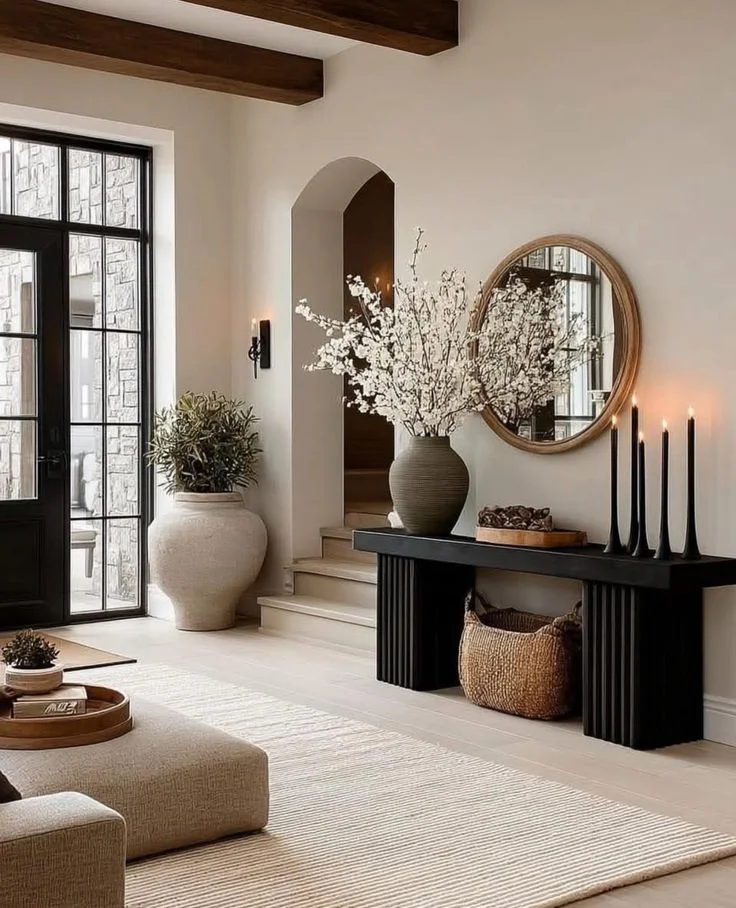
Open-plan foyers flow directly into the living or dining area with no wall separating them. These offer more visual breathing room but require careful zoning — because without defined boundaries, you have to use furniture, rugs, and lighting to communicate “this is where you arrive.”
Closed or corridor-style entryways are more common in older homes and apartments. They feel more contained, which actually makes it easier to treat them as a defined room. The main challenge is avoiding the tunnel effect — that long, narrow feeling that makes a space feel like a passageway rather than a destination.
Split-level entries — where the front door opens onto a landing that steps up or down to the main floor — have natural drama already built in. Modern design tends to lean into that rather than soften it, often using a statement fixture overhead or a bold flooring transition to draw attention to the change in level.
Once you understand your layout type, the rest of the decisions fall into place more naturally. Modern foyer ideas focus on continuity — making the entry feel like a deliberate extension of the home rather than something figured out after the fact.
Foyer Flooring Ideas That Set the Tone
The floor is the first surface anyone actually registers when they walk into a home. It’s also the hardest-working surface in the entire entry — dealing with dirt, moisture, foot traffic, and whatever the weather decided to do that day.
Among modern foyer ideas, flooring has to be practical first. Beautiful second. Fortunately, these two qualities align more often than you’d think.
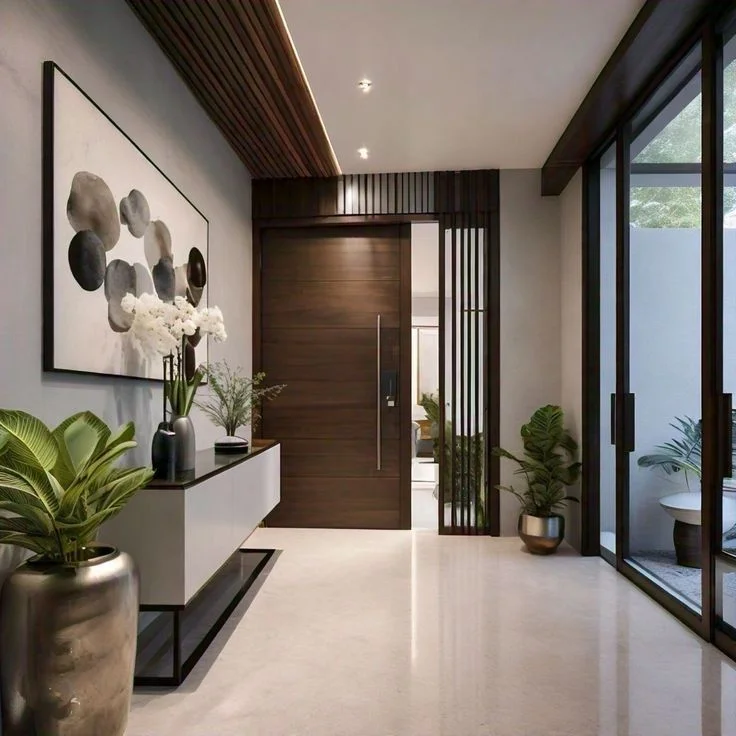
Large-format porcelain tile has become a consistent choice in contemporary entries. Tiles in the 24×24 or 24×48 inch range reduce grout lines significantly, which makes small spaces feel more open and easier to maintain. Matte finishes in warm gray, greige, or off-white tend to work across the widest range of design styles.
Concrete — poured or in tile form — brings a quiet industrial warmth that pairs well with wood accents and soft textiles. It’s also one of the few materials that genuinely improves with age. Scuffs and patina only add character over time.
White oak hardwood running continuously from the foyer into the main living space creates a sense of flow that makes the entire ground floor feel unified. This is especially effective in open-concept homes where the entry doesn’t have walls defining it.
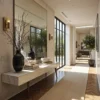
Natural stone — marble, limestone, travertine — reads as luxury without feeling overdone when the surrounding furniture is kept simple and modern. The key is restraint in everything else. Let the stone be the thing.
For tight or compact entries, one of the best modern foyer ideas is to continue the same flooring material from the adjacent room into the foyer. Removing that hard boundary between zones visually expands both spaces.
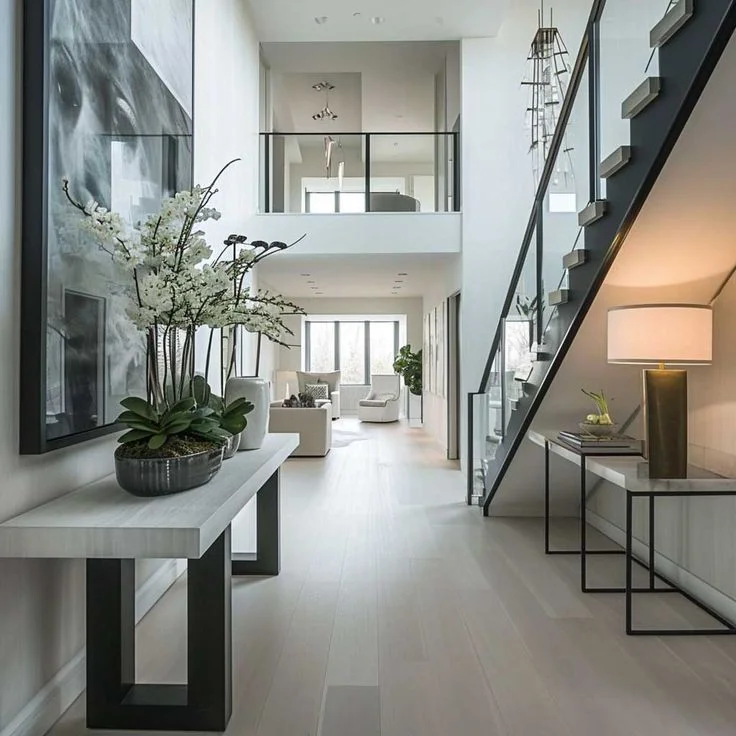
Minimalist Hallway Décor: The Art of Restraint
Minimalism in a foyer doesn’t mean stripping the space down to nothing. It means being deliberate about every single object that occupies it. Each piece should have a reason for being there, and there should be enough open space around things for them to be seen properly.
The most common mistake in minimalist hallway décor is overcrowding. It’s tempting to add “just one more hook” or another small basket, but the effect compounds quickly. Too many things — even beautiful things — read as visual noise.
A well-composed minimalist entryway typically includes:
- One statement mirror — large, simply framed in wood, black metal, or unlacquered brass.
- A single console table with clean lines and visible legs, so it doesn’t feel heavy in the space.
- One or two meaningful objects on the console surface — a sculptural vase, a ceramic dish for keys, a single well-chosen book.
- A functional hook system or built-in storage that blends into the wall rather than calling attention to itself.
- A quality rug in a natural fiber like jute or wool, sized generously enough to anchor the space.
Color in a minimalist hallway tends toward warm neutrals — off-white, sand, warm gray, soft taupe. Accent color shows up sparingly: a terracotta vase, an aged brass sconce, the dark grain of a walnut bench.
In modern foyer ideas, what you leave out matters as much as what you choose to include. That’s the discipline minimalist hallway décor actually requires.
Foyer Lighting Ideas: The Layer That Changes Everything
Lighting is where most entryways quietly fail. A single builder-grade flush mount on the ceiling does the bare minimum — it illuminates the space, but it does nothing for atmosphere. Modern foyer lighting works in layers, with each layer serving a different purpose.
The statement fixture — a pendant, chandelier, or sculptural ceiling light — establishes the visual personality of the space before anything else. In a modern foyer, this might be a geometric brass pendant, a paper lantern, a cluster of hand-blown glass globes, or a clean linear fixture. Think of it as the jewelry of the room.
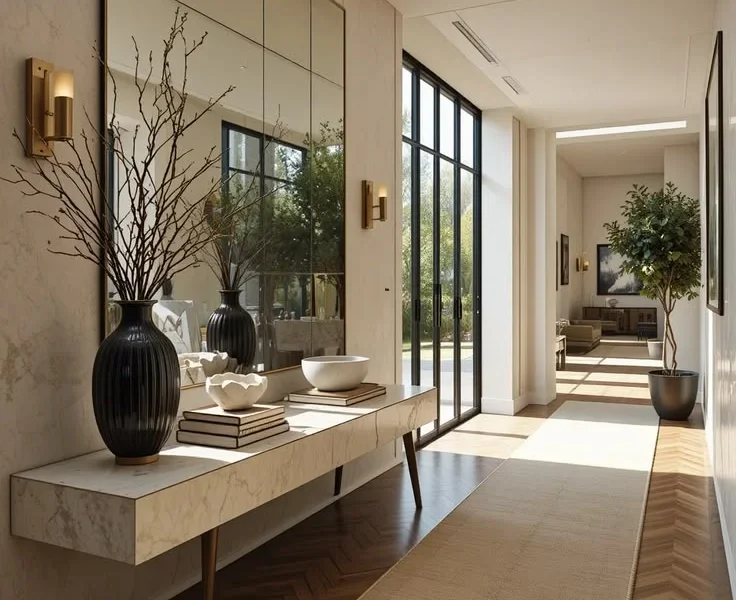
Wall sconces placed on either side of a mirror or console bring light down to eye level, where it becomes warm and flattering. This kind of human-scale light is what makes a foyer feel genuinely welcoming rather than simply visible.
Recessed lighting positioned carefully around the perimeter provides even ambient fill. It supports the other layers without competing with them. Warm white bulbs in the 2700K–3000K range are the right choice here — cooler temperatures feel clinical in an entryway.
Accent lighting — a table lamp on the console, a lit niche in the wall — adds depth and dimension. It creates pockets of light that make the space feel considered.
And dimmers. Dimmers are not optional in modern foyer ideas. The ability to lower the foyer lighting when you arrive home in the evening completely changes the feeling of walking through the door. That single adjustment is worth more than most people realize until they experience it.
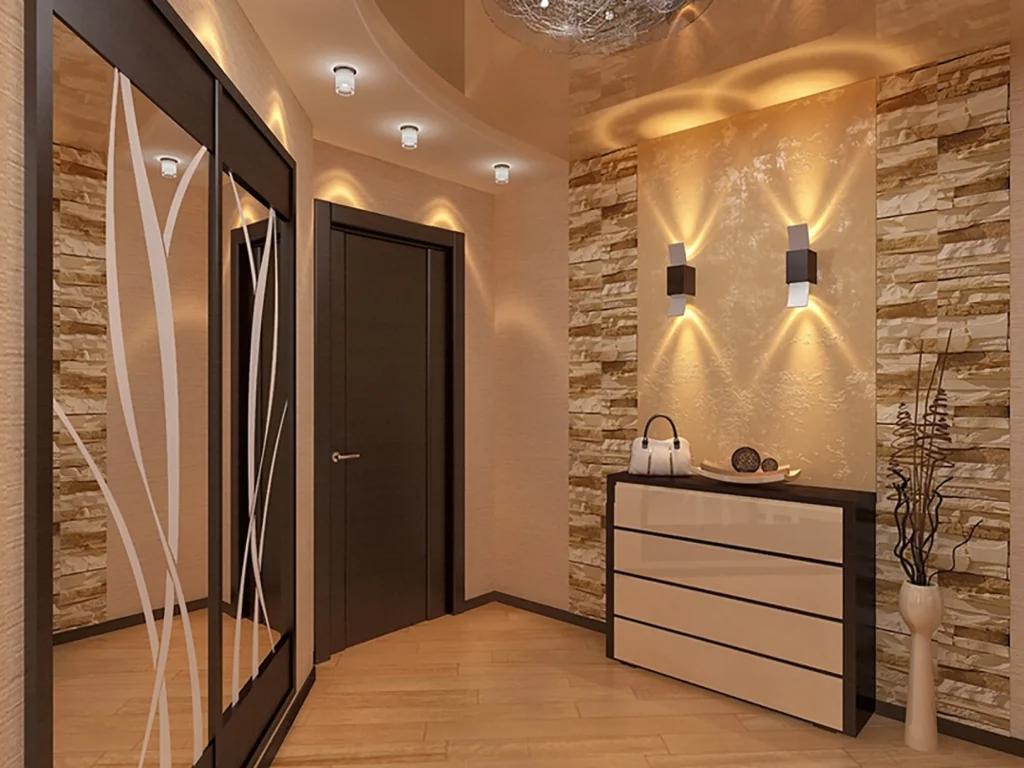
Entryway Furniture Ideas: Function First, Beauty Always
Every piece of furniture in a modern foyer needs to justify its presence. This is a high-traffic, high-function area — decorative-only pieces don’t hold up here, practically or aesthetically.
The console table is the anchor of most modern entryways. Look for clean lines, a minimal profile, and either open shelving or a single drawer for storage. White oak, walnut, and powder-coated steel all work well within a modern aesthetic. Ornate legs or decorative hardware tend to feel out of place — they draw attention to themselves in a way that disrupts the visual calm.
An entryway bench is one of the most genuinely useful pieces of furniture you can add. It provides a place to sit while removing shoes, holds bags, and grounds the space visually. Upholstered benches in boucle or leather add softness. Slatted wood benches bring texture without adding visual weight.
Built-in storage is the most polished solution when the budget and layout allow for it. A custom mudroom-style unit with concealed cabinets, open cubbies, and integrated hooks removes visible clutter from the equation entirely. Nothing reads as more intentional than storage that looks like it was always meant to be there.
A narrow pedestal or accent table works in very compact entries where a full console simply won’t fit. Even a small horizontal surface — just enough for keys and a phone — prevents the entry from becoming a drop zone for everything that doesn’t have another home.
The best modern foyer ideas include entryway furniture that feels specific to the space. Not borrowed from another room, not purchased because it was on sale, but chosen because it fits the scale, the layout, and the life being lived there.
Open Concept Foyer Design: When There Are No Walls
Open-concept homes present a particular challenge for entryway design: how do you create a sense of arrival when there’s no boundary marking where the entry ends and the living room begins?
The answer is zoning — using design elements to define a space that architecture hasn’t.
A distinct flooring material or pattern at the entry point creates a visual threshold. Even a simple transition from hardwood to large-format tile signals that this zone is different from the one beyond it.
A statement rug positioned just inside the door does something similar. The rug needs to be large enough to feel intentional — a small rug pushed against the door looks like an afterthought rather than a design decision.
A partial divider — an open shelving unit, a slatted wood screen, or a floating console positioned perpendicular to the main space — creates definition without closing anything off. It maintains sightlines while communicating that two different zones exist.
Overhead lighting is perhaps the most powerful zoning tool in modern foyer ideas for an open-concept space. A pendant or chandelier positioned directly above the entry area, even in a room with no walls, immediately draws attention to that zone and separates it from the space around it. The ceiling fixture effectively becomes the ceiling “wall.”
In open concept foyer design, restraint matters even more than in an enclosed hallway. The entry needs room to breathe. Crowding it with furniture creates competition with the living space beyond, and neither zone wins.
Small Entryway Makeover: Big Impact in Tight Spaces
A compact foyer is not a design problem — it’s a design focus. Some of the most visually striking modern entryways are also the smallest. When you have less room to fill, every choice carries more weight, and that discipline often produces better results than a larger space where the temptation to keep adding things is harder to resist.
Among modern foyer ideas, the single most impactful change you can make in a small entry is introducing natural light. Replacing a solid front door with one that has glass panels, or adding a sidelight window alongside the door, transforms how the space feels at every hour of the day.
Beyond that, these strategies consistently deliver results in tight spaces:
- Go vertical. When floor space is limited, the wall becomes your primary canvas. A tall, narrow mirror — ideally floor to ceiling — doubles the perceived depth of the space without taking up a single square foot.
- Choose furniture with legs. Pieces that show the floor beneath them feel lighter and less imposing than pieces that sit flush to the ground.
- Organize hooks at two heights. Adult coats up high, children’s bags and leashes lower. A thoughtful hook arrangement replaces the need for a closet.
- Keep the palette light. Warm white or soft off-white walls reflect available light and push the walls back visually. Dark walls can work, but only with strong, well-layered artificial lighting.
- Size the rug properly. A rug that’s too small makes the space feel cramped and unfinished. When in doubt, go larger.
Modern foyer ideas prove a small entryway makeover rarely requires a full renovation. More often, it requires editing — removing what doesn’t serve the space and replacing it with something that genuinely does.
Luxury Foyer Interior Design: When You Have Room to Make a Statement
When space and budget remove the usual constraints, a foyer can become one of the most memorable rooms in a home. It’s the place where architecture, craftsmanship, and personal taste converge in a way that no other room quite allows.
Modern foyer ideas make one thing clear about luxury foyer interior design — luxury and excess are not the same thing. The most impressive high-end entryways are often remarkably restrained — but executed with materials and craftsmanship that simply can’t be replicated at a lower price point.
Book-matched marble floors with a seamless transition into the first riser of a staircase. Hand-plastered walls finished in Venetian lime wash that shifts in tone as light moves through the day. A custom chandelier commissioned from an independent artisan rather than selected from a catalog.
Art in the foyer makes an immediate statement. A single large canvas, a sculptural installation, or a series of photographs lit with precision can define the entire character of the space in a way that furniture never could.
The staircase — when the foyer includes one — is the architectural centerpiece. Modern luxury staircases typically feature open risers, floating treads in white oak or walnut, and cable or slender steel railings. They’re designed to be looked at, not just climbed.
In luxury foyer interior design, the details carry everything. The hardware on the front door. The edge profile on the console tabletop. The quality of the light fixture’s finish. These are the things guests notice without being able to name exactly what they’re noticing.
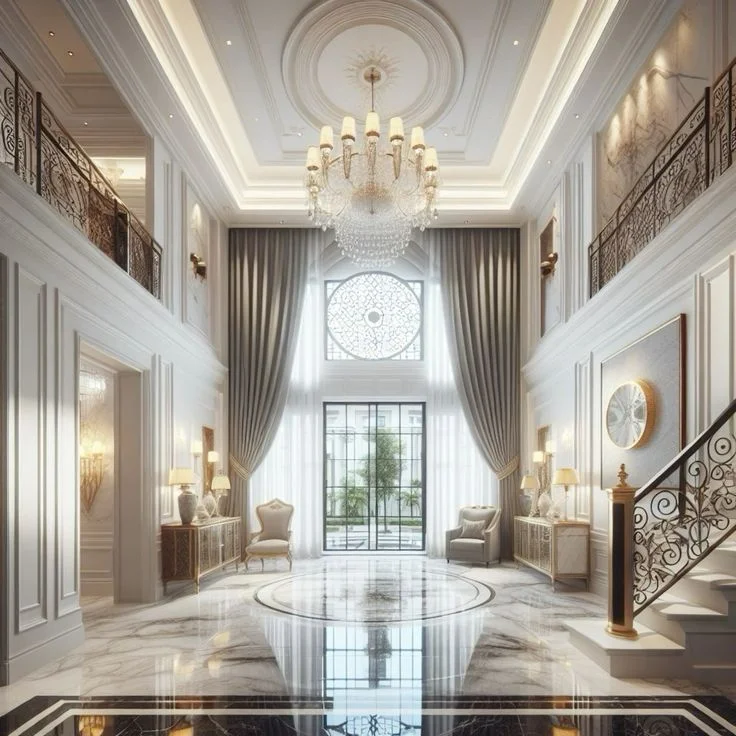
Entryway Wall Décor Ideas: What Belongs and What Doesn’t
In modern foyer ideas, foyer walls are valuable. Not every inch needs to be filled, but the choices you make about what goes on them define the personality of the space more than almost anything else.
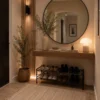
An oversized mirror remains the most effective single wall element available in an entryway. It reflects light, creates depth, and actually serves a function — checking your appearance before leaving the house is something people do every day. In a modern entryway, leaning a large mirror against the wall rather than hanging it feels more relaxed and considered. Less formal, more intentional.
A single well-chosen piece of art does more for a small foyer than a curated gallery wall. When you’re working with limited wall space, one strong image speaks more clearly than five smaller ones competing for attention. Abstract works, photography, and textile art all translate particularly well in modern entries.
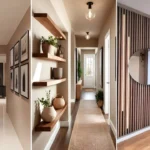
Floating shelves — two or three, placed asymmetrically rather than perfectly aligned — create surface area for plants, ceramics, and books without the visual weight of a console table below them.
An accent wall — whether painted in a deep tone or covered in a distinctive wallpaper — brings immediate personality to the entry without requiring any furniture. A warm charcoal, a quiet navy, or a terracotta creates a sense of arrival the moment the door opens. Geometric or botanical patterns work especially well in smaller foyers where furniture is intentionally minimal.
In modern foyer ideas, what tends to undermine a foyer wall: clusters of small frames with no clear relationship to each other, generic inspirational prints, and objects that only make sense to the person who put them there.
Home Entrance Design Inspiration: Bringing It All Together
The best modern foyers have something in common — they feel inevitable. Like every choice was obvious. That impression, though, is the result of careful decision-making, not happy accident.
Before purchasing anything or making changes, clarify three things:
- The mood you want someone to feel when they step inside — calm, impressed, at ease, energized.
- The primary function the space needs to serve — a quick transition zone, a formal arrival experience, a practical family drop spot.
- The one element you want to anchor the design — the floor, the lighting fixture, the mirror, the art.
Every subsequent decision should be measured against those three answers. If a piece of furniture doesn’t support the mood, serve the function, or reinforce the focal element, it doesn’t belong in the space — regardless of how attractive it is in isolation.
Home entrance design inspiration is useful, but the most effective entryways are the ones designed for a specific life in a specific space, not for a mood board. Browse for ideas, but filter everything through the reality of how your entry is actually used.
FAQ: Modern Foyer Ideas
What is the best flooring for a modern foyer?
Large-format porcelain tile, polished concrete, and white oak hardwood are consistently strong choices. All three are durable, manageable to maintain, and compatible with a wide range of modern design directions.
How do I make a small foyer look bigger?
A large mirror is the most effective tool. Pair it with light-colored walls, furniture that shows the floor beneath it, and flooring that continues from the adjacent room. Removing the hard boundary between zones visually expands both.
What furniture is essential for a modern entryway?
At minimum: a console table, a mirror, and either a bench or coat hooks. In larger spaces, a quality rug, layered lighting, and built-in storage round the design out considerably.
What lighting works best in a foyer?
Layered lighting — a statement overhead fixture, wall sconces at eye level, and dimmers — produces far better results than a single ceiling light. Warm white bulbs in the 2700K–3000K range maintain the right atmosphere.
How do I add personality to a minimalist foyer?
One strong piece of art, a distinctive rug, or an unusual lighting fixture carries significant personality without creating clutter. Choose one element to be expressive with and keep everything around it calm.
What colors work for a modern foyer?
Warm neutrals — off-white, greige, soft taupe, warm gray — give you the most flexibility. Accent with deeper tones like charcoal, navy, forest green, or terracotta where you want depth and definition.
Is wallpaper appropriate in a modern entryway?
Yes — and the foyer is actually one of the best rooms for it. Because the space is small, you won’t tire of a bold pattern the way you might in a larger room. Geometric, botanical, and textural designs all work well in modern entries.
Conclusion
Your foyer is the first thing people experience when they enter your home — and the last thing they see when they leave. It deserves the same care and consideration you bring to any other room.
Modern foyer ideas are not about following a single aesthetic or buying a specific set of pieces. They’re about understanding your space, making deliberate choices, and building an entry that genuinely reflects how you live. Whether you’re refreshing a small entryway with a new mirror and better lighting, or designing a luxury foyer from the ground up, the principles hold: clarity over clutter, warmth over perfection, and function underneath everything.
Start with one change. Often that’s enough to shift how the entire space feels — and how it feels to come home.