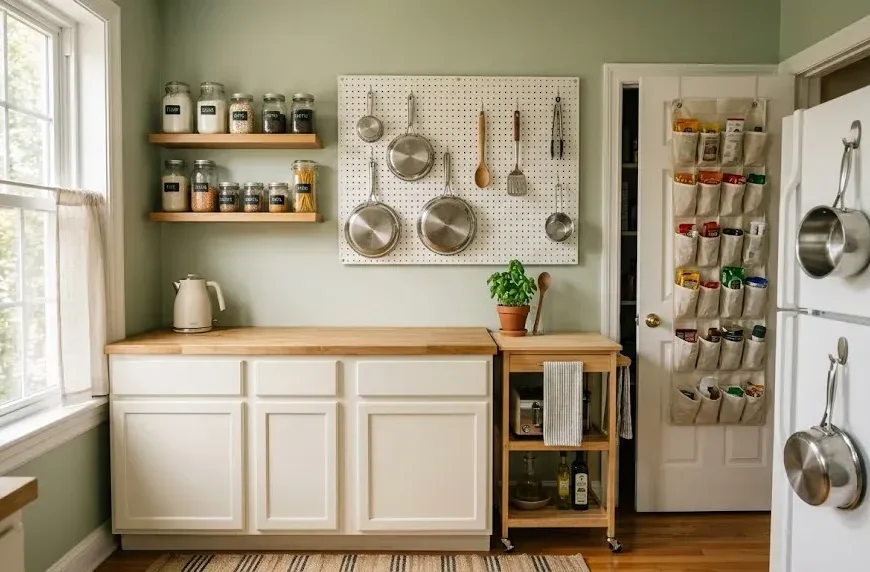
You open a cabinet and a lid slides out, bounces off your foot, and rolls under the fridge. Meanwhile, the counter is buried under a toaster, three mugs, and last week’s mail.
Sound familiar? Good apartment kitchen storage isn’t about owning less of what you love. It’s about giving every item a spot that makes sense. And you can do it without drilling a single hole in your landlord’s wall.
Here’s why this matters. The average apartment in the US reached 910 square feet in 2025, and studios average only about 460, according to RentCafe. Kitchens usually get whatever space is left over. Below, you’ll find seven fixes, in order, that clear your counters, tame your cookware, and work even if you rent.
Fix 1: Start Your Apartment Kitchen Storage With a Ruthless Declutter
Before you buy a single organizer, deal with what you already own. Every solid apartment kitchen storage plan starts here, because no rack on earth can fix a kitchen that’s holding too much stuff.
Pick one cabinet or drawer and empty it completely. Then sort everything into three piles: daily, sometimes, and never.
Daily items stay within easy reach. “Sometimes” items, like the stand mixer or the big roasting pan, move out of prime space. Think top shelves, a hallway closet, or a bin under the bed. “Never” items go in a donation bag today, not “later.”
A few things almost everyone can cut:
- Duplicate tools. Three spatulas and two can openers? Keep your favorites.
- Single-use gadgets. If it makes one thing and you make that thing twice a year, it’s costing you a shelf.
- Mismatched containers. Match every lid to a box, then recycle the orphans.
- Expired food. Check the dates while you’re in there.
One Reddit tip is worth stealing: let your kitchen hold only the things you use daily, and find other homes for everything else. Once you’ve done this, you’ll often find you didn’t need more storage. You needed more room.
Set a timer for 20 minutes per cabinet. Any longer and you’ll start reorganizing instead of deciding. And take a quick before photo. It’s oddly motivating.
Fix 2: Set Up Kitchen Zones So Everything Lives Where You Use It
Zones sound fancy, but the idea is simple: store things where you use them. Redditors suggest keeping pots, pans, spices, and oven mitts near the stove so everything you need for cooking is within arm’s reach.
Think of your kitchen as four tiny neighborhoods.
The cooking zone
Everything around the stove: pots, pans, oils, salt, spices, spatulas, and oven mitts.
The prep zone
Next to your biggest stretch of counter: cutting boards, knives, mixing bowls, and measuring cups.
The cleanup zone
By the sink: dish soap, sponges, a drying rack, trash bags, and dish towels.
The food zone
Pantry items and fridge basics, grouped by category. One Redditor suggests organizing like a grocery store: pasta and grains together, baking supplies in a basket, and cans lined up with shelf dividers.
Here’s a quick example. Say your coffee beans live in one cabinet, your mugs in another, and your kettle across the room. Put the mugs, beans, and filters on one tray next to the kettle. Your morning takes thirty seconds, and nothing else on the counter is fighting for space.
The same rule runs through all good apartment kitchen storage: if you walk more than two steps for something you use every day, it’s in the wrong place.
Fix 3: Go Up With Vertical Storage on Walls, Doors, and Ceilings
Your walls are free real estate. Most people leave them blank while stuffing a cabinet to the brim. Done right, vertical storage is the single biggest upgrade for apartment kitchen storage, because it adds space without eating floor or counter.
On the walls
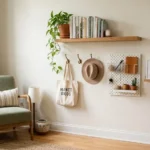
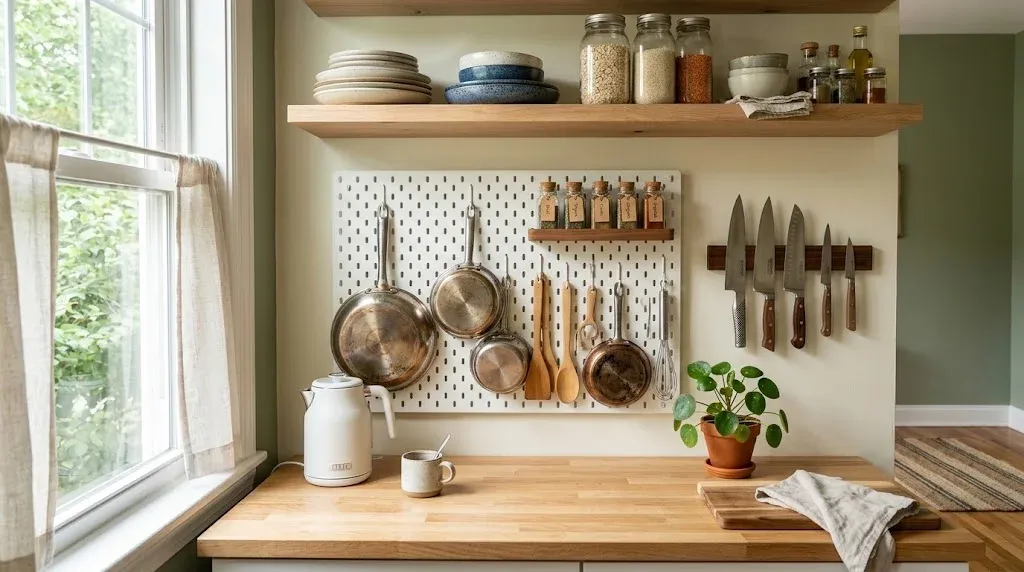
A pegboard is the classic move. You can hang pans, utensils, and small shelves, then rearrange whenever your needs change. Julia Child famously used a pegboard system for her pots and pans. Floating shelves work well too. Use them for everyday plates, jars, or cookbooks. A magnetic strip holds your knives and frees up a whole drawer.
On the doors
An over-the-door organizer is a renter’s best friend. Hang it on the pantry door or a cabinet for foil, snacks, and cleaning supplies. Inside the cabinet doors, adhesive hooks can hold measuring spoons, lids, and small cutting boards.
Above and beside the fridge
The top of the fridge is perfect for baskets or jars of things you rarely use. If your fridge is magnetic, the side can hold hooks, a paper towel holder, or a small spice shelf.
Up near the ceiling
A tiered hanging basket in a corner is great for onions, potatoes, and fruit, and it frees up a counter.
Keep it tidy, though. Too many hanging items make apartment kitchen storage look cluttered even when it isn’t. Choose your daily tools, and tuck the rest away. Also, check the weight rating on everything you hang. A cast-iron skillet is heavier than it looks.
Fix 4: Tame Pots, Pans, and Lids Without Adding Cabinets
Ask any renter what drives them up the wall and the answer is cookware. Nothing ruins a quiet evening like a pile of pans crashing out of a cupboard. Honestly, this is the hardest part of apartment kitchen storage, so let’s take it piece by piece.
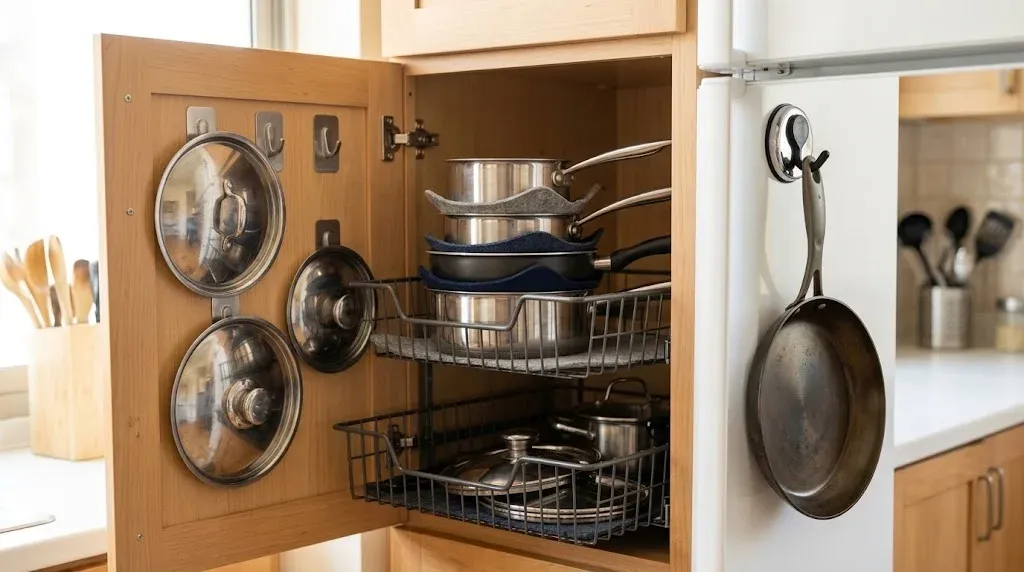
- Lids on cabinet doors. Professional organizers suggest storing lids on the backs of cabinet doors, which keeps them out of the stack. Use adhesive hooks or a slim rail.
- Protective liners. If you have to stack pans, slip a felt pad or paper towel between them so they don’t scratch.
- A pull-out wire basket. One writer bought a two-tier pull-out basket for a bottom cabinet and found it kept all her pots in one easy-to-reach place.
- Hooks on the fridge. One apartment dweller hung all her pots and pans on the side of her fridge with inexpensive magnetic hooks.
- Your oven. Organizers point out the oven has plenty of unused space and adjustable racks. Store the pans you use most there, and just pull them out before you preheat.
- The deepest drawer. If you have one, store pans there without stacking them.
Then ask yourself an honest question: how many pots do you really use? Most of us rotate between a skillet, a saucepan, and a stockpot. Keep those three within reach and store the rest somewhere else.
Fix 5: Add Furniture That Works Twice
In a small kitchen, every piece of furniture should earn its place. If it only does one job, it’s probably the wrong piece.
A rolling kitchen cart
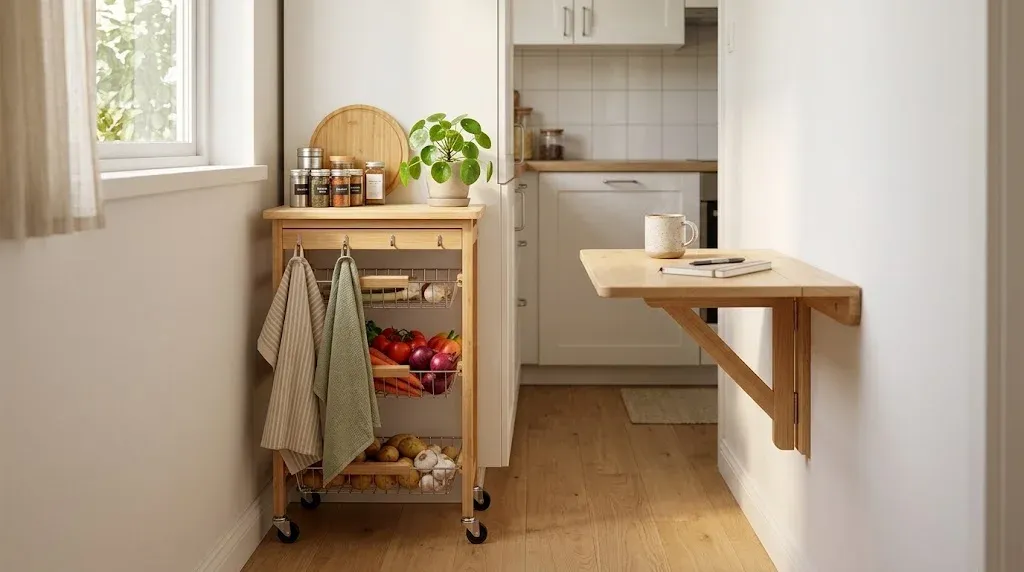
A cart is storage, prep space, and a serving station in one. Look for one with a lower shelf for small appliances and hooks on the side for towels. When you don’t need it, roll it into a corner.
A bar cart in disguise
A bar cart can become a mobile kitchen station with hooks for utensils, shelves for storage, and a cutting board on top. It’s a smart move when you want something lighter than a full island.
A storage bench
If you have a dining nook, a bench with a lift-up seat holds table linens, spare containers, or the waffle iron you use twice a year.
A cabinet as a mini pantry
No pantry? You can use an enclosed storage cabinet, new or antique, as a hideaway pantry. A freestanding shelf unit works too.
A fold-down table
A wall-mounted drop-leaf table gives you a place to eat or prep, then folds away when you’re done.
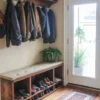
Measure the space twice, and leave room to open the oven and fridge doors fully. A cart that blocks either one will quickly become the thing you resent. Don’t forget the floor, either. Baskets under a metal shelf can hold produce, bags, or a spare set of dishes.
Done right, furniture makes apartment kitchen storage feel almost effortless.
Fix 6: Level Up Your Pantry Organization (Even Without a Pantry)
A pantry doesn’t have to be a room. It can be one shelf, a rolling cart, or the top of your fridge. What matters is that you can see what you own.
Decant and label
Move pasta, rice, and flour into clear containers. Square ones stack better than round ones. Label the front, and you’ll stop buying a fourth bag of lentils by accident.
Add height with risers
Shelf risers and tiered stands turn one flat shelf into two. Put canned goods on a tiered rack so every label is visible.
Use the under-sink space
The cabinet under the sink is often a jumble of pipes and bottles. Put a tension rod across the top to hang spray bottles, and use a two-tier basket for sponges and cleaning supplies.
Fix the corner cabinet
Corners are classic dead space. Adding a pull-out shelf to a corner cabinet helps, since the back is awkward to reach. A lazy Susan does the same job for less.
Tame the spices
Mount a small spice rack on a cabinet door, or stick a magnetic strip with tins on the side of the fridge.
Put new items at the back and older ones in front, so nothing expires behind the cereal. Tie this together with the zones from Fix 2, and your pantry organization takes about an hour. It also makes the rest of your apartment kitchen storage easier to maintain, since everything finally has a home.
Fix 7: Choose Renter-Friendly Storage That Leaves No Marks
If you rent, you’ve probably hesitated over every nail hole. Fair. Landlords notice, and deposits are real. The good news is that renter-friendly storage has gotten really good.
Before you stick anything to a wall, check two things. First, read your lease for rules on alterations. One small-kitchen guide suggests checking whether there’s a security deposit clause that specifically covers kitchen changes. Second, take photos of your walls and cabinets now, so you have proof of their original condition.
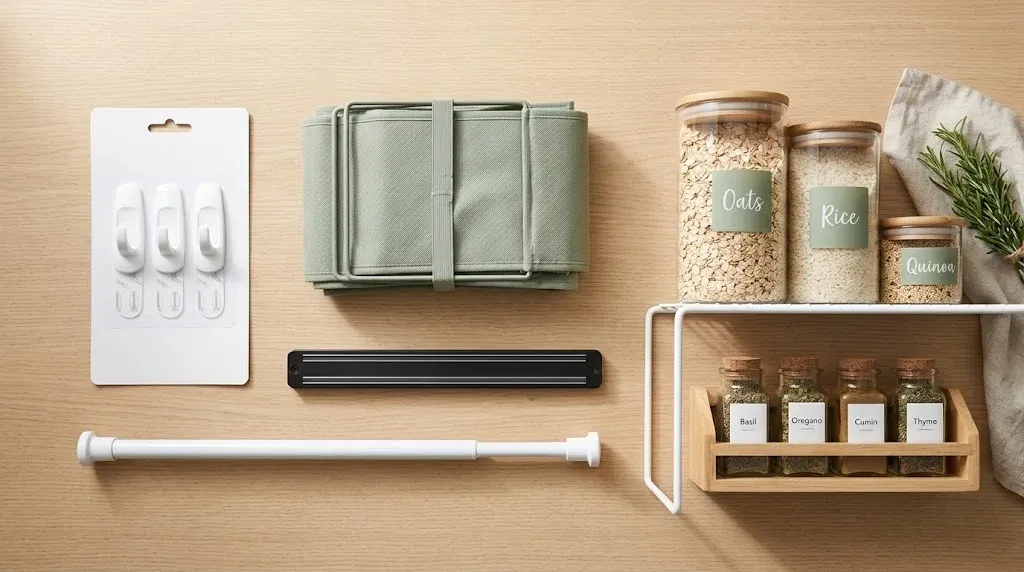
Here’s what works without damage:
- Adhesive hooks and strips for lids, utensils, and lightweight tools.
- Tension rods under the sink or inside cabinets.
- Over-the-door organizers on pantry and cabinet doors.
- Magnetic hooks and strips on the fridge or range hood (if they’re magnetic).
- Freestanding shelves and carts that never touch the wall.
- Peel-and-stick hooks inside cabinets, for mugs and measuring cups.
When it’s time to move out, pull the adhesive strip tab slowly, straight down along the wall, not outward. It should come off clean.
Always check the weight rating, too. A strip that holds a mug won’t hold a cast-iron skillet. When in doubt, go lighter or choose a freestanding option. That’s the easiest way to build renter-friendly apartment kitchen storage that actually lasts. And here’s a quiet bonus: you can take most of it with you to your next place.
Your Weekend Plan: Where to Start
Don’t try to fix everything at once. Here’s an order that works:
- Saturday morning: Declutter one cabinet and the counter (Fix 1)
- Saturday afternoon: Set up your zones and move items (Fix 2)
- Sunday morning: Add hooks, a pegboard, or door racks (Fixes 3 and 7)
- Sunday afternoon: Tackle pots and the pantry (Fixes 4 and 6)
- Later: Buy furniture only if you still need it (Fix 5)
Most of these steps cost very little. Hooks, tension rods, and containers are cheap, and you’ll often find that sorting alone solves half the problem. Spend on furniture last, once you know exactly what’s missing. That order keeps your apartment kitchen storage budget low and your results high.
FAQs: Apartment Kitchen Storage
What’s the best storage for a tiny apartment kitchen?
Start with vertical space. A pegboard, floating shelves, and an over-the-door rack add storage without using floor or counter. Then add a rolling cart for flexibility. For most people, that combination solves apartment kitchen storage problems faster than buying more cabinets.
How do I store pots and pans with no cabinet space?
Hang them. Magnetic hooks on the side of your fridge, a wall rail with S-hooks, or a pegboard all work. Lids can go on adhesive hooks inside doors. You can also keep your most-used pan in the oven between meals, as long as you remove it before preheating.
How can renters add kitchen storage without drilling?
Use adhesive hooks, tension rods, over-the-door organizers, and magnetic strips. Freestanding shelves and carts need no wall contact at all. These options make apartment kitchen storage possible without risking your deposit. Always check weight limits, and take before photos.
How do I stop my counters from getting cluttered?
Give everything a home that isn’t the counter. Keep only daily items out, like a kettle or coffee maker. Use a tray to group small things, and do a two-minute reset each night. If something keeps landing on the counter, it needs a better spot.
How many pots and pans do I really need?
Most home cooks do well with a skillet, a saucepan, and a stockpot or Dutch oven, plus lids. Add a baking sheet and a sauté pan if you cook often. If a pan hasn’t left the cupboard in a year, it can go.
Conclusion: Start With One Cabinet
A small kitchen isn’t a design failure. It’s a puzzle with a few clever answers. Good apartment kitchen storage comes down to three habits: keep less, store things where you use them, and use every vertical inch. Everything else is a bonus.
You don’t need a renovation, a big budget, or a landlord’s blessing. You need an hour, a donation bag, and a little patience. Start with the declutter, because it makes every other fix easier and costs nothing.
Here’s your next step. Pick the one cabinet that annoys you most. Empty it tonight, sort it into daily, sometimes, and never, and put the daily items back in an order that makes sense. Tomorrow, add one hook or one rack. That’s it.
By the end of the week, you’ll notice how much calmer cooking feels. Your kitchen is small. It doesn’t have to feel that way.