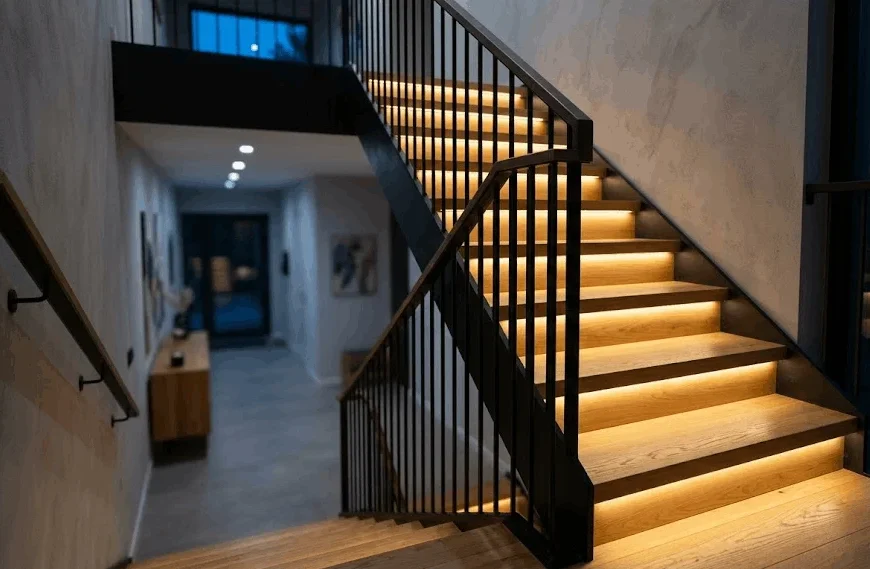
If you’ve ever missed a step in the dark on your way to grab a glass of water, you already know why staircase lighting ideas matter more than most people think. It’s not just about making your stairs look nice for guests — it’s about not falling on your own steps at 2am. This guide walks you through real, workable staircase lighting ideas that balance safety with style, plus the numbers you actually need to get it right.
By the end, you’ll know exactly what fixtures to consider, how much light your stairs really need, and which mistakes to avoid so you’re not redoing the work in six months.
Why Staircase Lighting Ideas Need to Start With Safety
Before we get into the fun stuff — pendants, LED strips, all of it — let’s talk about why staircase lighting ideas have to start with safety first, design second. It sounds obvious, but a lot of people (myself included, on a past project) pick fixtures based on looks and figure out placement later. That’s backwards.
Here’s why: staircase lighting requires a minimum of 1 foot-candle (11 lux) of light on treads and landings, per US International Residential Code IRC R303.7. That’s the legal floor, not a suggestion. If you’re renovating or building new, an inspector will actually check this.
For a practical number to work with, general staircase lighting works out to roughly 100 lumens per square foot covering treads, risers, and landings — so a 50 square foot staircase needs around 5,000 lumens total. That’s a helpful starting point whether you’re using recessed downlights, step lighting for stairs, or a mix of everything.
One more code detail that trips people up: stairways with six or more risers need a wall switch at each floor level, unless the lighting is controlled remotely, centrally, or automatically. So if you’re leaning toward motion sensor stair lights, you may not need a manual switch at all — which is honestly one of the more convenient loopholes in the code.
This is exactly why motion sensors show up so often in modern staircase lighting ideas — they solve a code requirement and a convenience problem at the same time. You still get automatic illumination the moment someone steps onto the stairs, without wiring a switch at every landing.
That said, don’t assume “automatic” means “install anywhere and forget about it.” Sensors still need to be positioned so they actually detect movement at the top and bottom of the stairs, not just the middle. And if you’re mixing sensor-based lights with a few manual fixtures elsewhere on the staircase, double-check with your electrician that the whole setup still meets code — mixing systems is where most inspection issues actually come from.
Staircase Lighting Fixtures: What Your Options Actually Are
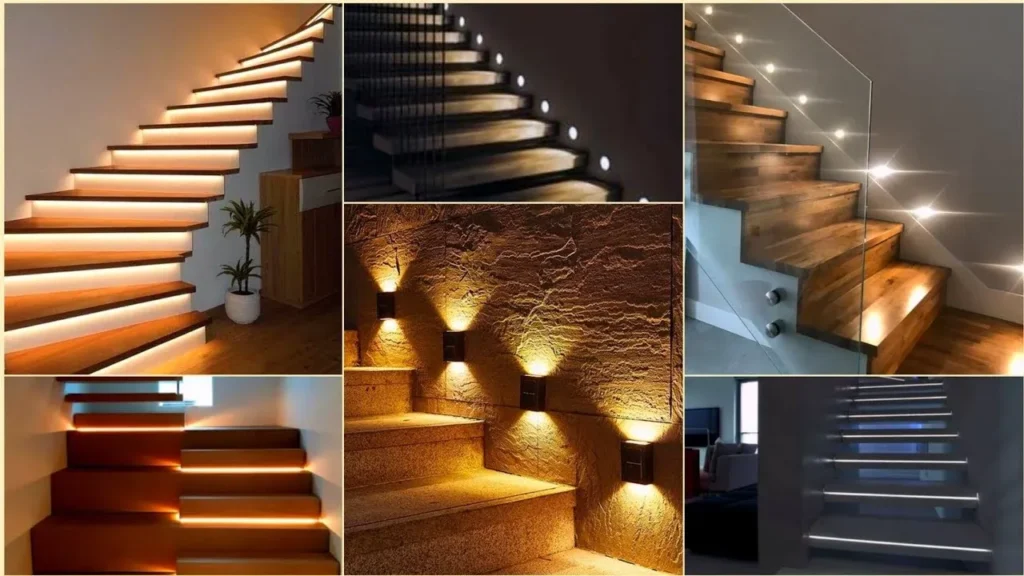
Once safety is sorted, staircase lighting fixtures fall into a few main categories, and most great staircases use two or three of these layered together rather than just one.
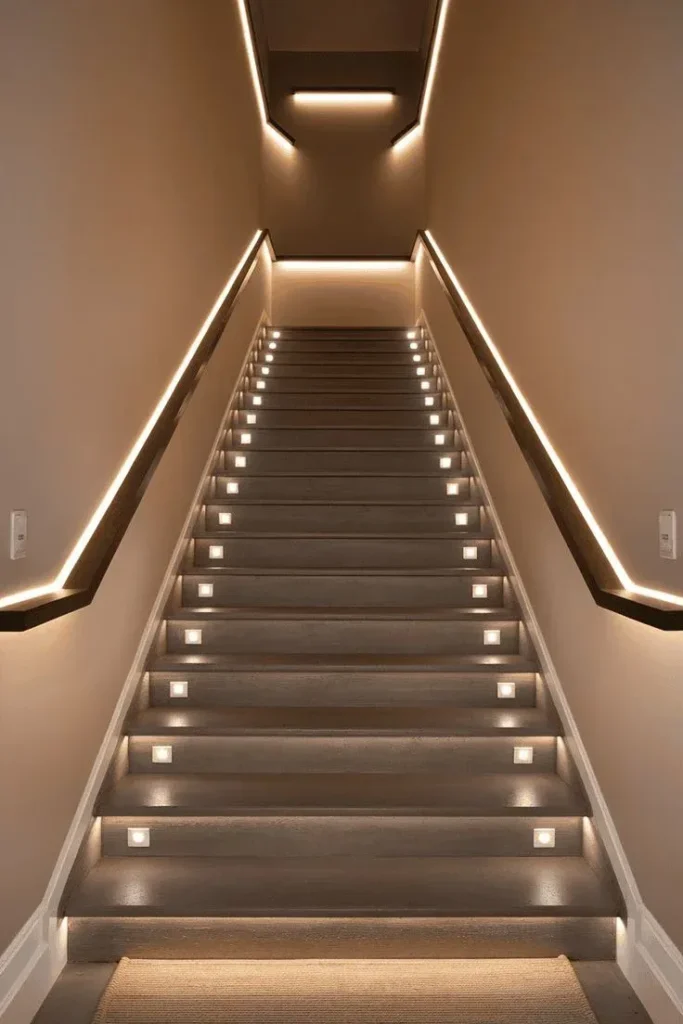
Recessed step lights — These sit flush into the wall beside each tread or into the riser itself. They’re subtle, they don’t stick out to bump your shoulder, and they throw light exactly where you need it: right on the step. This kind of recessed placement is one of the most requested staircase lighting ideas for homes with kids or older family members, since there’s nothing protruding to trip over.
Installation does take a bit more planning than a surface-mounted fixture, since you’re cutting into drywall or the tread itself. But once it’s in, maintenance is minimal — most models use long-life LED bulbs that rarely need replacing.
Under-stair LED lighting — Linear LED strips tucked under the nose of each tread. This is one of the most popular staircase lighting ideas right now because it works on almost any staircase style, from carpeted to open riser. They’re also one of the easiest options to retrofit, since many kits come with adhesive backing and don’t require cutting into the tread at all.
You can find them in fixed white tones or full RGB color-changing versions if you want to switch things up for different moods or seasons. The main thing to watch for is even spacing — gaps in the strip run can create uneven light pooling instead of that clean, continuous glow.
Wall-mounted stair lights — Small sconces spaced along the stairwell wall. These add ambient light rather than direct downlight, so they’re often paired with something brighter lower down for actual foot visibility. Spacing is key here — too far apart and you’ll get uneven pools of light along the wall, too close and it starts to look cluttered.
Most homeowners space them every third or fourth step, adjusting based on ceiling height and staircase length. Since sconces sit at eye level, they’re also one of the easier fixtures to swap out later if you want to update the style without touching any wiring.
Pendant or chandelier lighting — Usually reserved for open, multi-story stairwells where you’ve got the vertical space to hang something dramatic. Staircase pendant lighting works best when it doesn’t block sightlines on the stairs themselves. Height is the trickiest part to get right — hang it too low and it becomes a hazard or an eyesore from the stairs above; too high and you lose the visual impact entirely.
A general rule is to keep the bottom of the fixture at least 7 feet above the lowest tread it hangs over. Because it’s often the focal point of the whole stairwell, it’s worth spending a bit more here even if you’re keeping the rest of the lighting simple.
Handrail-integrated lighting — Less common but growing in popularity — LED strips built directly into the underside of the handrail, casting a soft glow down onto the treads without any visible fixture at all. Because the strip is hidden inside the rail itself, it gives a clean, almost floating light effect with zero visible hardware.
This option usually needs to be planned early, since the handrail has to be milled or channeled to fit the strip before installation. It’s a pricier upgrade than most, but for anyone chasing a truly minimalist staircase look, it’s hard to beat.
Modern Staircase Lighting Ideas for Open and Floating Stairs
If you’ve got an open riser or floating staircase, you have more flexibility than a traditional boxed-in staircase, and this is where modern staircase lighting ideas really shine.
Light Under Each Tread
For floating stairs, LED strips recessed into the underside of each step cast light downward, illuminating the step below it. It looks architectural and it solves the safety problem at the same time, since open risers have nothing blocking the light from reaching the floor. Out of all the staircase lighting ideas suited to floating designs, this one tends to deliver the biggest visual payoff for the effort involved.
The light naturally draws the eye down the staircase, emphasizing the floating effect rather than fighting against it. Just make sure the strip sits far enough back under the tread that the LED itself stays hidden — you want the glow, not the light source, to be what people see.
Light in the Stringer
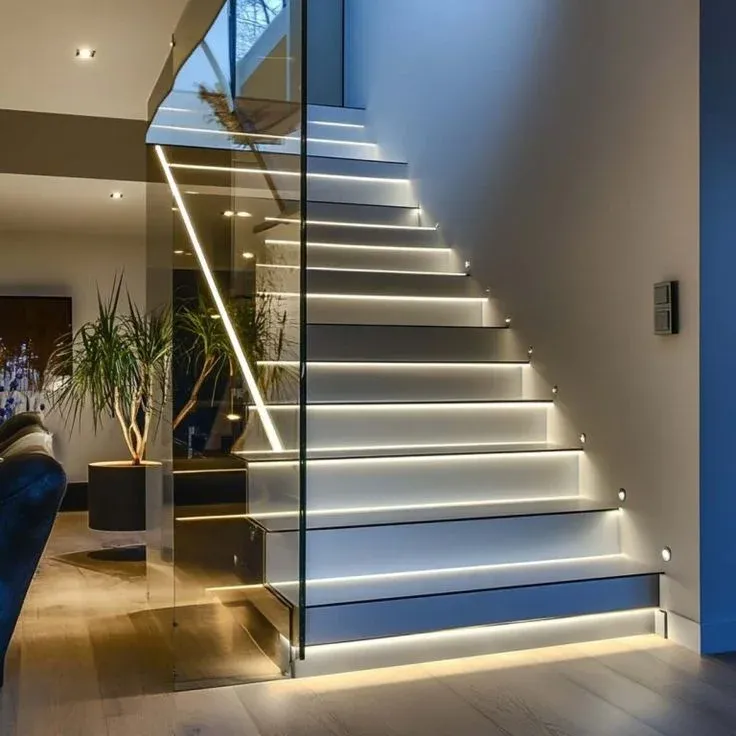
If your staircase has a visible stringer (the structural side piece the steps sit on), running an LED channel along it creates a continuous glowing line down the whole staircase. It’s a clean, minimal look that works especially well with wood or metal stringers.
Aluminum LED channels are worth the extra cost here since they help dissipate heat and keep the light diffused evenly rather than showing individual LED dots. This works especially well on staircases with a strong architectural line, since the light literally traces the shape of the stairs. Just keep the channel recessed slightly below the stringer’s surface so it doesn’t catch shins or bags on the way up and down.
Combine Heights
Don’t rely on just one lighting level. A staircase that mixes step-level lighting with a pendant or two overhead tends to look far more finished than one relying on a single light source. Layering is the difference between “lit” and “designed.” This is one of the biggest differences between amateur and professional-looking staircase lighting ideas — designers rarely rely on a single fixture type.
Try combining ambient light from above, task lighting at the treads, and a bit of accent lighting somewhere unexpected, like under a handrail or along a stringer. Once you start layering, you’ll notice the staircase feels less like a single lit corridor and more like a designed part of the home.
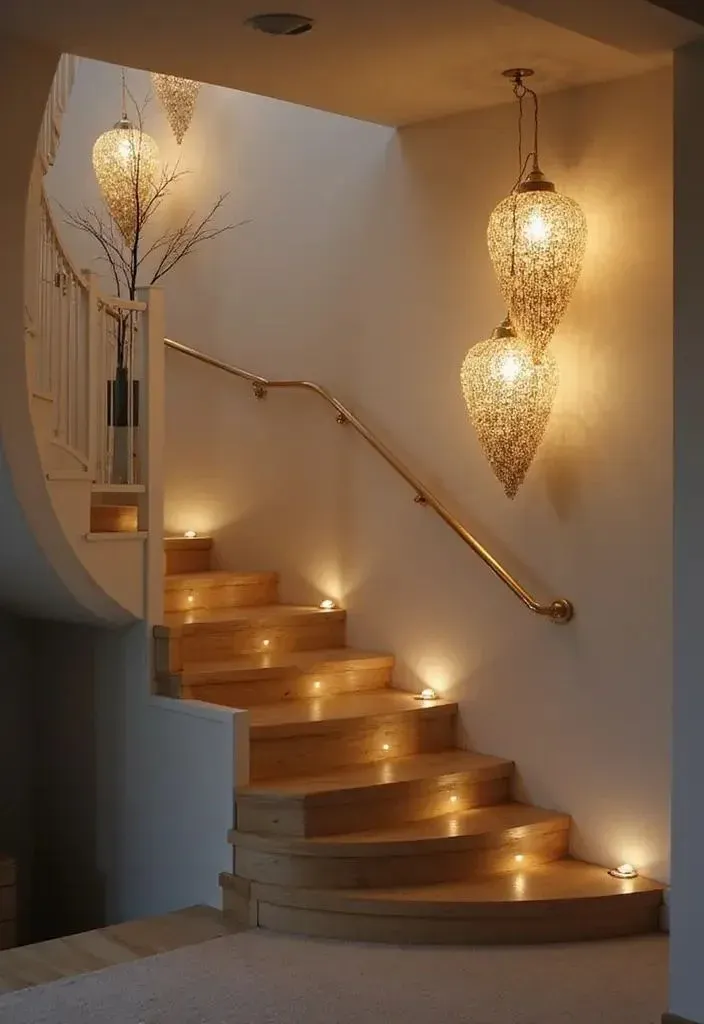
Step Lighting for Stairs: Placement Tips That Actually Matter
Placement makes or breaks step lighting for stairs, and it’s the part most DIY installs get wrong. A few things to keep in mind:
- Avoid harsh hotspots. If your fixtures are spaced too far apart, you’ll get bright spots followed by dark gaps, which is actually worse for depth perception than dim, even lighting.
- Keep the light source low enough to hit the tread, but high enough to avoid glare. Around riser height, angled slightly downward, tends to work best.
- Overlap the beams slightly. This keeps visibility consistent along the whole run of stairs instead of creating shadow gaps between fixtures.
- Watch for dust and fingerprints on low fixtures. Lights mounted right at foot level show every bit of dust. Recessing them into the wall a bit higher up can help.
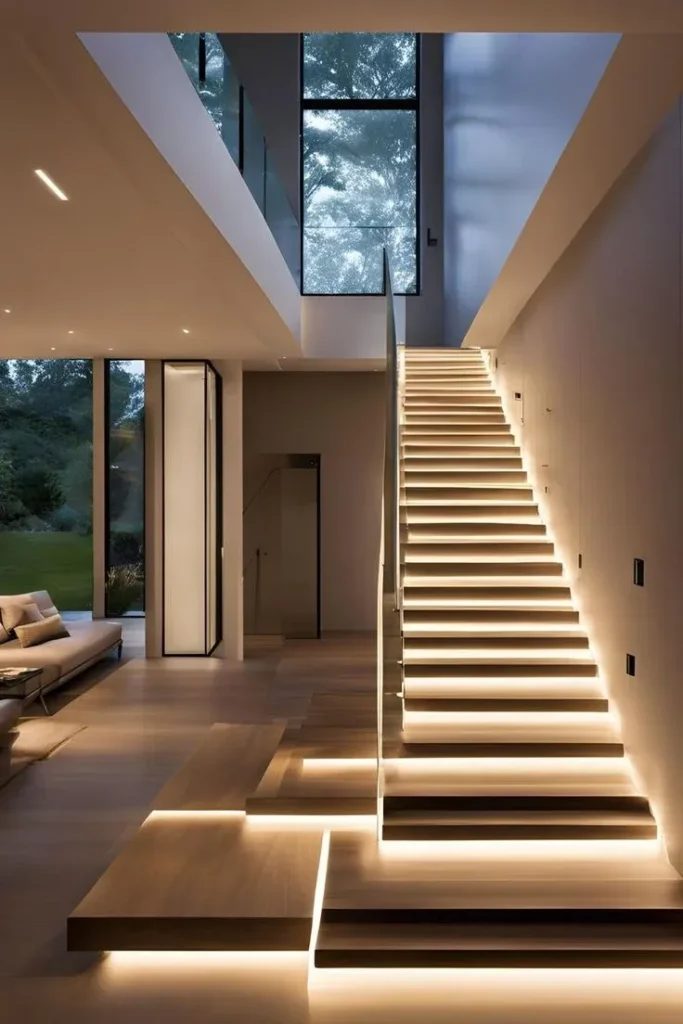
Under Stair Lighting Ideas for Dead Space
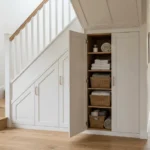
The space under your stairs is almost always wasted, and under stair lighting ideas can fix that fast — whether you’re using it for storage, a reading nook, or just leaving it open.
A simple LED strip run along the underside of the staircase turns a dark, forgotten triangle into usable, good-looking space. If you’ve built in shelving or a closet under there, add a motion sensor light so it switches on automatically when someone opens the door or walks near it. It’s a small upgrade that makes a genuinely noticeable difference.
Of all the under stair lighting ideas out there, this one has the best return for the least effort, since most kits are battery-powered and stick-on, no rewiring required. If you’re using the space for storage, warm white light tends to make it easier to actually find things versus a cooler, harsher tone.
For a reading nook or seating area, consider adding a dimmer so the space can shift from bright and functional to soft and relaxing. Either way, this is one of those staircase lighting ideas that costs very little but changes how often the space actually gets used.
Staircase Lighting Installation: DIY vs. Calling an Electrician
This is the part people ask about most. Staircase lighting installation can go either way depending on what you’re doing.
You can probably DIY if:
- You’re adding plug-in or battery-powered LED strip lights.
- You’re installing a motion sensor step light kit that doesn’t require rewiring.
- You’re swapping an existing fixture for a similar one.
Call an electrician if:
- You’re adding new switches or rewiring for switch placement at multiple floor levels.
- You’re running new wiring inside walls, treads, or stringers.
- Your project needs to meet inspection for a renovation or new build.
Given the code requirements around switch placement and minimum illumination, staircase lighting installation involving new circuits is one area where it’s genuinely worth paying a professional. It’s not the place to save $200 and risk a failed inspection or unsafe wiring.
A licensed electrician will also know local variations in code that generic online guides won’t cover, which matters more than people expect. When you’re comparing quotes, ask specifically whether staircase lighting installation is something they’ve done before, not just general electrical work. The extra cost upfront is small compared to redoing wiring behind a finished wall later.
Stair Riser Lighting: A Detail Worth the Extra Effort
Stair riser lighting — lights embedded in the vertical part of each step — is one of the more overlooked staircase lighting ideas, but it’s worth the extra install time. Because the light source sits at riser height, it lines up almost perfectly with where your eyes naturally look while descending stairs, which makes it genuinely one of the safer lighting placements available.
It also emphasizes stair carpet weave, wood grain, or stone texture in a way overhead lighting can’t. If your staircase has any decorative tread material, riser lighting shows it off far better than a ceiling fixture ever will.
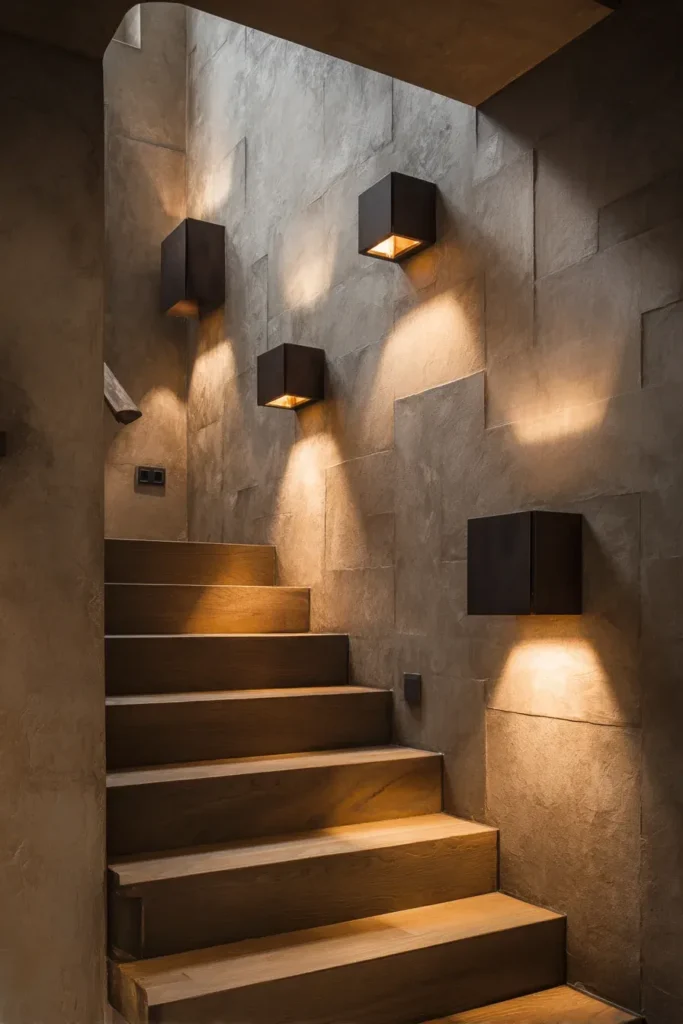
Indoor Stairway Lighting Design for Different Home Styles
Your indoor stairway lighting design should match your home’s overall style, not fight against it.
- Traditional homes often suit wall sconces or a classic chandelier at the top landing.
- Modern or minimalist homes lean toward recessed step lights and clean LED lines with no visible fixture at all.
- Industrial-style homes work well with exposed linear LED strips along stringers or handrails.
- Farmhouse or rustic homes often pair warm-toned wall lights with wood tread lighting for a cozy glow.
Color temperature matters here too. Warmer light (around 2700K–3000K) feels cozy and residential. Cooler light (4000K+) feels more modern and commercial, and it’s often used in contemporary, high-contrast staircase designs. Getting this right is one of the simplest staircase lighting ideas to execute, since it’s often just a matter of picking the right bulb rather than changing any fixtures at all.
Common Mistakes to Avoid
- Choosing fixtures before checking code minimums for illumination.
- Spacing step lights too far apart, creating shadow gaps.
- Mounting lights too low, where they collect dust and show smudges.
- Forgetting a switch requirement for stairs with six or more risers.
- Mixing warm and cool color temperatures without meaning to.
FAQs: Staircase Lighting Ideas
How many lumens do I need for staircase lighting?
Aim for roughly 100 lumens per square foot of staircase area, covering treads, risers, and landings. A 50 sq ft staircase needs around 5,000 lumens total to comfortably meet safety standards.
Do stair lights need a switch at every floor?
Yes, if there are six or more risers, code typically requires a wall switch at each floor level — unless the lighting is automatic, motion-activated, or centrally controlled.
What’s the best staircase lighting idea for open riser stairs?
LED strips recessed under each tread work especially well for open riser stairs, since there’s nothing blocking the light from reaching the step below it.
Are motion sensor stair lights worth it?
Yes — they solve the switch problem automatically, save energy since they’re not on all the time, and they’re genuinely useful for nighttime trips up or down without fumbling for a switch.
What color temperature is best for stairs?
Warm light (2700K–3000K) suits traditional homes and feels cozier. Cooler light (4000K+) suits modern, minimalist staircases and feels crisper and brighter.
Conclusion
Good staircase lighting ideas do two things at once: they keep you safe on the stairs and they make the space look like it was actually designed, not just lit as an afterthought. Start with the code minimums, figure out your lumens, then layer in the style — pendants, LED strips, riser lights, whatever fits your home. Once the safety side is handled, the design part is genuinely the fun bit.
Next step: grab a tape measure, calculate your staircase’s square footage, and figure out roughly how many lumens you’re currently working with. You might be surprised how far below the minimum your current setup actually is.