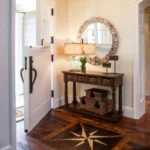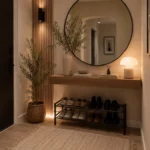
The First Thing Guests See Shouldn’t Be a Mess
There’s something quietly frustrating about an entryway that never quite comes together. You tidy it up, and three days later it looks exactly the same — shoes near the door, bags on the floor, keys somewhere unknown. Most people accept this as just how entryways are. It doesn’t have to be.
Your entryway is the first space people walk into and the last one they leave from. It shapes how guests feel the moment they arrive, and honestly, it shapes how you feel coming home after a long day. Yet it remains one of the most overlooked spaces when it comes to real, thoughtful design.
That’s why entryway bench styling has grown into one of the most searched home décor topics in recent years. A well-placed, well-styled bench does something that most furniture can’t — it organizes the chaos while making the space feel genuinely welcoming. It gives daily life a place to land without making everything look like a storage unit.
This guide covers the full picture. Small apartments, large mudrooms, farmhouse aesthetics, minimalist setups — it’s all here. If you’re starting fresh or simply tired of a space that isn’t working, what follows will give you a clear, practical path forward.
What Makes Entryway Bench Styling Different From General Décor
Most people approach their entryway the way they approach a junk drawer — they know it needs attention, but they keep putting it off. And when they do address it, the result often looks like an afterthought rather than a design decision.
Entryway bench styling is not simply placing a bench and adding a cushion. It’s the deliberate layering of function, proportion, and personality in a space that has very specific demands. Unlike a living room or bedroom, your entryway has to perform daily. Things get dropped there. People rush through it. It needs to look good and hold up to real life.
Before choosing anything, it helps to ask a few honest questions:
- Scale — Does the bench fit the wall without crowding the path?
- Storage — Does it actually solve daily problems, or just create new ones?
- Visual weight — Does it anchor the space or overwhelm it?
- Texture and color — Does it feel connected to the rest of your home?
A bench that answers these questions well becomes the anchor point of the entire entryway. It draws the eye naturally, organizes the space quietly, and makes the whole room feel like someone made a real decision — not just a quick purchase.
Choosing the Right Bench for Your Entryway
Good styling starts with the right foundation. Bench selection is where most entryway projects go sideways — the wrong size, the wrong style, or a purely decorative piece in a space that desperately needs storage.
Size and Scale
A reliable starting point: your bench should be no wider than two-thirds of the wall it sits against. In a narrow hallway, something in the 36–42 inch range works cleanly. A larger foyer can handle 60 inches or more. Height matters just as much — standard bench height runs 18–20 inches, which is comfortable for sitting and proportional for most spaces.
Bench Types to Consider
| Bench Style | Best For | Storage? |
|---|---|---|
| Upholstered bench | Comfort-first styling | No |
| Bench with cubbies | Families, mudrooms | Yes |
| Backless wooden bench | Minimalist, small spaces | No |
| Storage ottoman bench | Small entryways | Yes |
| Built-in bench | Permanent mudroom setup | Yes |
| Rattan/wicker bench | Coastal or boho styling | Sometimes |
For most households, a foyer bench with storage is the most practical investment you can make. You get the visual benefit of a styled, intentional piece while solving a very real daily problem — where to put the shoes, the bags, and everything else that tends to pile up.
The Core Elements of Great Entryway Bench Styling
Once the bench is in place, the real work begins. Strong entryway bench styling comes down to five layered elements, each one building on the last.
1. A Quality Cushion or Seat Pad
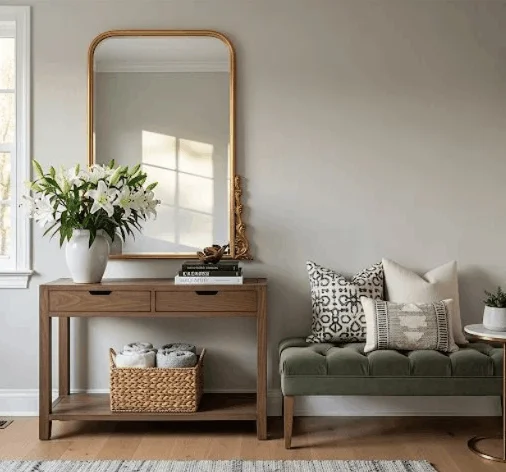
If your bench doesn’t have built-in upholstery, a cushion isn’t optional — it’s essential. It adds comfort, yes, but more importantly it adds visual warmth and a sense of intention. A bare wooden bench in an entryway reads as unfinished. A cushioned one reads as considered.
When choosing hallway bench cushions and pillows, keep three things in mind:
- Durability first — Entryways take a beating. Performance fabrics like indoor/outdoor canvas, microfiber, or Sunbrella-style materials are worth the extra cost. They clean easily and hold their shape over time.
- Color strategy — Neutral tones (cream, linen, warm gray, charcoal) give you the most flexibility, especially if you like refreshing your space seasonally. A bold or patterned cushion makes a stronger first impression but gives you less room to play with.
- Thickness matters — A 2–3 inch cushion looks deliberate and comfortable. Thinner than that tends to disappear visually, which defeats the purpose.
Adding a lumbar pillow behind the seat cushion is a small move with a noticeable impact. It creates depth, softens the look, and makes the bench feel more like a designed moment than a simple seat.
2. Hooks and Vertical Storage
Wall-mounted hooks above the bench are among the highest-impact changes you can make to an entryway. The combination of an entryway bench with hooks and baskets solves function and aesthetics at the same time — which is exactly what a tight, high-traffic space needs.
Hooks keep coats, bags, and keys off the floor, which immediately makes the space look cleaner. They also draw the eye upward, making the entryway feel taller and more expansive than it actually is. For hook finishes:
- Matte black works well in modern and industrial spaces.
- Brass or antique gold suits traditional and transitional styles.
- Natural wood pegs feel right in Scandinavian or organic interiors.
- Shaker-style peg rails are a natural fit for farmhouse or cottage aesthetics.
Space hooks 8–10 inches apart to avoid crowding. A row of 4–6 hooks above a 48-inch bench is a classic, functional arrangement that rarely fails.
3. Baskets and Bins
Baskets do something that most decorative elements don’t — they genuinely improve daily life. In the context of mudroom bench organization, a well-placed basket is the difference between a cluttered entryway and one that actually functions.
Scarves, gloves, dog leashes, sunscreen, small umbrellas — these items need a home, and baskets give them one. Place 1–3 baskets under the bench or inside open cubbies. Matching baskets create a clean, cohesive look. Mixed textures (woven seagrass, wire, fabric bins) work well in more eclectic spaces where variety is part of the style.
One practical tip that’s easy to overlook in entryway bench styling: label your baskets, especially if you have children. Labeled bins significantly increase the chances that things actually get put away rather than simply dropped nearby.
4. A Mirror or Wall Art
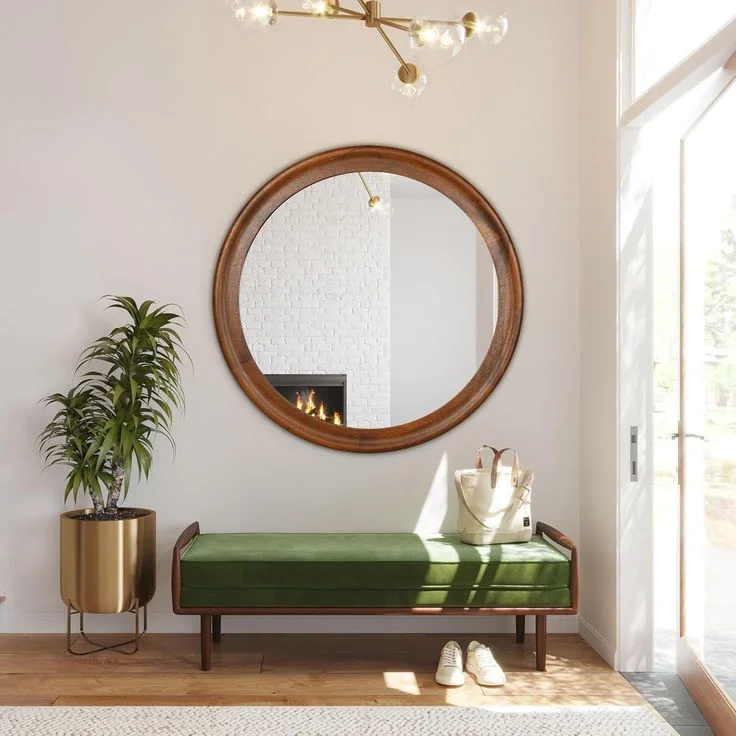
What surrounds the bench matters as much as the bench itself. A mirror is the most practical choice for the wall above — it serves a real function (a quick look before leaving the house) while also reflecting light and making the space feel larger than it is.
For entryway furniture arrangement, mirror placement follows a few clear principles:
- Width should be at least 18–24 inches for a standard bench.
- Hang it at eye level — approximately 57–60 inches from the floor to the center of the mirror.
- Keep it proportional — too large overwhelms the bench; too small looks lost.
If art feels more appropriate for your space, choose something that connects to the color palette in adjacent rooms. A small gallery wall above the bench can work well, but limit it to 3–5 frames. More than that creates visual noise in a space that already has a lot going on.
5. Lighting
Entryways are consistently underlit, and it shows. A sconce flanking a mirror, a pendant overhead, or even a small lamp on a nearby console can completely change the feeling of your entryway bench styling setup. Warm light — in the 2700–3000K range — makes an entryway feel genuinely welcoming rather than just functional.
Lighting is often the last thing people think about and the first thing visitors notice. It’s worth the attention.
Entryway Vignette Styling: Creating a Moment
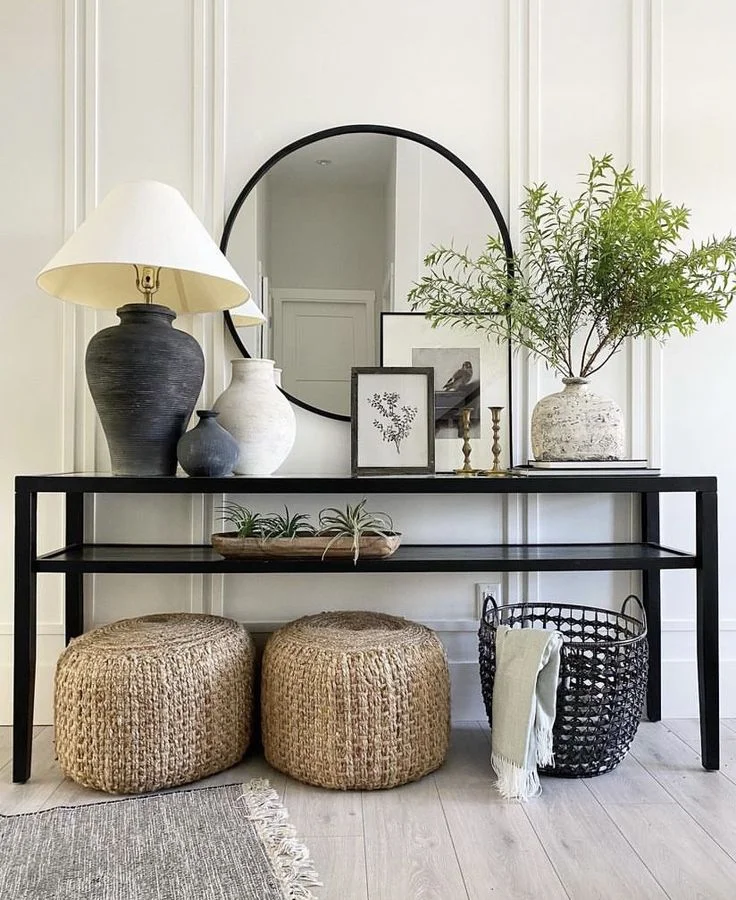
Entryway vignette styling is the practice of building a small, intentional scene around your bench — something that feels personal, composed, and considered. Think of it as visual editing: you’re not filling the space, you’re curating it.
A well-constructed vignette typically works in three layers:
- One tall element — a floor plant, a slim lantern, or a narrow console beside the bench.
- One medium element — a basket, a decorative object, or a small stack of books.
- One small element — a candle, a tray, or a single meaningful object.
The rule of odd numbers is worth keeping in mind. Three items almost always look more balanced than two or four. Varying the height, texture, and shape of objects keeps the eye moving without creating disorder.
Trays deserve a special mention in entryway bench styling. A small tray placed on or beside the bench corrals loose items — sunglasses, keys, a small plant — and instantly makes a scattered collection look intentional. It’s one of the simplest upgrades you can make.
Small Entryway Bench Ideas That Don’t Compromise Style
Not every home comes with a grand foyer. Most people are navigating a narrow hallway, a compact apartment entry, or a coat-closet-adjacent situation where every inch counts. Small entryway bench ideas call for a slightly different mindset — one where function leads and every design decision earns its place.
A few principles that consistently work in tight spaces:
- Go vertical aggressively — Wall space above the bench is valuable. Hooks, shelves, and mirrors all free up floor space while adding visual interest.
- Choose storage over style alone — A storage ottoman or hinged-lid bench does two jobs in the space of one. That tradeoff is almost always worth it.
- Keep the palette light — Light-colored walls, a pale or white bench, and a mirror create the visual impression of more space, even when the dimensions haven’t changed.
- Edit your decorative objects — In a small entryway, restraint is a design choice. One plant, one tray, one piece of art is genuinely enough.
- Consider bench depth — A bench at 12–14 inches deep (compared to the standard 16–18) keeps the walkway clear and the space feeling open.
A floating, wall-mounted bench is worth considering in very compact entryway bench styling setups. Without legs touching the floor, the eye reads more floor space — and the room feels larger as a result.
Modern Farmhouse Entryway Decor: A Style Deep Dive
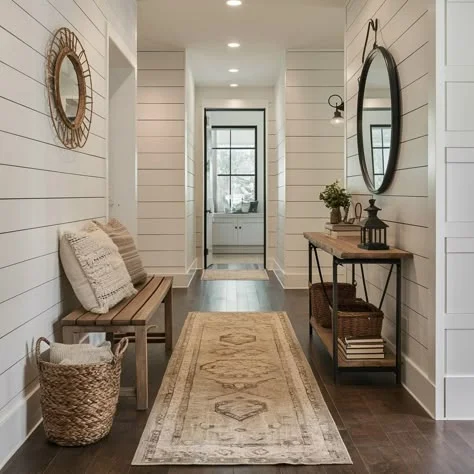
Modern farmhouse entryway decor has stayed popular for years because it hits a balance that few aesthetics manage — it’s warm without being fussy, rustic without being rough, and simple without being cold.
For an entryway that leans into this style:
The bench itself: Look for solid wood with a distressed or whitewashed finish. Shiplap-style backs, X-frame bases, and turned legs all read farmhouse without crossing into costume territory.
Color palette: White, cream, warm gray, and natural wood tones form the foundation. Black accents — in hooks, hardware, or frames — sharpen the look and keep it from feeling too soft.
Textiles: Chunky knit cushions, grain sack stripes, buffalo check, and linen all work here. A natural fiber rug — jute, sisal, or a simple wool weave — in front of the bench grounds the whole composition.
Accessories: Galvanized metal bins, woven baskets, lantern-style lighting, shiplap or beadboard wall treatments, and greenery (eucalyptus, a potted fern, or a small olive tree) complete the picture without overcomplicating it.
The entryway bench with hooks and baskets setup is particularly well-suited to farmhouse styling. A shaker peg rail, a shiplap wall, and a row of woven baskets beneath the bench — it’s a combination that’s become almost synonymous with the aesthetic for good reason.
Seasonal Entryway Bench Decor: Keeping It Fresh Year-Round
One of the most practical approaches to entryway bench styling is building a base that stays constant and swapping out seasonal accents around it. The bench itself becomes a fixed element; the personality shifts with the season.
| Season | Cushion/Textile | Accent Colors | Key Decorative Elements |
|---|---|---|---|
| Spring | Light linen or floral | Soft green, blush, white | Fresh tulips, pastel basket |
| Summer | Stripe or coastal | Navy, coral, sand | Shells, citrus tones, woven hat |
| Fall | Chunky knit or plaid | Burnt orange, rust, brown | Mini pumpkins, dried botanicals |
| Winter | Velvet or faux fur | Deep green, red, gold | Pinecones, candles, greenery |
Seasonal entryway bench decor doesn’t require a significant investment. A small bin of rotating accessories — a cushion cover, a throw, a few seasonal objects, some dried or fresh stems — is all it takes. Swap them out every 10–12 weeks and the space stays fresh without a full redesign.
Entryway Bench Decor Ideas by Home Style
Different aesthetics call for different approaches. Here’s how entryway bench decor ideas translate across five popular interior styles:
Minimalist / Scandinavian
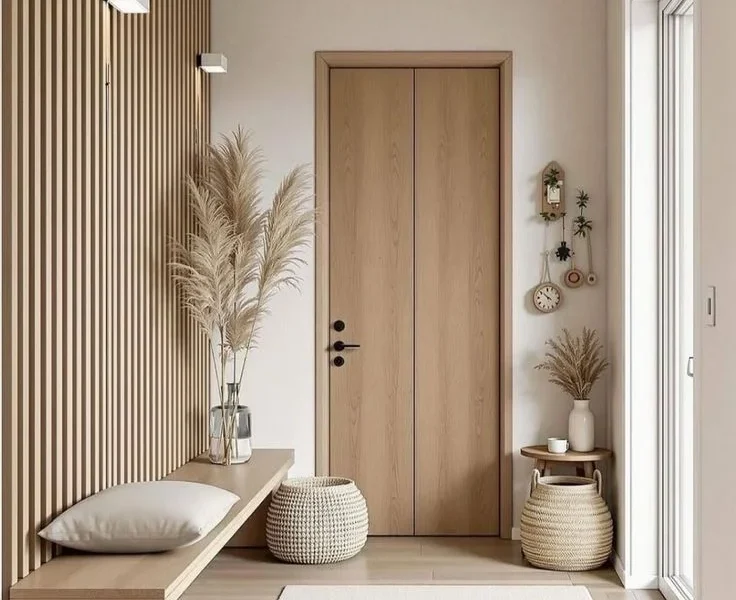
- Pale wood bench, kept clear of clutter.
- One neutral cushion in a muted tone.
- Simple black hooks, evenly spaced.
- A single potted plant — snake plant or fiddle leaf fig.
- Monochrome palette with clean lines throughout.
Bohemian
- Rattan or raw wood bench.
- Layered textiles in mixed patterns and warm tones.
- Macramé wall hanging above the bench.
- Woven baskets in varying sizes beneath.
- Plants used generously — the more, the better.
Traditional / Classic
- Upholstered bench in a rich, textured fabric.
- Antique brass hooks and matching hardware.
- Ornate-framed mirror or gallery of framed art.
- Symmetrical arrangement on both sides.
Industrial / Urban
- Metal-framed bench in dark tones.
- Concrete accents or dark wood surfaces.
- Black pipe hooks for an unfinished, raw look.
- Minimal accessories — the less, the sharper.
Coastal
- White or driftwood-finish bench.
- Blue and white striped cushion.
- Rope or jute accents throughout.
- Woven seagrass baskets underneath.
Common Entryway Bench Styling Mistakes to Avoid
Even thoughtful entryway bench styling can fall apart in the details. These are the mistakes that come up most often:
- Oversizing the bench — A bench that’s too wide or too deep narrows the path and makes the whole space feel smaller than it is.
- Ignoring the floor — A rug in front of the bench grounds the piece and adds warmth. Without it, the bench tends to look disconnected from the space.
- Overdoing the décor — Entryways have to function. Too many decorative objects leaves no room for real life, and the space starts to look staged rather than lived-in.
- Matching everything too closely — Perfect matchy-matchy rooms rarely feel warm. A little contrast and variation is what makes a space feel curated rather than assembled.
- Forgetting about lighting — A dark entryway feels unwelcoming no matter how well the bench is styled. Warm, layered light makes a significant difference.
- Skipping the rug — Beyond aesthetics, a rug protects the floor and visually anchors the bench to the room. It’s a small addition with a noticeable effect.
FAQ: Entryway Bench Styling
Q: What size bench works best in a small entryway?
A bench between 32–42 inches wide and 14–16 inches deep works well in narrow spaces. Built-in storage makes a smaller bench work harder without adding bulk.
Q: How do I style a bench when I have no wall space for hooks?
A freestanding coat rack beside the bench is a practical solution. Benches with built-in hook rails on the sides also work well. Under-bench baskets can handle much of what hooks would normally hold.
Q: What’s the best cushion material for an entryway bench?
Performance fabrics — Sunbrella, polyester canvas, or microfiber — are the most practical choices. They resist stains, clean easily, and hold up to daily use. Delicate materials like silk aren’t well-suited to high-traffic entryways.
Q: How many decorative items should sit on an entryway bench?
Two to four items on the bench surface is a reliable limit. More than that tends to read as clutter. A tray helps group smaller objects into a single, cohesive unit.
Q: Should the entryway bench match the rest of my home décor?
It should connect, not necessarily match. Pick up a color, material, or texture from an adjacent room. A perfectly matching entryway can feel rigid; a completely mismatched one creates visual disconnect.
Q: How do I make a farmhouse entryway look intentional rather than themed?
Introduce a few refined or modern elements — a clean-lined mirror, simple hardware, a solid-color cushion. Restraint is what separates a thoughtfully styled farmhouse entryway from one that looks like a set decoration.
Q: Can I style an entryway bench on a limited budget?
Yes, genuinely. Paint an existing bench, add an affordable cushion, install basic hooks from a hardware store, and source baskets from a thrift shop or discount retailer. The principles of good entryway bench styling apply at every price point — what matters most is intention, not spending.
Conclusion: Your Entryway Deserves More Thought Than It Gets
There’s something satisfying about getting an entryway right. It’s a small space — sometimes just a few square feet — but it carries a lot of weight. It’s where your day begins and where it ends. It’s what guests see first, and it sets the tone for everything beyond it.
Entryway bench styling isn’t about creating a showroom. It’s about building a space that works for your life while looking genuinely good. The right bench, a few well-chosen accessories, some thoughtful vertical storage — these aren’t complicated moves, but they make a real difference.
Start with what bothers you most. Maybe it’s the shoe pile. Maybe it’s the bare wall. Maybe it’s just the general feeling that the space hasn’t been thought about. Pick one element from this guide and begin there. A single good decision in an entryway tends to build on itself — and before long, the space that was always an afterthought becomes one of your favorites in the house.