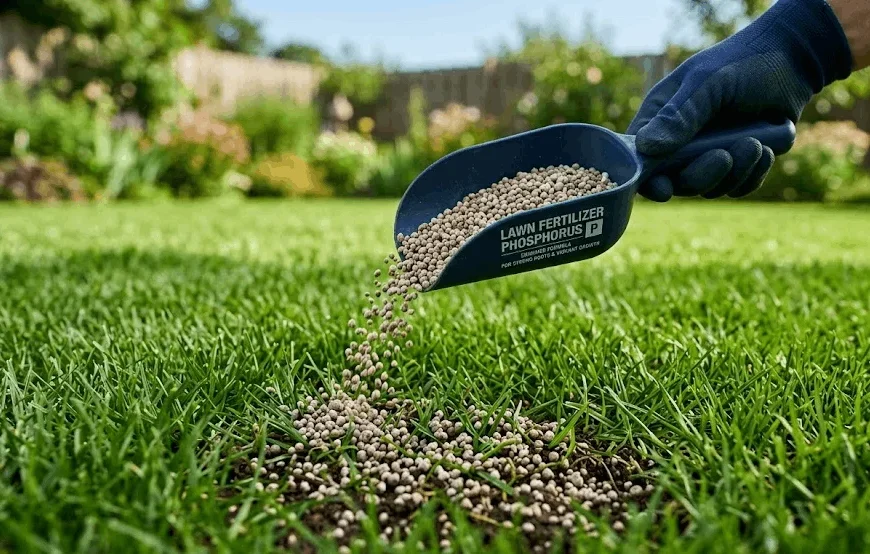
If your grass looks thin, yellow, or just refuses to recover after a rough summer, your soil may be missing one key nutrient — phosphorus. A well-chosen lawn fertilizer with phosphorus does far more than feed your grass on the surface. It builds the underground foundation that decides whether your lawn truly thrives or merely survives from season to season.
Most homeowners pour their attention into nitrogen, and for good reason — it delivers that rich green color so many people want. But here’s the problem: nitrogen without phosphorus is a bit like building a house on sand. The roots stay shallow, the turf stays fragile, and no amount of extra watering changes that. This guide walks you through everything that actually matters when it comes to choosing, timing, and applying a phosphorus-rich lawn fertilizer — whether you’re starting fresh from seed or trying to bring a tired, patchy lawn back to life.
Quick answer: Lawn fertilizer with phosphorus supports root development, seedling establishment, and energy transfer inside grass plants. On any fertilizer bag, the middle number of the NPK ratio tells you the phosphorus content. For new lawns, aim for a value between 10 and 20 in that position.
What phosphorus actually does for your lawn
Before spending money on a bag of fertilizer, it’s worth understanding exactly what you’re paying for. Phosphorus (P) is one of three primary macronutrients grass plants depend on — the other two being nitrogen (N) and potassium (K). Together, these three nutrients make up the NPK ratio you’ll find printed on every fertilizer label. That middle number is your phosphorus reading, and it matters more than most people realize.
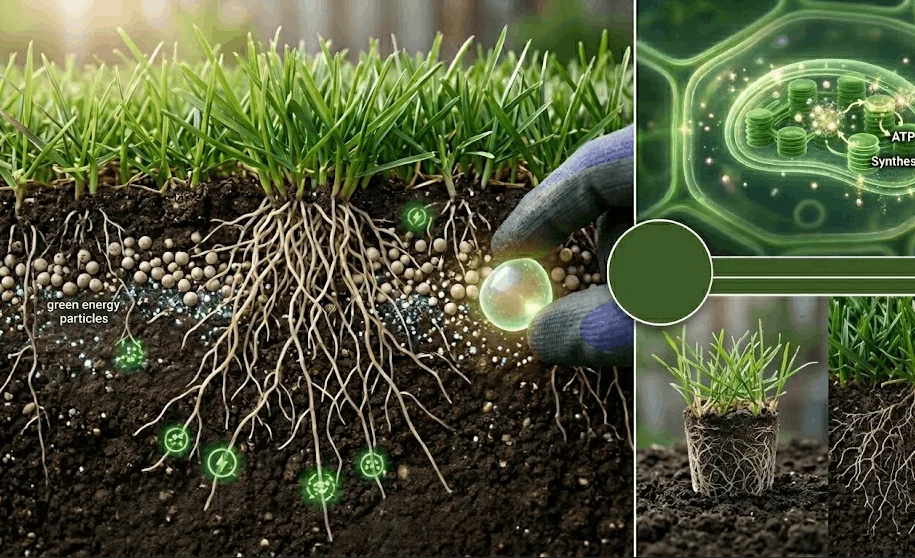
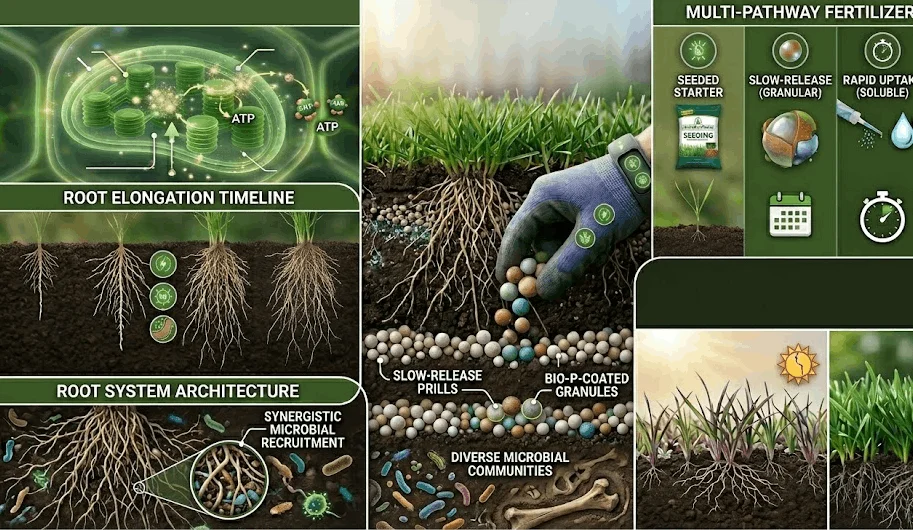
Inside the plant, phosphorus is involved in almost every major biological function. It drives photosynthesis, supports root cell division, manages energy storage, and helps the plant convert sunlight into fuel it can actually use. When phosphorus levels fall short, grass struggles to move energy efficiently from its leaves down to its roots. The blades may still look reasonably green, but the root system underneath stays thin and shallow — a problem that shows up later when drought or heat stress hits.
Here’s what phosphorus contributes in practical terms:
- Drives root elongation and density, especially in the first 6 to 8 weeks after seeding.
- Improves drought tolerance by helping roots reach deeper soil moisture.
- Supports turf recovery after stress from heat, heavy use, or mowing.
- Helps seedlings establish faster — essential when overseeding or laying new sod.
- Plays a role in seed and flower formation in ornamental turf varieties.
For established lawns with well-balanced soil, phosphorus requirements tend to be lower. The mineral binds tightly to soil particles and releases gradually over time, which means existing reserves can carry healthy turf for long periods. That said, new lawns, compacted soils, or turf showing early deficiency signs — purplish blade tips, slow growth, thin coverage — will often respond noticeably to a targeted lawn fertilizer with phosphorus within just a few weeks of application.
How to read NPK labels when shopping for phosphorus fertilizers
Walk through any lawn and garden store and you’ll encounter bags marked with ratios like 10-10-10, 16-4-8, or 18-46-0. These three numbers represent the percentage by weight of nitrogen, phosphorus (listed as P₂O₅), and potassium — in that exact order. Any lawn fertilizer with phosphorus is simply a product where that middle number is greater than zero. Knowing which ratio fits your situation is where the real decision-making begins.
| Fertilizer goal | Recommended NPK range | Phosphorus role |
|---|---|---|
| New lawn from seed | 10-20-10 or 5-10-5 | High — accelerates root establishment |
| Overseeding existing lawn | 10-10-10 or 12-12-12 | Moderate — supports germination |
| Established healthy lawn | 28-3-10 or 30-0-10 | Low to none — roots already established |
| Phosphorus-deficient soil | 8-32-16 or 10-20-10 | High — corrective application |
| Organic approach | Varies (bone meal ~3-15-0) | Moderate — slow-release natural source |
One of the most common mistakes homeowners make is applying a high-phosphorus fertilizer out of routine — season after season — without stopping to test the soil first. Phosphorus doesn’t rinse away quickly. It binds to soil particles and builds up over time. When it accumulates in excess, it can actually begin blocking the absorption of other important micronutrients like zinc and iron, creating a secondary deficiency that wasn’t there to begin with. A soil test before applying any lawn fertilizer with phosphorus is genuinely worth the small investment. Most cooperative extension services offer them for under $20, and the results take the guesswork out of the process entirely.
The best types of lawn fertilizer with phosphorus
Starter fertilizers
Starter fertilizers are specifically designed for new lawns, and they represent the most widely used category of lawn fertilizer with phosphorus on the market. Products like Scotts Starter Food and Jonathan Green Green-Up Seeding and Sodding Fertilizer rely heavily on phosphorus to give young root systems the early push they need. These formulas typically run around 10-18-10 and are either worked into the soil before seeding or applied directly to freshly laid sod. When used correctly, a starter fertilizer can shorten the time to full lawn establishment by 30 to 40 percent compared to using a nitrogen-only product.
Granular slow-release formulas
Slow-release phosphorus lawn feed products use coated granules or sulfur-coated prills that break down gradually over an 8 to 12 week window. This approach works particularly well for established lawns that need a measured phosphorus boost without the risks that come with rapid-release applications — salt burn, surface runoff, and unpredictable uptake. Brands like Pennington and Milorganite have built solid reputations with slow-release formulas, and their products tend to be far more forgiving during hot weather. Another advantage: because the release is extended, most lawns need only one or two applications per season to stay on track.
Water-soluble phosphorus fertilizers
When speed matters — specifically when correcting an acute phosphorus deficiency in lawn treatment — liquid or water-soluble formulations are the most direct option. Products like Hi-Yield Super Phosphate, or liquid blends containing monoammonium phosphate, move phosphorus into the root zone within a matter of days rather than weeks. They work well as a foliar supplement or a soil drench during active growing periods. The trade-off is frequency: liquid applications need to be repeated more often than granular alternatives to maintain consistent phosphorus availability through the season.
Organic options
For homeowners who prefer an organic phosphorus fertilizer for grass, bone meal has long been the most reliable choice. Derived from steamed animal bones, it typically carries 3 to 15 percent phosphorus depending on how it was processed. Rock phosphate is another natural slow-release source, though it requires slightly acidic soil to become readily available to plants. Both options do something synthetic fertilizers can’t: they feed the soil’s microbial community at the same time as the plant, building long-term phosphorus cycling capacity rather than simply delivering a nutrient hit.
Signs of phosphorus deficiency in your lawn
Phosphorus deficiency can be subtle. It doesn’t produce the obvious yellow banding associated with iron deficiency, or the crisp brown edges that signal salt damage. Instead, it tends to manifest as a general underperformance — the lawn just never quite reaches the level you’d expect, no matter what you do.
Watch for these specific signals:
- Purplish or reddish tinting on grass blades, particularly during cooler weather or in sandy, low-fertility soils.
- Thin, patchy growth that doesn’t respond to watering or nitrogen fertilizer alone.
- Slow recovery after wear, heat, drought, or regular mowing.
- Seedlings that sprout and then stall — emerging but failing to develop into mature turf.
- Visibly shallow root systems when you pull a small plug from the ground.
- Persistent poor response to nitrogen-heavy fertilizing programs.
If your lawn checks two or more of those boxes, a targeted application of high phosphorus lawn treatment — paired with a proper soil test — is the most practical next step. Applying more fertilizer without knowing your current phosphorus levels is one of the most common and costly lawn care errors homeowners make, and it often makes the underlying problem worse rather than better.
How to apply lawn fertilizer with phosphorus the right way
Product selection matters, but application method matters just as much. Even a well-formulated lawn fertilizer with phosphorus will fall short of its potential if the timing is wrong, the rate is off, or the equipment isn’t suited to the job. Getting these details right doesn’t require professional training — it just requires a bit of attention before you start spreading.
Timing your application
For cool-season grasses — Kentucky bluegrass, fescue, and ryegrass — the most effective windows for phosphorus application are early spring, once soil temperatures reach around 50°F, and early fall between August and October. Fall timing is especially valuable because it supports root development heading into the dormant winter months, when roots continue growing even as surface growth slows. For warm-season grasses like Bermuda, zoysia, and St. Augustine, the sweet spot is late spring through early summer, when the plant is actively growing and nutrient uptake is at its peak.
Application rates and equipment
The label rate on any bag of fertilizer is there for a reason — follow it. Overapplying phosphorus fertilizer doesn’t produce better results; it produces runoff risk. When phosphorus reaches nearby waterways, it contributes to algae blooms that harm aquatic ecosystems. A standard rotary spreader handles most granular lawn fertilizer with phosphorus products well. Near slopes or water features, switch to a drop spreader for tighter control, and always apply when dry weather is forecast for at least the next 24 hours.
Watering in after application
Granular phosphate fertilizer for turf needs water to start working. A light irrigation of about a quarter inch immediately after spreading activates the granules and begins moving phosphorus toward the root zone, without generating the kind of surface flow that washes nutrients off the lawn. One important note: avoid applying before a heavy rain is forecast. The same water that activates the fertilizer can carry it off your lawn entirely if the volume is too high — which means all that effort and expense accomplishes nothing.
Phosphorus regulations: what you need to know by region
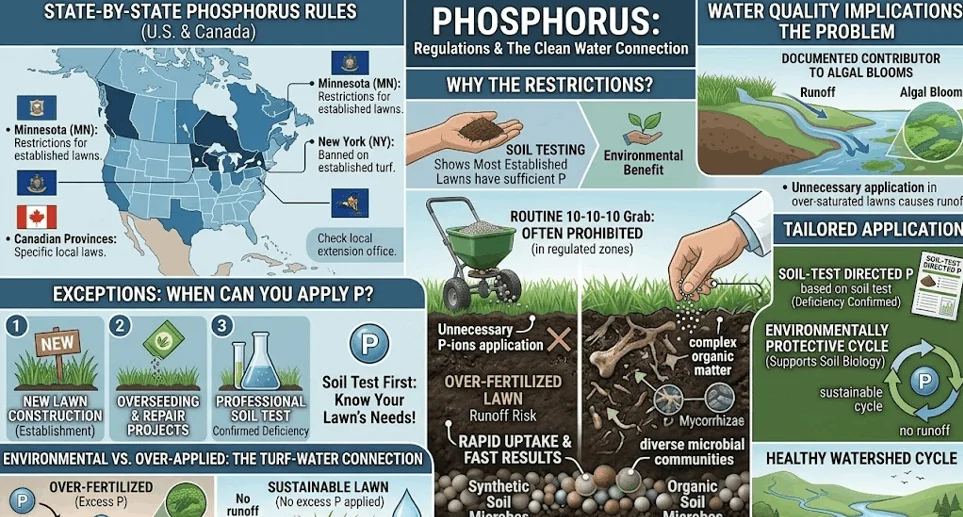
This is one detail most fertilizer guides overlook, and it’s genuinely important to understand before you make a purchase. A growing number of U.S. states and Canadian provinces have restricted — or outright banned — the use of phosphorus in lawn fertilizers for established turf. Minnesota, New York, Wisconsin, and Michigan all have phosphorus lawn fertilizer laws currently on the books. The reasoning behind these restrictions is sound: soil testing across North America consistently shows that the majority of established lawns already contain sufficient phosphorus, making routine applications unnecessary and environmentally counterproductive. Runoff from over-fertilized lawns is a documented contributor to water quality problems in lakes and rivers.
The good news is that exceptions typically exist. In most regulated states, you can still legally apply a lawn fertilizer with phosphorus for new lawn construction, overseeding projects, or any area where a professional soil test has confirmed a documented deficiency. But the routine habit of grabbing a balanced 10-10-10 for general lawn maintenance is no longer appropriate in many parts of the country. Before purchasing, check with your local cooperative extension office or state department of agriculture for current regulations in your area.
Phosphorus and soil pH: the connection most people miss
Here’s something that catches many homeowners off guard: even if you apply the right product at the right rate, your grass may absorb very little of it if your soil pH is outside the ideal range. Of all the major nutrients, phosphorus is the one most sensitive to pH fluctuations. It’s most available to grass roots when soil pH sits between 6.0 and 7.0. Drop below 6.0, and phosphorus begins binding to iron and aluminum in the soil. Rise above 7.5, and it locks up with calcium. In either case, the phosphorus is still there in the soil — but the plant can’t reach it.
This is exactly why a soil test should always come before any phosphorus fertilization decision. If your pH is below 6.0, a lime application to raise it may release enough naturally occurring phosphorus to make a new fertilizer application unnecessary. If pH is above 7.5, sulfur amendments can bring it back into the effective range. The sequence that produces results is always: test first, adjust pH, then fertilize. Skipping those early steps is the reason so many homeowners conclude that fertilizer “didn’t work,” when the real issue was that conditions were never right for the product to perform.
Practical tip: A standard soil test costs between $15 and $25 at most cooperative extension offices. It returns results for pH, phosphorus, potassium, and organic matter — everything you need to make an informed fertilizer decision. It’s the most underused tool in home lawn care, and arguably the most valuable one.
Starter fertilizer vs. all-purpose: which phosphorus fertilizer is right for you?
The difference between a starter fertilizer with phosphorus for new lawns and a general-purpose NPK blend is more significant than many product labels communicate clearly. Understanding that distinction can save you money, prevent soil imbalances, and help your lawn respond the way you’re expecting it to.
| Feature | Starter fertilizer with phosphorus | All-purpose NPK blend |
|---|---|---|
| Phosphorus content | High (10–20%) | Low to moderate (0–10%) |
| Best use case | New seeding, sod installation, overseeding | Established lawn maintenance |
| Application frequency | Once per establishment cycle | 2–4 times per year |
| Risk of excess P | Low if used correctly for new turf | High if applied repeatedly on established lawn |
| Cost range | $25–$55 per bag (5,000–10,000 sq ft) | $20–$45 per bag |
The practical answer is straightforward. If you’re seeding, laying sod, or overseeding a bare area, reach for a dedicated starter lawn fertilizer with phosphorus. For everything else, have your soil tested before adding any phosphorus at all. Most established North American lawns don’t have a phosphorus shortage — what they often have is soil biology that isn’t cycling the available phosphorus efficiently. Addressing that distinction makes a real difference in how your lawn responds over time.
Organic vs. synthetic phosphorus fertilizers: a real comparison
The conversation around organic versus synthetic phosphorus options is more layered than most product marketing lets on. Both approaches can produce results — the actual differences lie in how quickly they work, what they cost over time, how they affect soil health, and what their broader environmental footprint looks like.
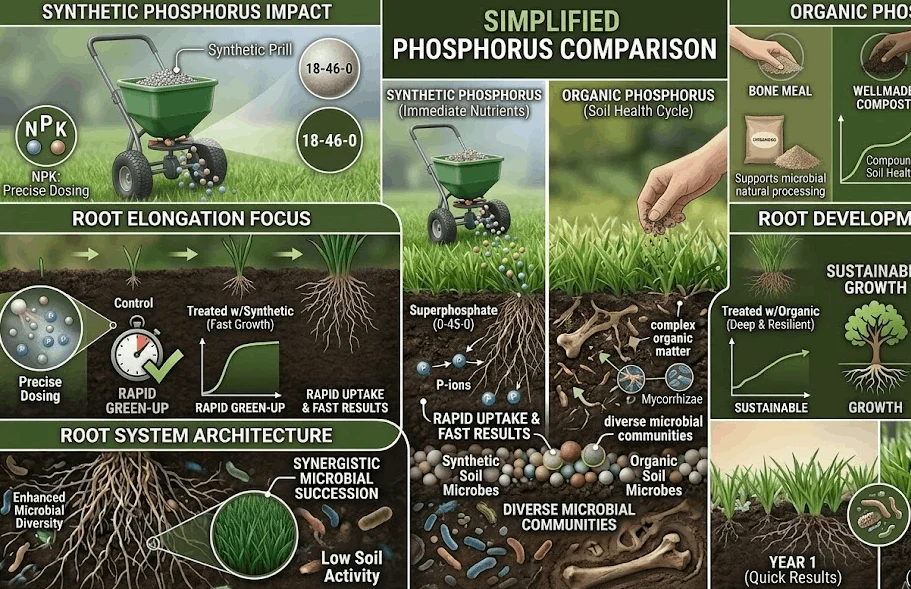
Synthetic phosphorus sources like superphosphate (0-45-0) and diammonium phosphate (18-46-0) are straightforward: they’re water-soluble, immediately available to plant roots, and easy to apply at a precise dose. They work fast, which is useful when you need quick results. The limitations are equally clear — they don’t contribute to soil organic matter, can disrupt microbial activity at high doses, and carry a higher runoff risk when not applied carefully.
Organic phosphorus fertilizer for grass — bone meal, rock phosphate, and well-made compost — takes a different path. Rather than bypassing the soil biology, it works through it. These inputs support the microbial communities that naturally process and release phosphorus, building cycling capacity that improves season after season. The results come more slowly and can be harder to predict precisely. But for homeowners focused on long-term soil health rather than short-term green-up, the compounding benefits of an organic program typically outpace a synthetic-only approach within three to four growing seasons.
Frequently asked questions
How often should I apply lawn fertilizer with phosphorus?
For new lawns, a single starter application at the time of seeding or sodding is usually all that’s needed for the establishment phase. For established turf, apply a lawn fertilizer with phosphorus only when a soil test confirms that phosphorus levels are genuinely low — at most once per growing season. Applying it more frequently than necessary is both wasteful and potentially harmful to nearby water sources.
Can I use a high-phosphorus fertilizer on an established lawn?
Yes, but only when a soil test shows that phosphorus is actually deficient. Most established lawns accumulate phosphorus over years of regular fertilization, so additional applications are rarely needed. In several U.S. states, applying phosphorus to established turf without a documented soil deficiency is restricted by law, so it’s worth checking local regulations before purchasing.
What’s the best lawn fertilizer with phosphorus for new grass seed?
Look for a starter fertilizer where the middle NPK number falls between 10 and 20 — ratios like 10-18-10 or 5-10-5 are well-suited for seeding situations. Apply before or at the time of seeding and water in lightly afterward. Products from Scotts, Pennington, and Jonathan Green are widely available and have strong track records for new lawn establishment.
How do I know if my lawn has a phosphorus deficiency?
Visual indicators include purple or reddish tinting on grass blades, patchy growth that doesn’t respond to nitrogen feeding, sluggish seedling development, and shallow root systems. That said, these signs can overlap with other issues, so a soil test is the only reliable way to confirm a phosphorus deficiency rather than guessing based on appearance alone.
Is phosphorus fertilizer safe around pets and children?
Granular lawn fertilizer with phosphorus should be watered in thoroughly and the treated area allowed to dry completely — typically 24 to 48 hours — before pets or children return to it. Store all fertilizers out of reach and follow the product’s safety instructions. Organic options like bone meal carry lower chemical risk but should still be kept away from pets that might try to eat the granules.
Does soil pH affect how well phosphorus fertilizers work?
Yes, and more significantly than most people expect. Phosphorus is most accessible to grass roots when soil pH falls between 6.0 and 7.0. Outside that range — either too acidic or too alkaline — phosphorus binds to other soil minerals and becomes largely unavailable to the plant. Testing and correcting pH before applying any phosphorus fertilizer is often more effective than simply increasing the application rate.
What’s the difference between phosphorus and phosphate in fertilizer labels?
Fertilizer labels express phosphorus content as phosphate (P₂O₅) rather than elemental phosphorus. That middle NPK number reflects the P₂O₅ percentage by weight. To convert it to elemental phosphorus, multiply by 0.43. For most practical lawn care decisions, though, the middle NPK number alone gives you everything you need to compare products and choose the right one for your situation.
conclusion
A healthy lawn doesn’t happen by accident. It’s the result of consistently meeting the soil’s needs — and phosphorus is one of those needs that tends to go unaddressed for far too long. Whether you’re working with a brand-new lawn that needs a proper foundation or an established one that’s been quietly underperforming, getting your phosphorus strategy right makes a real, measurable difference in the results you see.
The approach doesn’t have to be complicated. Test your soil before anything else. If phosphorus is genuinely low, choose a lawn fertilizer with phosphorus that fits your situation — a high-phosphorus starter formula for new seeding, a slow-release granular for a gentle corrective boost, or an organic source like bone meal if long-term soil health is your priority. Apply at the right time of year for your grass type, water it in properly, and let the biology do the rest.
What most lawn owners discover, once they start paying attention to phosphorus, is that their previous fertilizing routine was doing less than they thought. The right product, applied at the right time and for the right reason, consistently outperforms more frequent applications of the wrong one. That’s as true for phosphorus as it is for any other part of lawn care. Start with a soil test, follow the science, and your lawn will show you the difference within a single growing season.