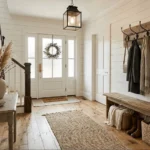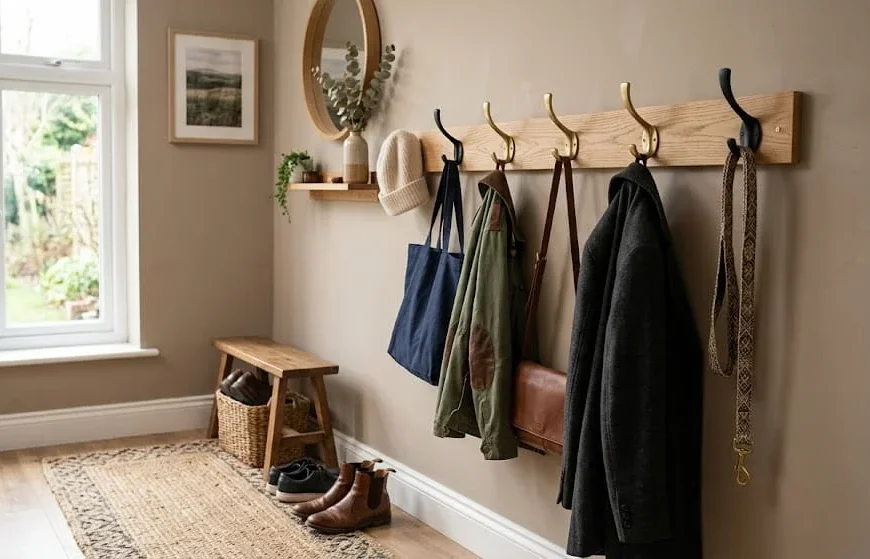
Walk into ten different homes, and you will probably find ten versions of the same scene: coats piling up on the stair railing, backpacks dumped right by the door, a dog leash that nobody can find when everyone is already running late. It is such a common picture that most of us stop noticing it after a while. Entryway wall hooks solve this problem in a way that furniture rarely manages. They cost very little, they go up in an afternoon, and they put everything exactly where your hands expect it to be when you walk in tired with your arms full.
This guide looks at the real differences between hook styles, what actually holds weight on drywall compared to plaster, and how to plan a layout that suits a busy household rather than just a nice photo. If you have ever bought a hook that looked great in a product photo and then watched it sag sideways under a damp winter coat, the installation section further down will be especially useful.
Why Entryway Wall Hooks Matter More Than You Think
The entryway is, in most homes, the single most walked-through patch of floor in the house, yet it is often the space people think about least. People pass through it many times a day carrying something, and most homes simply ask them to put that something down somewhere nearby — a chair, the floor, a pile that keeps growing until someone finally gets annoyed enough to deal with it.
Entryway wall hooks remove that decision entirely. There is no door to open, no drawer to dig through, no bin to sort out later. A coat goes onto a hook in one quick motion, and that is really the whole appeal. It is also why a simple row of hooks often does more for everyday household calm than an expensive entryway organizer full of cabinets and drawers that slowly fill up with things nobody wants to deal with.
There is a design benefit too, and it is easy to overlook. A well-chosen set of hooks says something about a home before a visitor has even taken their shoes off, whether that is a farmhouse with hand-forged iron pieces, a modern apartment with brushed brass fittings, or a family home where each child’s hook is clearly labeled with their name.
The Main Types of Entryway Wall Hooks
Not every hook solves the same problem, and picking the wrong category is one of the most common reasons people end up unhappy with their choice within six months.
Single Wall Hooks
These are individual hooks fitted one at a time, usually spaced a short distance apart. They offer the most flexibility, since you can add more later, space them however the wall allows, and replace a single one without disturbing the rest. Renters tend to favor single hooks for a simple reason: a few small holes are far easier to patch than one large mounting board when it is time to move out. The trade-off is that fitting several hooks individually takes longer than mounting one strip in a single step.
Wall Mounted Coat Hooks on a Rail
This is the style most people picture when they think of an entryway: a wooden or metal rail fitted with four to six hooks, mounted together as one piece. Wall mounted coat hooks on a rail are popular largely because you only need to locate one or two studs, or use properly rated anchors, instead of measuring and drilling for each hook separately. They also tend to look the most consistent, since every hook matches and sits at the same height without any extra effort on your part.
Coat Rack With Hooks
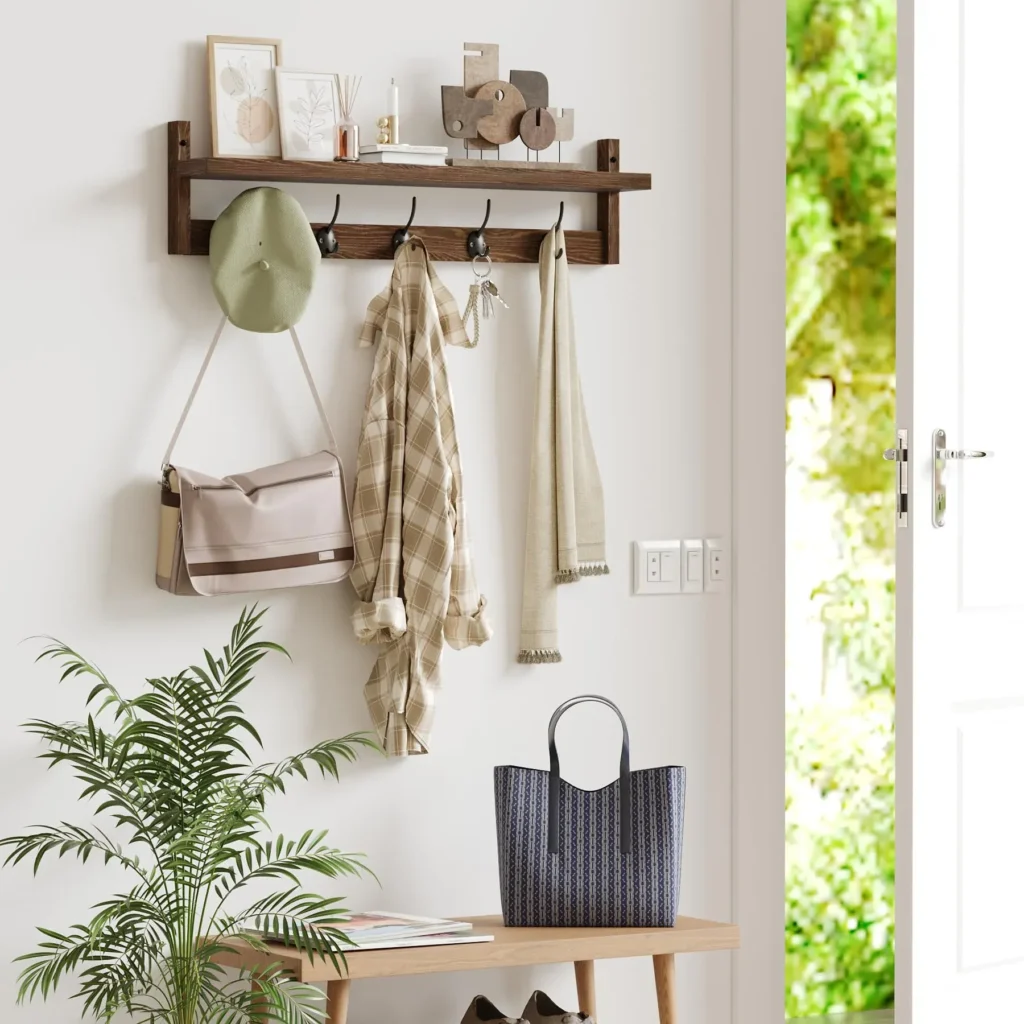
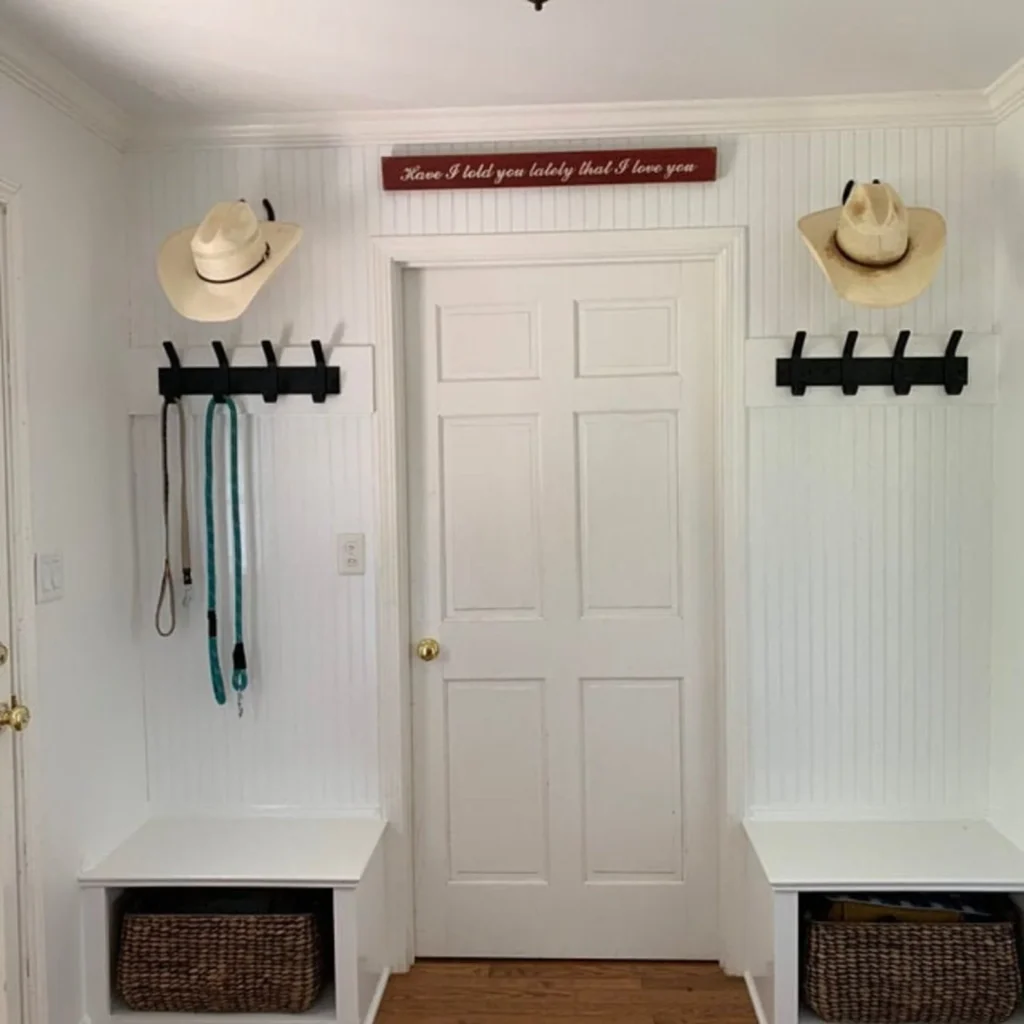
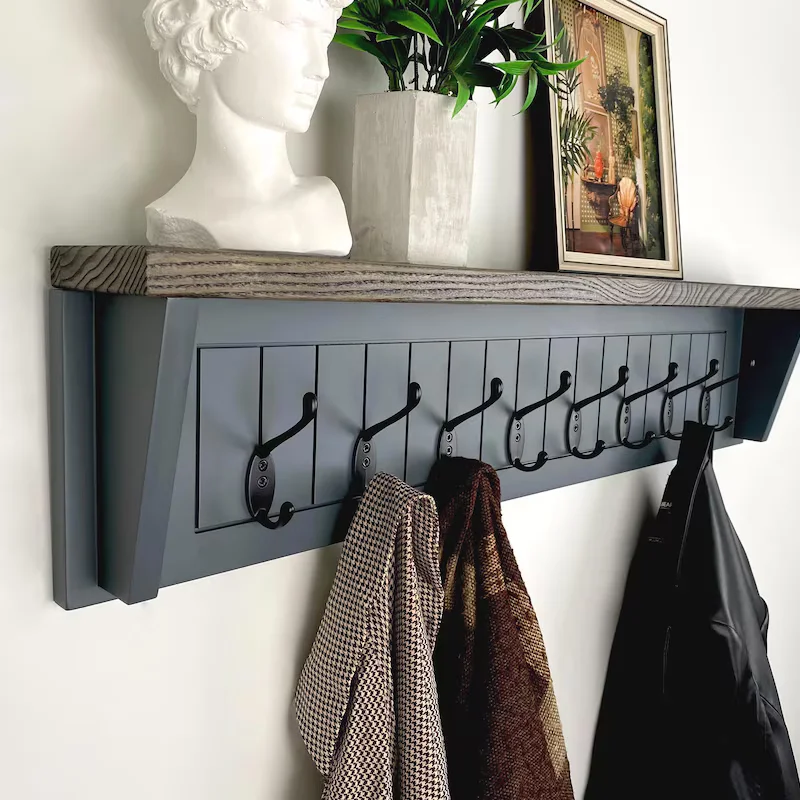
This term actually covers two different products, so it helps to know which one you are shopping for before you buy. A wall-mounted coat rack with hooks is essentially a wider version of a rail, often paired with a shelf above or a small bench underneath. A freestanding coat rack with hooks, on the other hand, is a piece of furniture in its own right. It needs no wall mounting at all. Freestanding versions tend to suit renters who cannot drill into walls, homes with stone or tiled entryways where mounting is impractical, or households that simply move home more often than most.
Decorative Wall Hooks
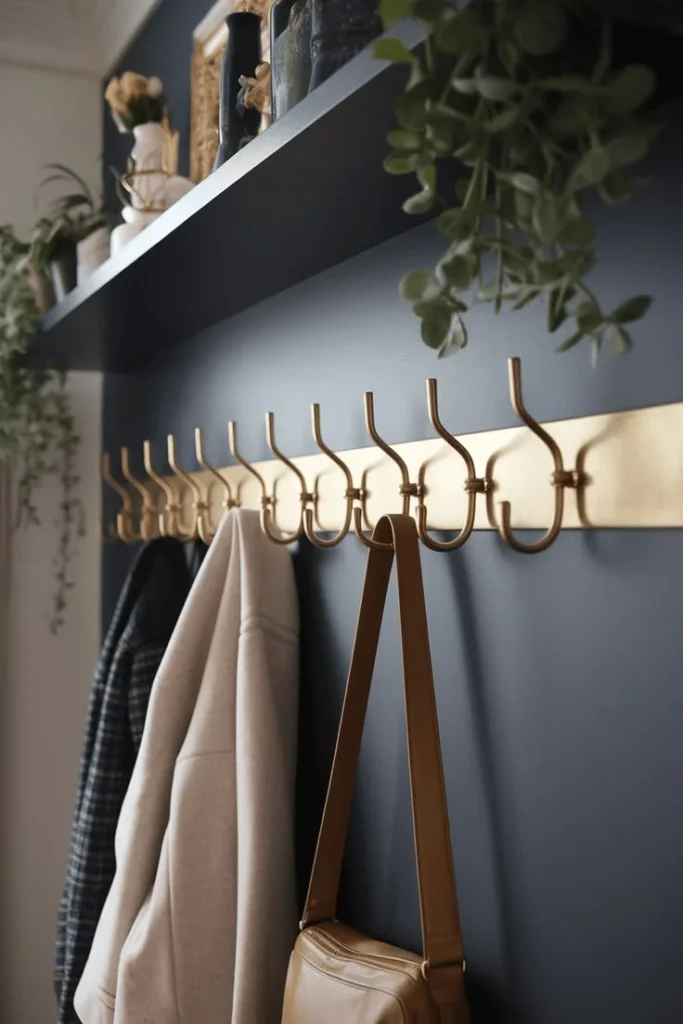
These prioritize appearance nearly as much as function. Think sculptural brass shapes, repurposed ceramic knobs, or hand-painted finishes. Decorative wall hooks suit a formal entry or a spot beside a console table particularly well, though it is worth checking the weight rating before hanging a heavy coat on something that was really designed to be admired rather than loaded down.
Rustic Wall Hooks
Reclaimed wood backing, hammered or blackened iron, the occasional leather strap detail — rustic entryway wall hooks lean into texture and a sense of age rather than polish. They suit farmhouse interiors, cabins, and any home that favors warm, lived-in materials over anything too sleek or minimal.
Materials and Durability
| Material | Typical Weight Capacity | Best For | Watch Out For |
|---|---|---|---|
| Solid brass | High | Modern, transitional, formal entries | Tarnishes without sealant |
| Wrought/cast iron | Very high | Rustic, farmhouse, industrial | Heavier, needs studs |
| Powder-coated steel | High | Everyday family use | Coating can chip over time |
| Painted wood-backed | Moderate | Cottage, coastal, kids’ rooms | Can split if overloaded |
| Ceramic or resin | Low to moderate | Decorative accents | Brittle, not for heavy coats |
If you plan to hang anything heavier than a light jacket — winter coats, backpacks loaded with books, or a dog leash along with a collar and treat pouch — metal hooks rated for at least 10 to 15 pounds each are worth paying a little more for, rather than choosing something more delicate simply because it looks nicer on a shelf.
Entryway Wall Hooks vs. Other Entryway Storage Options
| Option | Cost | Install Effort | Renter-Friendly | Capacity |
|---|---|---|---|---|
| Entryway wall hooks | Low | Low to moderate | Yes (with care) | Moderate |
| Built-in mudroom bench/cubbies | High | High (often contractor) | No | High |
| Coat closet | None extra | None | Yes | High, but hidden |
| Freestanding coat rack with hooks | Low to moderate | None | Yes | Moderate |
Hooks win on cost and effort in almost every comparison. The honest trade-off is capacity. A closet or a built-in mudroom system can absorb far more clutter out of sight, while hooks keep everything visible. That visibility is exactly what makes hooks so easy to use day to day, and it is also exactly why they can start to look untidy if the layout is not planned with a little care.
How to Choose the Right Entryway Wall Hooks for Your Space
Before buying anything, it helps to walk through your entryway and notice what actually lands there on an ordinary Tuesday, not the tidy, idealized version you might picture. A household of two people with light jackets needs something quite different from a family of five juggling backpacks, sports bags, and a dog.
A few questions are worth answering first:
- How many people use this entry regularly? Plan on roughly one to two hooks per person as a starting point.
- What is the heaviest item that will hang here? A padded winter coat needs a sturdier hook than a light scarf.
- What is the wall actually made of? Drywall, plaster, and brick each call for different hardware.
- Do you want a uniform row, or a mixed, gallery-style arrangement? Both can look good, but they call for slightly different hook styles.
- Is this a rented home? If so, single hooks or adhesive-rated options are usually a safer choice than anything that needs several large anchors.
In my experience, matching the hook style to how the household actually behaves, rather than to the prettiest option in a photo, is the single biggest factor in whether entryway wall hooks still look good and still get used a year later.
Installing Entryway Wall Hooks So They Actually Hold Weight
This is where most disappointment happens, and almost all of it can be avoided with a little planning.
Finding Studs vs. Using Anchors
Wherever possible, anchor at least one screw per hook, or per rail, directly into a stud, since that is where the real holding strength comes from. A simple stud finder makes this quick work. If a stud does not line up exactly where you need it, use rated drywall anchors matched to the expected load; toggle-style anchors generally outperform plastic expansion anchors once you are hanging anything heavier than a light jacket. Skipping this step is the most common reason hooks eventually pull out of the wall.
Height and Spacing Guidelines
A general rule that works well for most households:
- Adult hooks: 60 to 66 inches from the floor, roughly shoulder height for most adults.
- Kid hooks: 24 to 36 inches, low enough that a child can use them without help.
- Spacing between hooks: at least 6 to 8 inches, so coats and bags do not tangle together.
- Distance from doorframes: leave a few inches of clearance so the door swings freely and nobody bumps into a hook on their way in.
Drywall vs. Plaster vs. Brick
Plaster walls are more brittle than drywall, so it helps to drill a small pilot hole before driving any screw, just to avoid cracking the surface. Brick or masonry entries need a masonry bit and a matching anchor type, since standard drywall anchors will not hold there at all. If you are not sure what lies behind your wall, a stud finder with material sensing, or a small test hole in an inconspicuous spot, will usually answer the question quickly.
Styling Entryway Wall Hooks Without It Looking Like a Catalog Page
The simplest way to make a hook wall feel intentional, rather than thrown together, is to mix function with a couple of decorative touches instead of lining up identical hooks in a perfectly straight row.
A few combinations tend to work consistently well:
- Pair hat and coat hooks at the main height with a smaller key and mail holder wall mount just inside the door, so keys are never lost in a coat pocket again.
- Add a wall mounted key rack near eye level, kept separate from the coat hooks, so the two functions do not compete for the same space.
- Mix two finishes deliberately, such as blackened iron hooks with a single brass accent hook for an umbrella, rather than keeping every piece identical.
- Stagger the heights slightly instead of forcing a perfectly rigid row, which tends to read as more like a home and less like a hotel coat check.
Decorative wall hooks earn their place here as well. One or two ornamental pieces mixed into an otherwise practical row keep the whole wall from feeling purely functional.
Small Entryways and Hallway Storage Hooks
Apartments and narrow hallways call for a different approach than a sprawling mudroom does. Vertical space becomes the priority. A tall, narrow hook rail uses less wall width than a horizontal row, yet still holds the same number of items. Hallway storage hooks placed just inside the door, or even on the back of the door itself, catch coats and bags before they make their way any further into the home.
A few small-space ideas worth trying:
- Use a single multi-hook rail instead of several individual hooks to save wall space.
- Mount hooks on the inside of a closet door if the hallway has no spare wall to work with.
- Choose slimmer hook profiles that do not jut too far into a narrow walkway people pass through daily.
- Skip a bench or shelf altogether if space is tight; hooks alone, placed well, can carry the entire job.
Mudroom Hooks for Families With Kids
Mudroom hooks earn their name because they are built for the messiest entry point in the house: wet boots, dripping umbrellas, school bags, and children who need to manage their own belongings without an adult stepping in each time.
The setup that tends to work best is a double row, with adult-height hooks around 60 inches and a second row at child height, roughly 24 to 30 inches depending on the children’s ages. Labeling each child’s hook with a name tag, a painted initial, or a small picture cuts down on the familiar “that’s not my hook” disagreement, and it genuinely helps younger children build the habit of hanging things up on their own.
Durable materials matter more here than anywhere else in the home. Wet coats and loaded backpacks are heavier and rougher on hardware than a dry blazer, so this is the spot to favor sturdy metal hooks over anything delicate or purely decorative.
Common Mistakes People Make With Entryway Wall Hooks
- Buying too few hooks. One hook per coat is rarely enough once bags, dog leashes, and umbrellas enter the picture.
- Skipping the weight rating. A hook rated for a light scarf will eventually fail under the weight of a heavy winter coat.
- Spacing hooks too close together. Bulky coats need real room, or they end up tangled and falling off one another.
- Ignoring the wall material. The same screw and anchor combination simply does not work across drywall, plaster, and brick.
- Mounting everything at one height. A single row may suit one adult, but it rarely works for an entire family.
- Choosing finish before function. A beautiful hook that cannot hold a backpack just becomes another thing to fix later.
Caring for and Rotating Your Setup
A hook wall is not really a one-and-done project; it tends to work better when it is allowed to shift with the seasons. Swapping heavy coats for lighter jackets, adding an umbrella hook during rainy months, or clearing space once sports gear changes with the season keeps the same set of hooks genuinely useful all year, rather than permanently overloaded. Metal finishes benefit from an occasional wipe-down, and it is worth checking screws for looseness every few months, especially on hooks that see heavy daily use.
FAQ: Entryway Wall Hooks
How many entryway wall hooks do I need for a family of four?
A reasonable starting point is one to two hooks per person, plus a couple of extras for bags, umbrellas, or visiting guests. Eight to ten hooks in total tends to work well for most families of four.
What height should entryway wall hooks be mounted at?
Adult hooks typically sit between 60 and 66 inches from the floor. If children will use them too, a second row at 24 to 36 inches lets them reach without help.
Can entryway wall hooks hold heavy winter coats?
Yes, as long as they are properly rated for the weight and anchored into a stud, or fitted with a suitably rated drywall anchor. Lighter decorative hooks are simply not built for bulky, wet coats.
Do entryway wall hooks need to go into wall studs?
Not in every case, but at least one anchor point per hook, or per rail, should ideally be in a stud, particularly for the heaviest items. Rated anchors can fill in the gaps between studs where needed.
What is the difference between entryway wall hooks and a coat rack with hooks?
Wall hooks mount directly onto the wall and take up no floor space at all. A coat rack with hooks can either be wall-mounted, which is really a wider version of the same idea, or freestanding furniture that needs no wall mounting whatsoever.
Are decorative wall hooks as sturdy as plain ones?
That depends entirely on the piece. Some decorative wall hooks use the same solid metal hardware found in plainer designs, while others are built more for appearance than for load. It is always worth checking the listed weight rating before hanging anything heavy.
Conclusion
After working through all the options, it usually comes down to something fairly simple. The best set of entryway wall hooks is not the one that photographs the best, but the one your household actually uses without thinking twice. A hook that gets ignored because it cannot hold a winter coat, or one mounted at the wrong height for your children, ends up being no better than no hook at all.
Take the time to get the basics right: find your studs, choose hardware rated for what you actually plan to hang, and leave a little breathing room in the layout so it can grow with your household rather than feel cramped from day one. Do that, and a simple row of hooks by the front door will quietly earn its place as one of the most useful small changes in the entire home, long after any passing design trend has moved on.