Lawn Fertilizer Phosphorus: What Your Grass Actually Needs (And What It Doesn’t)
Most homeowners think about nitrogen first. It makes sense — nitrogen is what turns a dull lawn green almost overnight. But here’s what often gets missed: without phosphorus working quietly underground, all that nitrogen has very little to hold onto.
Phosphorus is the nutrient that builds the foundation. It grows the roots, supports early development, and helps grass handle stress. Skip it when it’s needed, and your lawn will look fine on the surface for a while — until it doesn’t. Apply it when it isn’t needed, and you risk harming local waterways without gaining a single blade of extra grass.
This guide covers everything you need to know about lawn fertilizer phosphorus — what it does, when your lawn genuinely needs it, how to read product labels, and how to apply it responsibly. Whether you’re starting a new lawn from seed or managing an established yard, understanding phosphorus is one of the smarter investments you can make in your lawn care routine.
What Phosphorus Actually Does for Your Lawn
Phosphorus is the middle number in the NPK fertilizer ratio — the “P” in N-P-K. While nitrogen handles what you see above ground, phosphorus focuses on what happens below it.
It plays a direct role in several key plant processes:
- Root development — particularly important during lawn establishment.
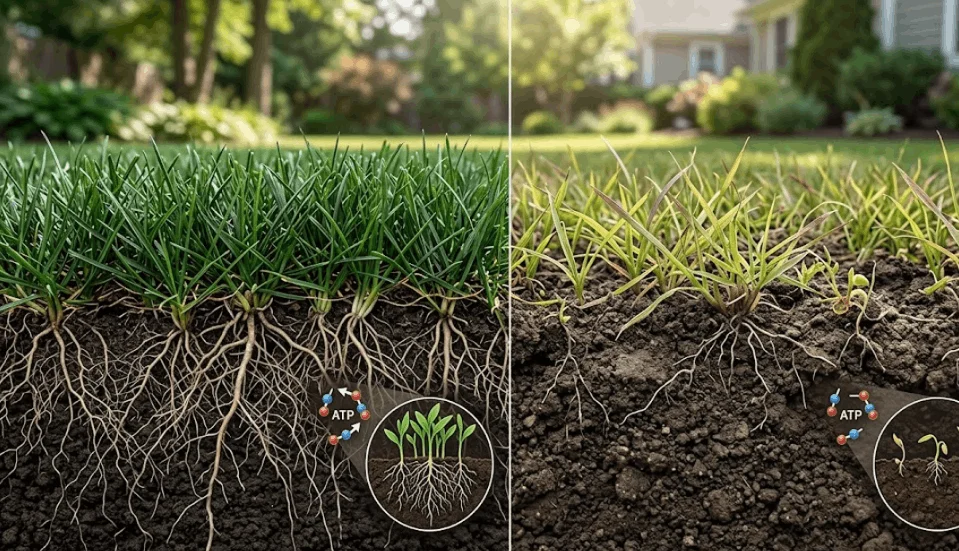
- Energy transfer within plant cells through ATP production.
- Seed germination and early seedling strength and resilience.
- Stress tolerance during periods of drought or temperature extremes.
- Photosynthesis efficiency at the cellular level.
When phosphorus is limited, grass roots stay shallow. The plant can’t pull water or nutrients from deeper soil layers, and anything you apply on the surface becomes less effective. Think of phosphorus as the infrastructure that makes everything else work — quiet, invisible, but genuinely important.
That said, most established lawns growing in healthy soil already have sufficient phosphorus from previous applications and natural decomposition. The real need arises when you’re seeding a new lawn, installing sod, or working with heavily compacted or nutrient-depleted soil.
Reading NPK Labels: Where Phosphorus Sits
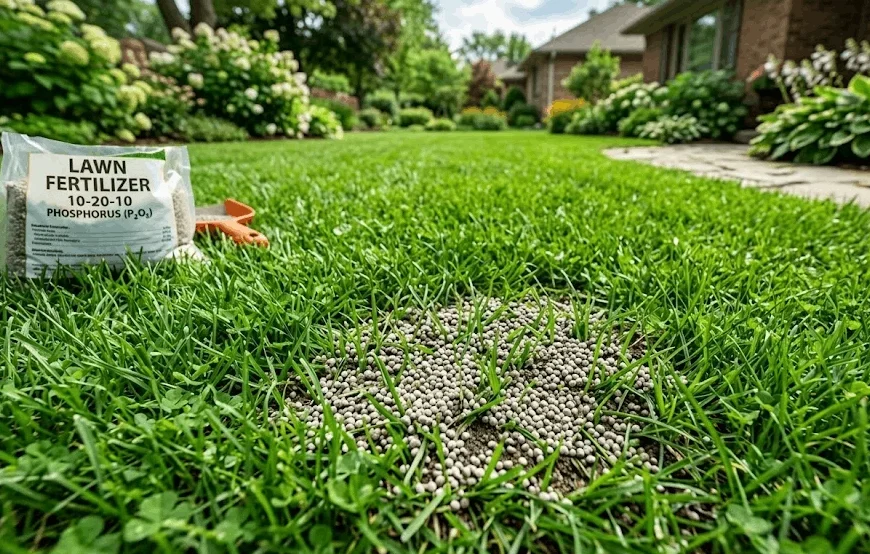
Every fertilizer bag carries three numbers — something like 10-10-10, 29-0-4, or 18-24-12. These numbers represent the percentage by weight of nitrogen (N), phosphorus as P₂O₅, and potassium as K₂O.
| NPK Example | Nitrogen | Phosphorus | Potassium | Best Use |
|---|---|---|---|---|
| 10-10-10 | 10% | 10% | 10% | General purpose |
| 29-0-4 | 29% | 0% | 4% | Established lawns |
| 18-24-12 | 18% | 24% | 12% | New lawn starter |
| 5-10-5 | 5% | 10% | 5% | Overseeding, root building |
| 0-46-0 | 0% | 46% | 0% | Phosphorus correction only |
A zero in the middle position means the product contains no phosphorus at all. Many fertilizers designed for routine maintenance of established lawns are made this way — because soil that already holds adequate phosphorus doesn’t benefit from more.
The lawn fertilizer phosphorus level on the label only becomes relevant when your soil is deficient, or when you’re working with new or disturbed ground.
Does Your Lawn Actually Need Phosphorus?
This is where a lot of lawn care goes wrong. The instinct is simple: more nutrients should mean better grass. But phosphorus doesn’t work that way. Applying it to soil that already has enough accomplishes nothing for the lawn and creates real downstream problems for water quality.
The only honest way to know whether your lawn needs phosphorus is through a soil test.
A standard soil test — available through your local cooperative extension office or a certified soil lab — will provide:
- Current phosphorus levels categorized as low, medium, high, or excessive.
- Soil pH, which directly controls how available phosphorus is to grass roots.
- Organic matter content.
- CEC (cation exchange capacity), which affects how well soil holds nutrients.
If results show medium or high phosphorus, skip it entirely. Choose a fertilizer with zero in the middle position and save yourself the cost and environmental risk.
If results show low or deficient phosphorus — which is common in sandy soils, newly developed lots where topsoil was removed, or heavily leached coastal areas — then lawn fertilizer phosphorus isn’t optional. It’s the missing piece your lawn needs before anything else can work properly.
Phosphorus Deficiency in Lawn Grass: Signs to Watch For
Phosphorus deficiency shows up differently than most nutrient problems. It’s not always obvious, and it’s frequently misread.
Unlike nitrogen deficiency, which produces a fairly uniform yellowing across the lawn, phosphorus deficiency tends to present with these signs:
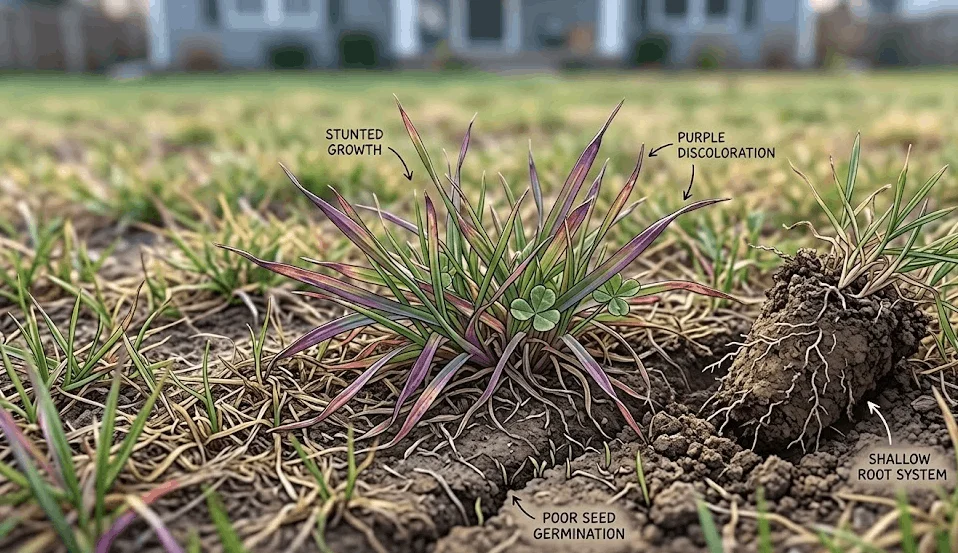
- A purplish or reddish discoloration on grass blades, most visible in cooler temperatures.
- Slow, stunted growth that doesn’t respond well to other fertilizers.
- Thin turf with persistent bare spots that resist filling in.
- A weak, shallow root system — visible when you pull up a small plug of soil and grass.
- Low germination rates during overseeding.
- Quicker wilting than expected during mild dry spells.
One important note: that purplish coloring can also appear naturally in certain grass varieties or during cold snaps. Don’t rely on visual symptoms alone when managing lawn fertilizer phosphorus. A soil test confirms the actual cause and prevents unnecessary applications.
Seedlings and young lawns are the most vulnerable. If a newly seeded area fails to establish even with consistent watering and reasonable care, low soil phosphorus is often one of the first things worth checking.
Starter Fertilizer and New Lawns: When Phosphorus Is Non-Negotiable
There are situations where the question isn’t whether to apply phosphorus — it’s which product and how much. Establishing a new lawn from seed or sod is the clearest example.
During the first weeks of growth, grass seedlings depend heavily on phosphorus to develop the root systems that will sustain them through heat, drought, and foot traffic later on. Without enough available phosphorus during this window, the lawn may technically grow but never really establish itself the way it should.
What to look for in a starter fertilizer for new lawns:
- A higher middle number — products like 18-24-12 or 10-20-10 are widely used for this purpose.
- Quick-release phosphorus so it’s available immediately when roots need it most.
- Nitrogen present but not dominant — root development takes priority at this stage.
- Applied at seeding time and lightly incorporated into the top inch of soil.
Once the lawn is fully established — usually by the second or third growing season — you can transition to a maintenance fertilizer with little or no phosphorus, provided your soil test supports that decision.
Sod installation follows the same principle. The root mat is cut during harvest and needs to regenerate contact with your existing soil quickly. Applying the right lawn fertilizer phosphorus starter gives it the best chance to do that before stress sets in.
High Phosphorus Lawn Fertilizer: When to Use It Carefully
High phosphorus fertilizers serve a specific purpose. They are not routine maintenance products, and using them as such can cause more harm than good.
When excess phosphorus builds up in soil, it begins to interfere with the availability of other nutrients — particularly zinc and iron. Grass can actually show signs of micronutrient deficiency even in well-fertilized soil simply because phosphorus levels are too high.
Situations where high phosphorus fertilizer is appropriate:
- Confirmed soil test deficiency — documented, not assumed.
- New lawn seeding or sod installation.
- Overseeding thinned or bare patches.
- Recovery after renovation, heavy aeration, or grading work.
- Poor-retention soils like heavy sand or compacted clay.
Application rates should come from your soil test report, not the general guidance on the bag. The bag instructions are averages — your soil’s specific condition may call for more or less.
For established lawns with a confirmed deficiency, a single corrective application of lawn fertilizer phosphorus at the recommended rate is standard practice. Follow it up with a retest the next season to see whether additional applications are warranted.
Organic Phosphorus Fertilizer for Turf: Natural Options That Work
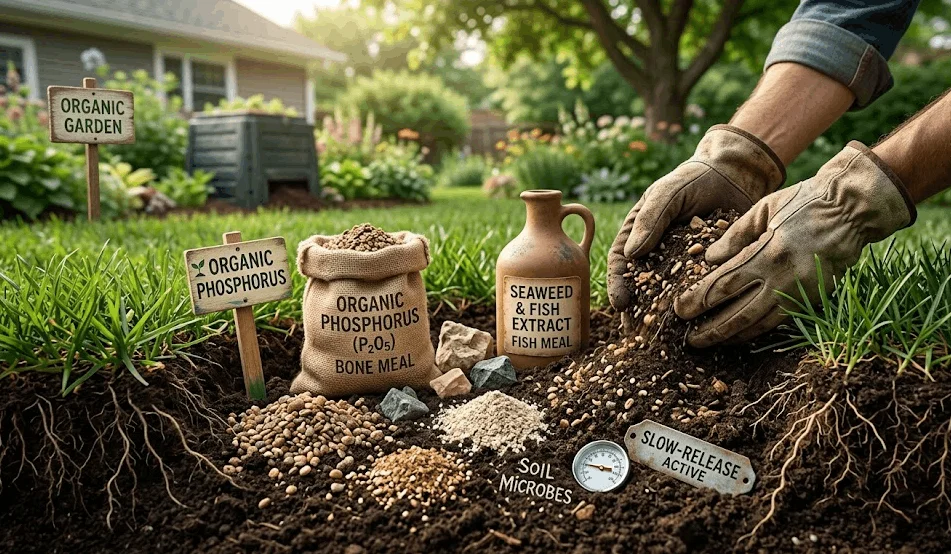
If you prefer to manage your lawn without synthetic inputs, there are effective organic sources of lawn fertilizer phosphorus that build soil health while addressing deficiency at a slower, more stable pace.
| Organic Source | P₂O₅ % | Release Speed | Notes |
|---|---|---|---|
| Bone meal | 12–18% | Slow | Works best in slightly acidic soils |
| Rock phosphate | 20–32% | Very slow | Long-term soil amendment |
| Quality compost | 0.5–2% | Slow | Broad-spectrum soil benefit |
| Fish meal | 4–8% | Moderate | Also contributes nitrogen |
| Poultry manure | 2–4.5% | Moderate | Widely available, cost-effective |
Bone meal is the most commonly used organic phosphorus source for residential lawns. It breaks down gradually, which lowers the risk of surface runoff, and it performs especially well in the slightly acidic soils found across much of the eastern United States.
Rock phosphate works on a longer timeline. It won’t correct an acute deficiency before the growing season, but as a pre-seeding soil amendment it contributes lasting phosphorus availability across multiple seasons without the risk of overapplication.
When working with organic lawn fertilizer phosphorus sources, applying them alongside quality compost helps stimulate the microbial activity that drives nutrient breakdown and release.
Phosphorus Lawn Fertilizer Runoff: A Real Environmental Problem
Phosphorus is a highly mobile nutrient once it leaves the soil. Applied in excess — or applied too close to a rain event — it runs off hard surfaces and flows into storm drains, streams, ponds, and lakes.
Once phosphorus enters a water body, it acts as a fuel source for algae. Growth accelerates, blooms form, oxygen is depleted, and aquatic life suffers. This process — called eutrophication — is one of the most well-documented causes of freshwater degradation across North America and Europe.
Why this matters for homeowners:
- Phosphorus binds to soil particles, and those particles move easily in stormwater runoff.
- Algal blooms reduce dissolved oxygen and are lethal to fish and other aquatic organisms.
- A growing number of municipalities have placed restrictions on phosphorus lawn fertilizers.
- States including Minnesota, Michigan, and Wisconsin have enacted specific phosphorus fertilizer regulations, with violations carrying real penalties.
Responsible application practices:
- Do not apply fertilizer when rain is forecast within 24–48 hours.
- Sweep any fertilizer that lands on pavement back onto the lawn immediately.
- Use slow-release formulations where possible to reduce surface movement.
- Apply only the rate recommended by your soil test.
- Keep a natural vegetated buffer between fertilized areas and any water features.
Responsible use of lawn fertilizer phosphorus isn’t complicated. It mostly comes down to applying only what the soil actually needs, at the right time, in the right place.
How Much Phosphorus Does a Lawn Need Per Season?
The honest answer is: it depends. Phosphorus requirements vary considerably based on several factors, and any flat recommendation without a soil test behind it is more guess than guidance.
Key factors that affect phosphorus needs:
- Soil type — sandy soils hold less phosphorus than clay-heavy soils.
- Existing soil phosphorus levels.
- Grass species — cool-season and warm-season grasses have different nutrient profiles.
- Lawn age and fertilization history.
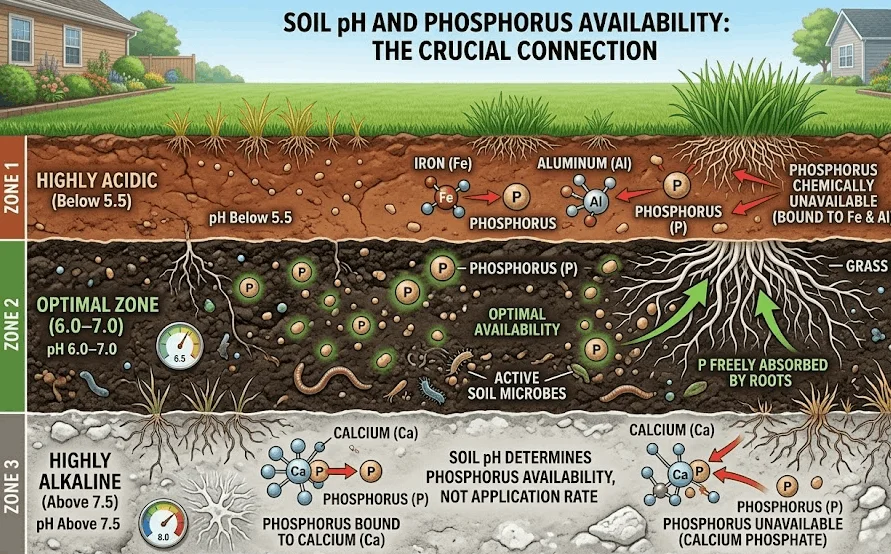
- Soil pH — phosphorus availability drops sharply below 6.0 and again above 7.5.
- Organic matter content, which affects both availability and retention.
General application guidelines based on soil test findings:
- Deficient or new/stripped soil: 1–2 lbs of P₂O₅ per 1,000 sq ft at establishment.
- Low-level deficiency in established lawn: 0.5–1 lb of P₂O₅ per 1,000 sq ft per season.
- Adequate levels confirmed by test: No phosphorus application needed.
- Excessive soil phosphorus: Avoid all phosphorus inputs until levels naturally correct.
Fertilizer labels express phosphorus as P₂O₅, not as elemental phosphorus. If your soil test gives you an elemental phosphorus recommendation, multiply by approximately 2.3 to convert to P₂O₅ equivalent.
Retesting every two to three years is a reasonable schedule. Applied lawn fertilizer phosphorus moves slowly through the soil system — a single corrective application can influence levels for several growing seasons.
Low Phosphorus Lawn Fertilizer Alternatives
When soil tests show adequate or high phosphorus — or when local regulations restrict its use — there is no shortage of effective fertilizer options that support healthy turf without adding more phosphorus to the mix.
Commonly used zero or low phosphorus lawn fertilizers:
- 29-0-4 — high nitrogen for active growth, potassium for stress tolerance, no phosphorus.
- Urea (46-0-0) — pure nitrogen source, widely used for routine greening.
- Sulfur-coated urea — slow-release nitrogen without phosphorus.
- Potassium sulfate (0-0-50) — used when potassium is the only deficit.
- Humic acid-based products — soil conditioners that improve overall nutrient efficiency without adding macronutrients directly.
The move toward phosphorus-free lawn maintenance is becoming more common, especially in lakefront communities and areas under municipal nutrient management programs. And for good reason — most established lawns in organically active soil maintain their own phosphorus balance over time, particularly when grass clippings are returned to the lawn after mowing rather than bagged and removed.
Soil pH and Phosphorus: The Connection Most People Miss
You can apply the best lawn fertilizer phosphorus product on the market, at exactly the right rate, at exactly the right time — and still see no benefit if your soil pH is off.
Phosphorus availability is more sensitive to pH than any other primary nutrient. The relationship is worth understanding before spending money on additional applications.
How soil pH affects phosphorus availability:
- Below 5.5: Phosphorus bonds with iron and aluminum, becoming chemically unavailable.
- 5.5–6.0: Availability begins to improve but is still partially restricted.
- 6.0–7.0: Optimal zone — phosphorus is most available to grass roots.
- 7.0–7.5: Availability starts to gradually decline.
- Above 7.5: Phosphorus binds to calcium and becomes largely unavailable again.
If you’ve applied phosphorus and seen little to no improvement, check your pH before applying more. In many cases, a lime application to raise acidic soil toward the 6.0–7.0 range unlocks the phosphorus that’s already in the soil — without any additional fertilizer cost.
This is one of the most practical and frequently overlooked aspects of lawn nutrient management. Fixing the pH first often makes everything else more efficient.
FAQ: Lawn Fertilizer Phosphorus
Q: Can I apply too much phosphorus to my lawn?
Yes — and it’s more common than most people realize. Excess phosphorus accumulates in soil over time, can suppress the availability of zinc and iron, and flows into waterways during rain events. Soil test first, then apply only what’s recommended.
Q: How do I know if my lawn fertilizer has phosphorus?
Look at the middle number in the NPK ratio printed on the bag. A zero means there’s no phosphorus in that product. Any number above zero represents the percentage of phosphorus by weight, expressed as P₂O₅.
Q: Is phosphorus fertilizer banned where I live?
Several U.S. states have passed restrictions on phosphorus lawn fertilizers, particularly for established lawns. Check with your local cooperative extension service or municipal government for the specific regulations in your area before purchasing.
Q: When is the best time to apply phosphorus fertilizer?
For new lawns, apply at seeding or sod installation. For established lawns with confirmed deficiency, early spring or early fall applications are generally most effective, aligned with active root growth periods.
Q: Does leaving grass clippings on the lawn return phosphorus to the soil?
Yes, it does. Grass clippings contain phosphorus that’s released back into the soil as the organic material breaks down. This natural recycling is one reason many established lawns never develop a true phosphorus deficiency.
Q: What is the difference between organic and synthetic phosphorus fertilizer for lawns?
Synthetic phosphorus fertilizers — such as superphosphate or triple superphosphate — release quickly and are available to grass roots almost immediately. Organic sources like bone meal and rock phosphate release slowly over time, building soil health gradually while carrying a lower risk of runoff or overapplication.
Q: Can poor soil pH make phosphorus fertilizer ineffective?
Yes, and this happens more often than people expect. Phosphorus availability peaks between pH 6.0 and 7.0. Outside that range, phosphorus forms chemical bonds with other minerals in the soil and becomes unavailable to grass roots — regardless of how much you’ve applied.
Conclusion: A Smarter Approach to Phosphorus
After years of watching homeowners apply fertilizer based on what the bag says rather than what the soil actually needs, one pattern stands out clearly: phosphorus is either over-applied out of habit or under-applied during the one time it truly matters — when a new lawn is getting started.
The truth is that lawn fertilizer phosphorus isn’t complicated once you have a soil test in hand. That single document tells you whether to use it, how much to apply, and when to stop. Without it, every fertilizer decision is a guess — and some of those guesses end up in the nearest lake.
For new lawns and seeding projects, prioritize phosphorus from the start and give roots the foundation they need. For established lawns in healthy soil, a zero-phosphorus maintenance product is almost always the right choice. And in both cases, keeping fertilizer off paved surfaces and away from rain events is the kind of simple habit that makes a real difference — for your lawn and the water around it.
Good lawn care is built on observation, testing, and measured action. Phosphorus is just one part of that, but getting it right makes the rest of your lawn program work the way it’s supposed to.