Picking the wrong grow bag size is one of those mistakes that quietly ruins an entire growing season. You start with good intentions — healthy seedlings, quality soil, a consistent watering routine — and still end up with plants that look tired by July and produce a fraction of what they should. More often than not, the problem started before you even put the seedling in the ground. The bag was simply too small.
Tomato grow bag dimensions matter far more than most gardening resources let on. When you grow tomatoes in the ground or in a raised bed, roots can travel freely in search of water and nutrients. Grow bags don’t offer that freedom. Every root has to work within whatever volume of soil you’ve provided. Choose that volume wisely and your plants thrive. Choose poorly and you’ve already set a ceiling on your harvest.
This guide walks through everything — gallon sizes, physical measurements, depth versus width trade-offs, and which bags suit which tomato types — so you can make a confident, informed decision before the growing season begins.
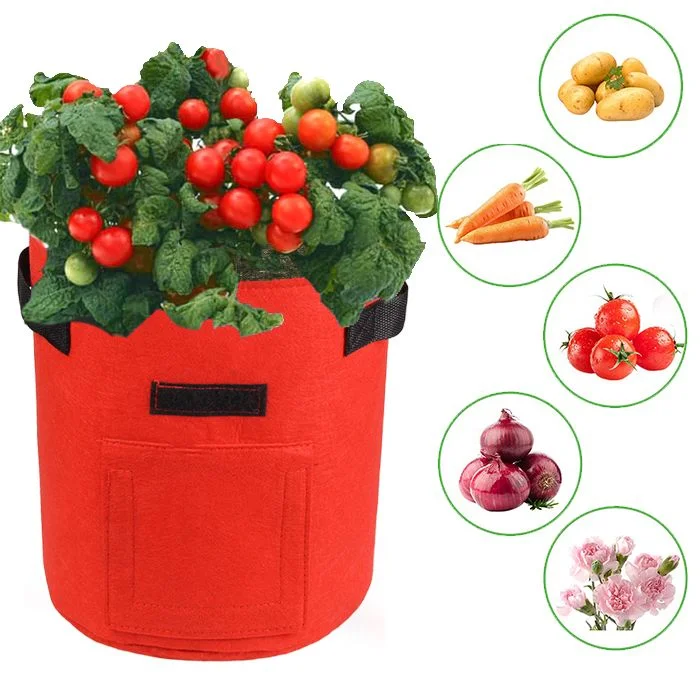
Why Tomato Grow Bag Dimensions Are Non-Negotiable
Tomatoes are not forgiving plants when it comes to root space. A single indeterminate variety — Beefsteak, Cherokee Purple, Sun Gold — can push its root zone 18 to 24 inches deep and spread just as wide when growing conditions are right. Squeeze that same root system into an undersized container and the roots start circling. They compete with each other. Nutrient uptake slows, moisture disappears faster, and the plant begins showing stress in ways that are easy to misdiagnose.
Blossom end rot, inconsistent fruit sizing, premature leaf yellowing — these are often blamed on watering habits or soil nutrition when the real issue is root restriction. Research published through the University of Florida’s IFAS Extension showed a direct relationship between container volume and total tomato yield. Plants in larger containers consistently outproduced those in smaller ones, even when every other growing variable was kept identical.
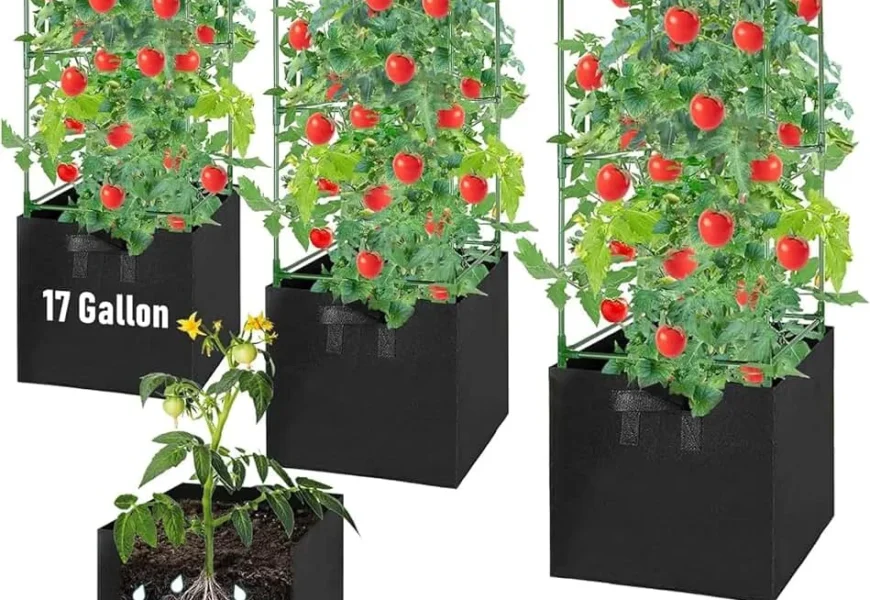
Fabric grow bags add their own consideration. Unlike rigid plastic pots, fabric walls allow air to reach the roots at the perimeter — a process called air pruning. When roots hit that air, they stop elongating and the plant responds by generating more lateral roots. This is genuinely beneficial for plant health, but it only works in your favor when the bag is large enough to give those lateral roots room to develop.
Understanding tomato grow bag dimensions is not a minor detail. It’s the decision that shapes everything else in your container setup.
Standard Tomato Grow Bag Dimensions by Gallon Size
Gallon volume is the clearest way to think about grow bag sizing. Here’s how the most common options translate into physical measurements — and which tomato varieties they realistically support.
5-Gallon Grow Bags
- Typical dimensions: 12 inches wide × 10–11 inches tall.
- Best for: Compact determinate varieties — Roma, Patio, Tumbling Tom, Bush Early Girl.
- Root space: Workable for plants that stay under 2–3 feet.
- Yield potential: Moderate — roughly 4–8 lbs per season with consistent care.
Five gallons is the minimum that makes sense for tomatoes. Some gardeners make it work with dwarf cherry varieties like Tiny Tim or Tumbler, but smaller bags demand daily watering in warm weather and weekly feeding to offset what the restricted soil volume can’t provide on its own.
7-Gallon Grow Bags
- Typical dimensions: 13–14 inches wide × 11–12 inches tall.
- Best for: Mid-size determinate varieties and smaller cherry tomatoes.
- Root space: Comfortable for plants reaching up to 4 feet.
- Yield potential: A noticeable step up from 5-gallon with less daily maintenance.
The 7-gallon size occupies a useful middle position. It’s still light enough to move around a patio or balcony but offers enough volume to carry a plant through a full season without the constant crisis management that smaller bags often require.
10-Gallon Grow Bags
- Typical dimensions: 15–16 inches wide × 12–14 inches tall.
- Best for: Most determinate varieties; compact indeterminate types like Sweet Million or Celebrity.
- Root space: Comfortable for most tomatoes staying under 5 feet.
- Yield potential: High — this is where home gardeners typically see the most satisfying results.
For most gardeners growing a standard slicing tomato, understanding tomato grow bag dimensions makes the 10-gallon bag the practical sweet spot — enough root volume without becoming difficult to manage or reposition.
15-Gallon Grow Bags
- Typical dimensions: 17–19 inches wide × 14–15 inches tall.
- Best for: Vigorous indeterminate varieties — Beefsteak, Big Boy, Brandywine, most heirloom types.
- Root space: Generous enough to support a full growing season without visible restriction.
- Yield potential: Very high — approaching what you’d expect from a small raised bed.
20-Gallon Grow Bags
- Typical dimensions: 20–22 inches wide × 15–16 inches tall.
- Best for: Large indeterminate vines; multiple plants per bag; high-output container setups.
- Root space: Excellent — the closest a grow bag comes to open-ground conditions.
- Yield potential: Maximum output for container growing.
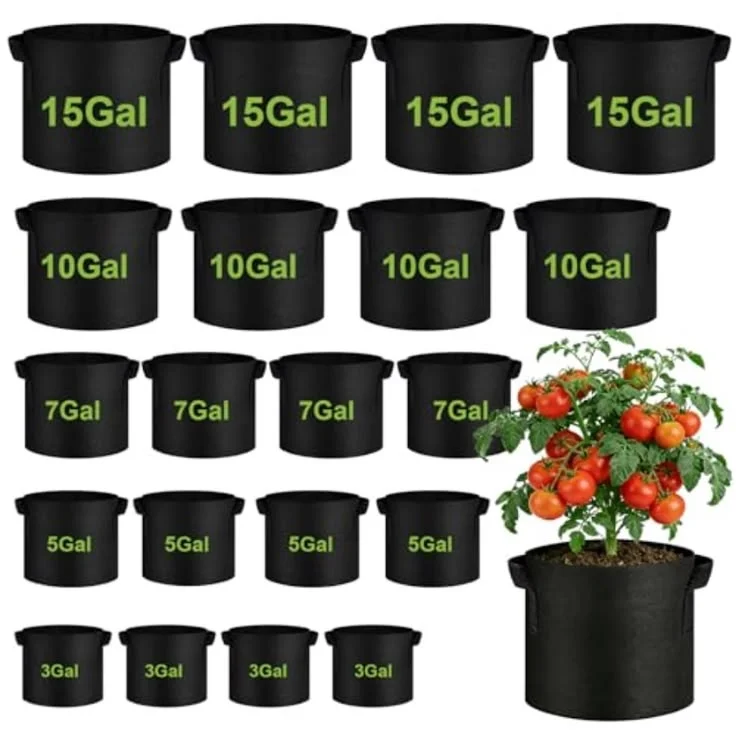
Comparison Table: Tomato Grow Bag Dimensions at a Glance
| Gallon Size | Width | Height | Best Tomato Type | Watering Frequency |
|---|---|---|---|---|
| 5 gal | ~12 in | ~10 in | Compact determinate | Daily in summer |
| 7 gal | ~14 in | ~12 in | Determinate, cherry | Every 1–2 days |
| 10 gal | ~16 in | ~14 in | Most determinate types | Every 2 days |
| 15 gal | ~18 in | ~15 in | Indeterminate, heirloom | Every 2–3 days |
| 20 gal | ~21 in | ~16 in | Large indeterminate | Every 2–3 days |
Depth vs. Width: Which Dimension Matters More?
Most conversations about tomato grow bag dimensions get absorbed by total gallon volume, but the shape of that volume is a separate and equally important question. Tomatoes are genuinely deep-rooted plants. The primary taproot pushes downward first, and lateral roots extend from there. A bag that is wide but shallow can hold 10 gallons of soil while still preventing the plant’s most important root growth from happening.
The practical minimum: 12 inches of depth for determinate varieties, 14–15 inches for indeterminate types.
When comparing two bags with similar gallon ratings but different proportions, the taller bag almost always serves tomatoes better. Deep soil holds moisture more reliably — the lower layers stay cooler and wetter far longer than surface soil, which becomes critical during late-summer heat. A plant with roots in deeper, stable soil handles a hot week far better than one confined to a wide, shallow container.
Width becomes more relevant when you’re considering planting two tomatoes in a single bag. That setup typically requires at least a 20-gallon container with a diameter of 22 inches or more to avoid serious root competition between plants.
5-Gallon vs. 10-Gallon Grow Bags for Tomatoes: A Real Comparison
This is genuinely one of the most common questions in container gardening, and it deserves a straight answer rather than a cautious hedge. For most tomato varieties, a 10-gallon bag outperforms a 5-gallon bag in almost every measurable way.
In a 5-gallon grow bag:
- Soil dries out quickly — twice-daily watering is realistic in July and August.
- Nutrients leach out faster and need more frequent replacement.
- Root zone temperatures spike higher and drop lower with outdoor temperature swings.
- Total yield typically runs 30–50% lower than the same variety in a 10-gallon bag.
In a 10-gallon grow bag:
- Soil moisture stays stable for longer between waterings.
- The root system develops more fully, supporting stronger fruit production.
- Consistent moisture means less nutrient leaching and more efficient feeding.
- Fruit set remains steadier from early summer through fall.
The exception is genuinely compact varieties — Tiny Tim, Tumbling Tom, Patio — where a 5-gallon is adequate. For anything larger, getting tomato grow bag dimensions right means the move from 5 to 10 gallons is one of the most practical upgrades a container gardener can make.
Tomato Root Space in Grow Bags: What’s Actually Happening Underground
When we talk about tomato grow bag dimensions, we are really talking about the quality of the root environment. Most of the visible problems that frustrate container tomato growers — yellowing leaves, poor fruit set, wilting despite regular watering — originate below the soil surface, where no one is looking.
A healthy tomato root system needs several things working together:
- Volume: At least 5 gallons for compact types; 10–15 gallons for full-size plants.
- Depth: 12 inches minimum of unobstructed, well-draining soil.
- Aeration: Fabric walls enable air pruning, which keeps roots branched and active.
- Drainage: Waterlogged roots deteriorate within days; fabric bags drain from all surfaces simultaneously.
- Temperature stability: Greater soil volume buffers roots against sharp temperature swings during heat waves or cool nights.
The air-pruning benefit of fabric containers is real and well-supported. Plants grown in fabric pots consistently develop denser, more fibrous root systems than equivalent plants in plastic containers. That root density translates directly into better water absorption, more efficient nutrient uptake, and plants that hold up better under stress.
Fabric Pot Dimensions for Tomato Gardening: What to Check Before You Buy
The fabric grow bag market has grown considerably, and product quality varies widely. When evaluating tomato grow bag dimensions from a specific product, the label should clearly state:
- Gallon capacity (or liters — 38L is approximately 10 gallons).
- Diameter when filled (not flattened).
- Height when filled.
- Fabric weight in GSM (grams per square meter).
GSM is often overlooked, but it matters. A minimum of 300 GSM is worth insisting on for tomatoes. Bags below 200 GSM tend to deform under the weight of moist soil — the walls bow outward, the bag loses its stated height, and root development suffers as a result. Heavier fabric also holds up better across multiple growing seasons, making it genuinely more economical over time.
One practical detail that often goes unmentioned: handles. On bags 15 gallons and larger, reinforced handles are not a luxury when managing tomato grow bag dimensions at this scale. A filled 20-gallon bag is a serious weight. Moving it without proper handles risks tearing the fabric and compressing the root zone at exactly the wrong moment in the season.
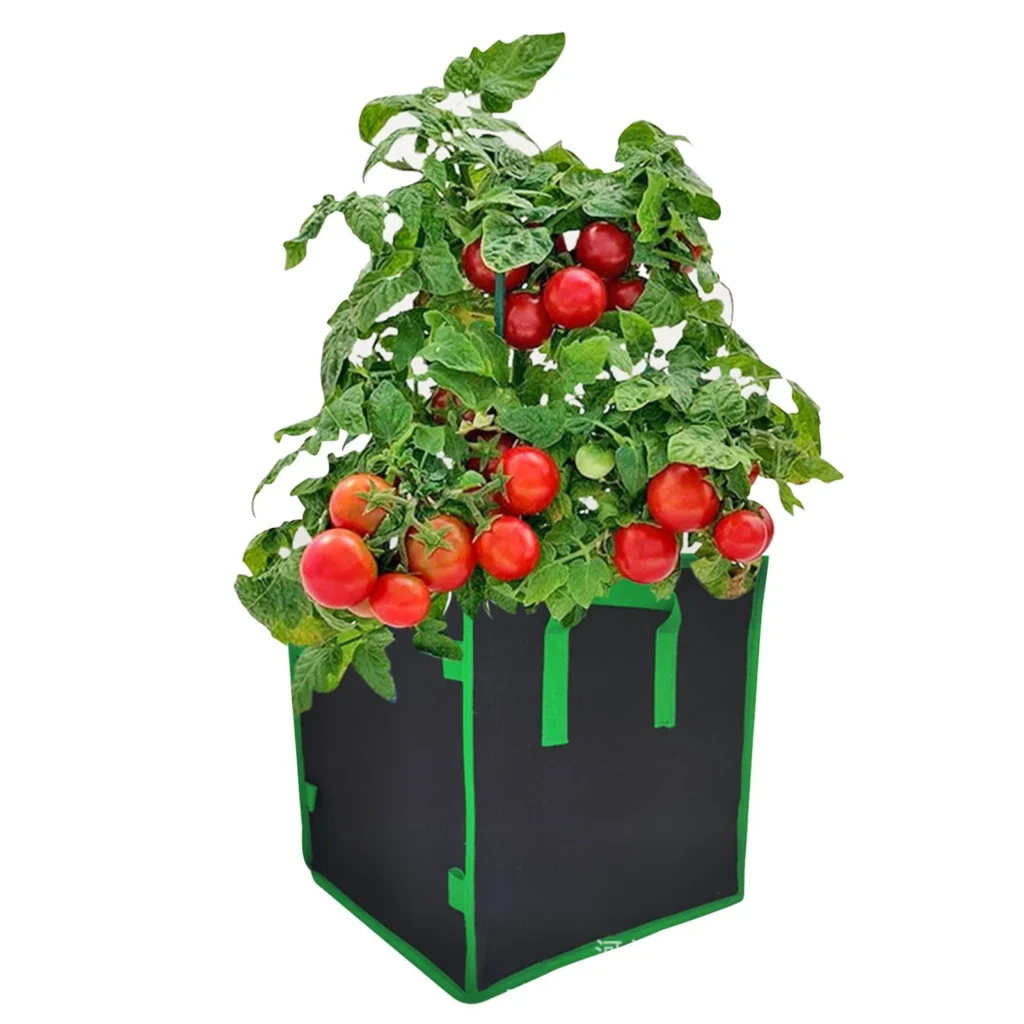
Grow Bag Volume Recommendations for Indeterminate Tomatoes
Indeterminate tomato varieties are in a category of their own when it comes to root space requirements. These are plants that continue growing, flowering, and producing fruit throughout the entire season — Brandywine, Cherokee Purple, Mortgage Lifter, Black Krim, most heirloom selections. They are vigorous, sometimes reaching 6 feet or more, and their root systems grow proportionally.
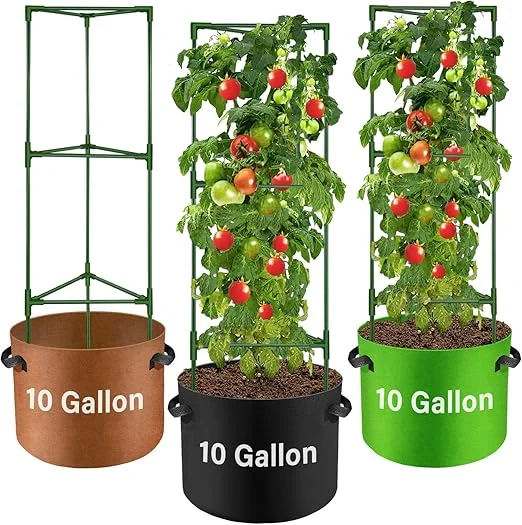
For indeterminate types, the minimum recommended tomato grow bag dimensions are:
- Volume: 15 gallons (20 gallons for premium yield).
- Depth: 14–16 inches.
- Width: 18–22 inches.
What often happens with indeterminate tomatoes in undersized bags is a slow deterioration that starts mid-season. A Beefsteak plant might look acceptable through June in a 10-gallon bag, but by mid-August the signs appear — lower leaves yellowing, fruit that won’t size up, inconsistent set. That same plant in a 15-gallon bag with otherwise identical conditions frequently produces twice the harvestable fruit before frost.
For gardeners working with limited space who can only fit 10-gallon bags, the practical answer is to choose semi-determinate varieties like Celebrity, Jet Star, or Patio F. These produce a concentrated flush of fruit over a defined period and have notably more modest root requirements than open-ended indeterminate types.
Large Grow Bag Measurements for Vegetable Gardens: Planning Beyond Tomatoes
If you are setting up a broader container vegetable garden and want to settle on a size that handles multiple crops well, a 15-gallon grow bag is the most adaptable choice. At roughly 18 inches wide by 15 inches tall, it comfortably supports:
- All tomato varieties with attentive management.
- Peppers and eggplant, both of which respond well to extra root space.
- Cucumbers and summer squash in a single-plant setup.
- Large herb clusters — basil, parsley, chives.
- Brassicas including kale and compact broccoli.
The 10-gallon is the next most versatile option, handling most determinate tomatoes along with virtually every pepper, carrot, or herb you’d want to grow. Purchasing bags in multipacks from wholesale suppliers tends to reduce the per-bag cost significantly when you’re outfitting a full growing space.
Common Sizing Mistakes and How to Avoid Them
1. Sizing by the plant’s canopy, not its root system A compact cherry tomato in a 5-gallon bag looks perfectly proportioned above ground. By midsummer, the root system is out of space and the plant is struggling. Always size for roots, not for what you see above the soil line.
2. Trusting labels that say “tomato bag” without reading the specs Some products marketed specifically for tomatoes are only 3–5 gallons. The label tells you the intended use; the dimensions tell you whether it will actually deliver. Check both.
3. Treating all 10-gallon bags as equivalent A wide, shallow 10-gallon bag performs very differently from a tall, narrower one. For tomatoes specifically, prioritize height when the proportions diverge.
4. Underestimating the impact of fabric quality Thin bags compress over time. As the walls bow and deform, the effective soil depth and volume decrease. The initial cost difference between 200 GSM and 300+ GSM fabric is small; the performance difference across a season is significant.
5. Filling bags to the brim Leaving 1–2 inches of headspace at the top prevents soil from washing out during watering and preserves space for a mid-season top dressing of compost.
Quick Reference: Choosing Your Tomato Grow Bag Dimensions
| Tomato Type | Examples | Minimum Bag | Recommended Bag |
|---|---|---|---|
| Compact/Dwarf | Tiny Tim, Tumbling Tom | 5 gal | 7 gal |
| Determinate | Roma, Bush Early Girl | 7 gal | 10 gal |
| Semi-determinate | Celebrity, Jet Star | 10 gal | 12–15 gal |
| Indeterminate | Beefsteak, Brandywine | 15 gal | 20 gal |
| Cherry (vigorous) | Sun Gold, Sweet Million | 10 gal | 15 gal |
Frequently Asked Questions
Q: What is the best size grow bag for tomatoes?
For most home gardeners growing standard slicing or cherry tomatoes, a 10-gallon grow bag — approximately 15–16 inches wide and 12–14 inches tall — offers the best balance of performance and ease of management. Indeterminate varieties are better served by 15 or 20 gallons.
Q: Can I grow tomatoes in a 5-gallon grow bag?
Yes, but realistically only for compact or dwarf determinate varieties. Standard slicing tomatoes and indeterminate types in 5-gallon bags will produce noticeably less fruit and require daily watering once summer temperatures climb.
Q: How deep should a grow bag be for tomatoes?
At least 12 inches for determinate varieties. For indeterminate types, 14–16 inches of usable soil depth gives the root system what it needs to support a full season of production.
Q: What are the dimensions of a 10-gallon grow bag?
Most 10-gallon grow bags measure 15–16 inches in diameter and 12–14 inches in height when properly filled. Exact measurements vary slightly depending on the manufacturer and fabric construction.
Q: Can I plant two tomatoes in one grow bag?
Only in bags 20 gallons or larger. Two plants sharing a 10-gallon bag will compete directly for water and nutrients, reducing the output of both. A 20-gallon bag at roughly 21 inches wide can support two compact determinate plants spaced 10–12 inches apart.
Q: Are fabric grow bags better than plastic containers for tomatoes?
Generally, yes. Fabric bags offer better drainage, air pruning of roots, and more stable root zone temperatures compared to plastic pots of the same volume. The practical trade-off is that fabric bags dry out faster, which calls for slightly more attentive watering.
Q: How many gallons does a tomato plant need?
A simple baseline: 5 gallons for dwarf varieties, 10 gallons for determinate types, and 15–20 gallons for indeterminate varieties that grow through the entire season.
Conclusion
Getting tomato grow bag dimensions right is one of those decisions that doesn’t feel critical until it is. By the time a plant is visibly stressed in midsummer, you’ve already lost weeks of productive growing time and a portion of your harvest. The good news is that this is entirely avoidable with a straightforward size decision made before planting begins.
The core principle is simple: match the bag volume to the root system, not the visible size of the plant. For most home gardeners, a 10-gallon bag handles a wide range of determinate tomatoes with room to spare. Step up to 15 or 20 gallons for indeterminate and heirloom varieties, and you’ll likely be surprised at how much more productive the same plant becomes when it has the root space it actually needs.
Pay attention to depth as well as width, invest in fabric that holds its shape across a season, and don’t treat all bags of the same gallon rating as equal. Those small distinctions add up to a measurable difference in what ends up on your table at harvest time. Container tomato growing, done with the right setup, can be genuinely rewarding — and choosing the correct tomato grow bag dimensions from the start is the single most impactful step in that process.