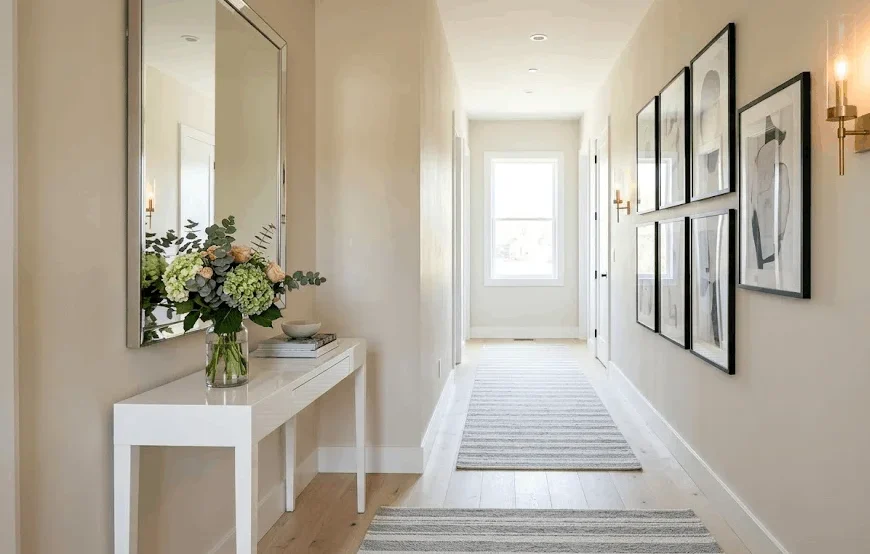
You walk into your home every single day through that hallway. And every single day, it feels a little too tight, a little too dark, and honestly — kind of boring. You’re not alone. According to Houzz, 74% of homeowners say the hallway is the most neglected space in their entire home.
Here’s the thing: narrow hallway decor doesn’t have to be complicated. You don’t need to knock down walls or spend a fortune. With the right combination of lighting, mirrors, color, and smart furniture choices, even a hallway that’s barely 3 feet wide can feel open, welcoming, and stylish.
This guide walks you through exactly how to do that — practically, affordably, and without anything that’ll make your hallway feel more cluttered than it already does.
Why Narrow Hallway Decor Is Harder Than It Looks
Most people treat their hallway like an afterthought. They throw up a coat hook, maybe a small rug, and call it done. But narrow hallway decor actually requires more intentional thinking than a regular room — because every inch matters.
The core challenge? A narrow hallway has competing problems all happening at once:
- Not enough width to move freely.
- Usually poor lighting, which makes it feel smaller.
- Walls that feel like they’re closing in.
- No obvious place to store things like shoes, bags, or keys.
What makes it harder is that most design advice online shows you beautiful hallways that are actually 5–6 feet wide. Your hallway might be closer to 36 inches. That’s a completely different design problem.
The good news is once you understand why a hallway feels tight, fixing it becomes much more straightforward. Everything in this guide is built around that principle — make it feel bigger, brighter, and more functional without adding bulk.
Start With Small Entryway Ideas Before You Buy Anything
Before you touch a single wall or order anything online, take 10 minutes to actually look at your hallway. Measure the width. Note where the light switches are. Check how much natural light comes in (probably very little).
Here’s a simple framework for small entryway ideas that applies to almost any narrow hallway:
The Rule of Three:
- One thing that adds light.
- One thing that adds depth or visual space.
- One thing that adds function (storage or organization).
If every piece of decor you add hits at least one of these, your hallway will improve. If something doesn’t hit any of them, it’s probably clutter in disguise.
What to Measure Before You Shop
- Width of your hallway — anything under 42 inches needs slim or wall-mounted furniture only.
- Wall height — taller ceilings are your friend; use them with tall vertical art or tall mirrors.
- Natural light source — if there’s a window at the end, design toward it, not against it.
These three measurements will save you from buying furniture that doesn’t fit and decor that makes things worse.
Hallway Wall Decor: The Fastest Way to Transform the Space
Your walls are doing nothing right now. In a narrow hallway, the walls are the room. They’re what you see first, and they’re where most of your design impact is going to come from.
Good hallway wall decor does two things simultaneously: it looks great and it makes the space feel larger. Here’s how to get both.
Go Vertical, Not Horizontal
This is the biggest mistake people make with narrow hallway decor. They hang art at eye level, horizontally — and it makes the hallway feel wider but shorter, which isn’t what you want.
Instead, hang a tall, vertical piece of art or a series of frames stacked vertically. This draws the eye up, making your ceiling feel higher and your hallway feel longer in the right way.
Mirror Placement Hallway Tips
Mirrors are the single most effective tool in narrow hallway decor. But placement matters more than size.
What works:
- One large mirror on a short wall (like the wall at the end of the hallway) — this creates the illusion the hallway continues.
- A full-length mirror leaned against the wall saves drilling and looks intentional.
- Mirrors placed opposite a light source double the light in the space.
What doesn’t work:
- Two mirrors facing each other (creates an infinite tunnel effect — unsettling, not beautiful).
- Tiny decorative mirrors that don’t add enough visual impact.
- Mirrors placed too high where they only reflect the ceiling.
A well-placed mirror can make your narrow hallway decor feel like a completely different space. It’s not cliché — it genuinely works when done right.
Hallway Storage Solutions That Don’t Eat Up Space
Storage is the practical heart of any hallway. Keys, bags, shoes, umbrellas — everything lands here when you walk through the door. But in a narrow hallway, the wrong storage makes everything worse.
The best hallway storage solutions for tight spaces follow one rule: go up, not out.
Thin Hallway Furniture That Actually Fits
A standard console table is usually 12–15 inches deep. That’s too deep for most narrow hallway decor ideas. Look for:
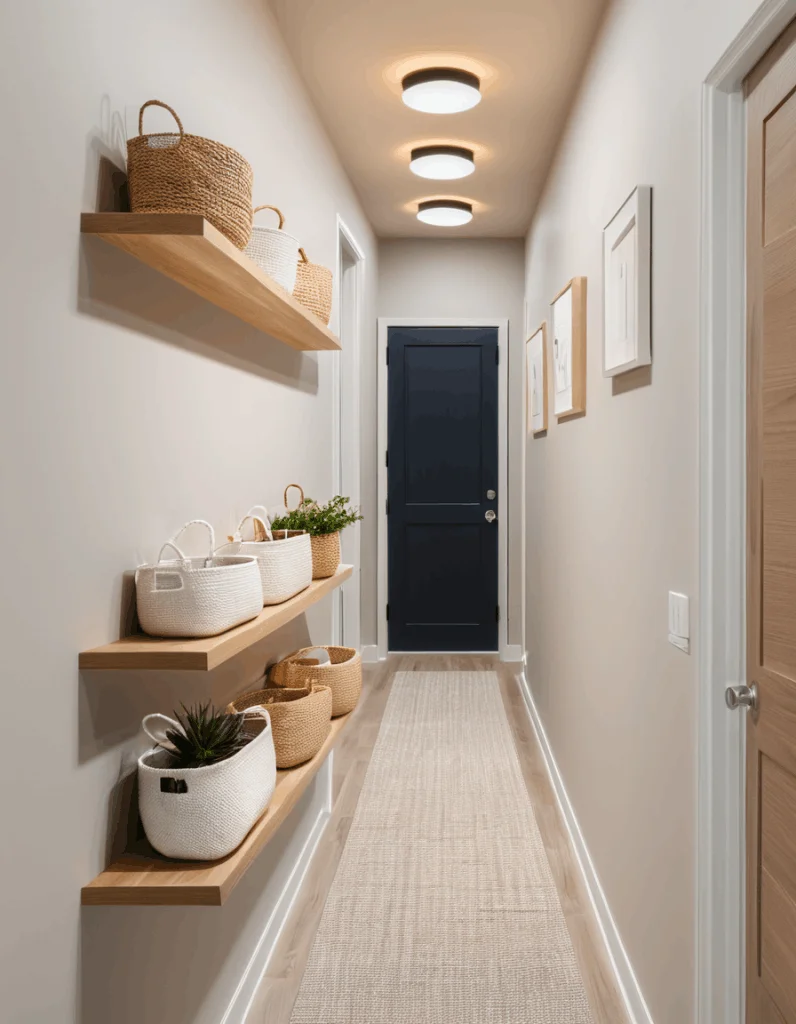
- Floating shelves — zero floor footprint, great for keys and small items.
- Wall-mounted coat racks — keeps bags and coats off the floor.
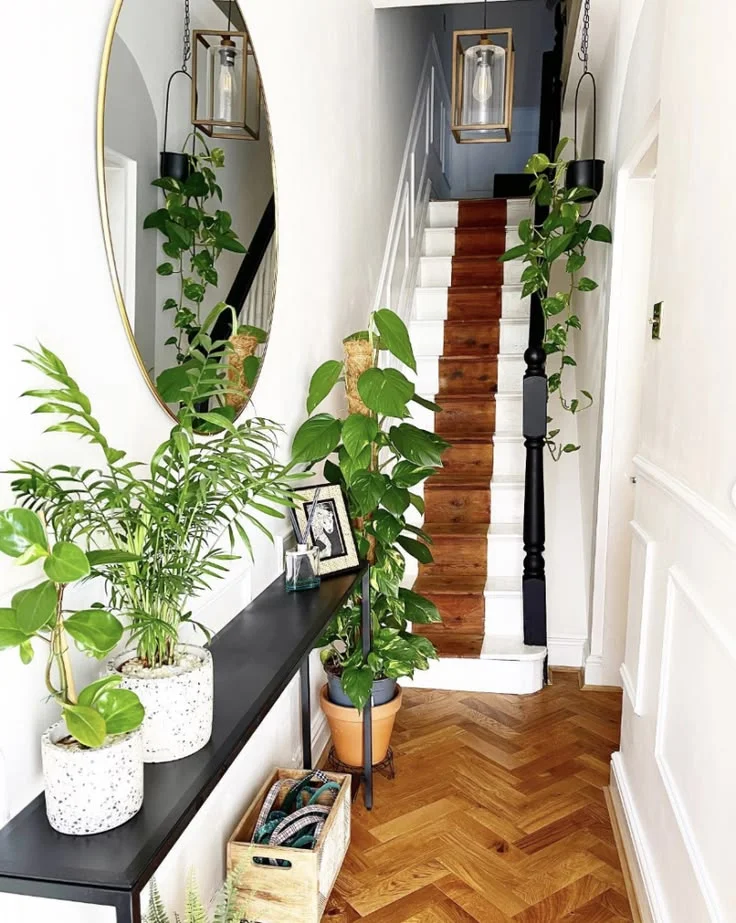
- Slim console tables (under 10 inches deep) — they exist, and they’re worth searching for.
- Hooks with a small shelf above — combines two functions in one wall mount.
If your hallway is under 36 inches wide, skip floor furniture entirely. Thin hallway furniture is great in concept, but wall-mounted options give you the same function with zero space cost. Every inch of floor space you free up makes the hallway feel noticeably wider — it is one of those small decisions that has a surprisingly big visual payoff the moment you make it.
Think of your walls as free real estate that most people completely ignore — the moment you start using them smartly, your whole hallway opens up in a way that no floor furniture ever could.
The Shoe Problem
Shoes are the biggest source of hallway chaos. A small floating bench with hooks above it — or a wall-mounted shoe pocket organizer — keeps things tidy without blocking the path. Even a simple basket tucked near the door is better than shoes scattered across the floor.
Hallway Lighting Ideas That Make Everything Better
Lighting is where most narrow hallways go completely wrong. The standard single overhead light fixture creates harsh shadows, makes the space feel clinical, and does nothing for the feeling of depth.
Good hallway lighting ideas layer light at different heights, the same way good interior designers do in any room.
Three Layers of Hallway Lighting
1. Overhead light (ambient): Keep this but switch to a warmer bulb (2700K–3000K). Cool white light makes narrow spaces feel harsh and smaller.
2. Wall sconces (mid-level): These add warmth and depth. Even one sconce halfway down the hallway dramatically changes the feel. Plug-in versions exist for renters — no drilling needed.
3. Floor-level accent light: Small LED strip lights along the floor or under a floating shelf add a sense of depth and dimension, especially at night.
The goal is to eliminate that “dark tunnel” feeling. Layered lighting turns your narrow hallway decor from flat and forgettable into warm and intentional. It is one of those changes that costs very little but makes every single person who walks through your front door stop and notice — even if they cannot quite explain why.
Good lighting does not just illuminate a space, it completely changes how that space makes you feel the moment you step inside.
Small Hallway Paint Colors: The Choices That Actually Open Up Space
Paint is the cheapest, highest-impact change you can make. But the advice to “always use white in small spaces” is oversimplified. Here’s what actually works for small hallway paint colors.
Light Colors — But Not Just White
Off-whites, pale grays, soft warm beiges, and very light sage greens all work well. Pure bright white can feel cold and stark, especially without natural light. A warm white like Benjamin Moore’s “White Dove” or Sherwin-Williams “Alabaster” feels open without feeling clinical.
The Bold Alternative
Here’s what most guides won’t tell you: dark paint can work beautifully in narrow hallways. A deep navy, forest green, or charcoal makes the walls “disappear” and creates a cozy, intentional atmosphere — like a boutique hotel corridor.
The key is going all in. Paint the ceiling the same dark color. Add warm lighting. The hallway stops feeling small and starts feeling deliberately designed.
For most people, light paint colors are the safer, easier choice. But if you want your narrow hallway decor to feel genuinely distinctive, a dark accent color deserves consideration. Think deep emerald green, moody charcoal, or a rich terracotta — these shades add personality and depth that no beige wall ever could.
The secret is committing fully — half-hearted dark paint in a narrow hallway just looks like a mistake, but when you own it with matching trim and warm lighting, it looks completely intentional and seriously impressive. If you are nervous about going dark on all four walls, start with just the end wall as a bold focal point — it adds drama without making the whole hallway feel like a cave.
Entryway Runner Rug and Hallway Flooring Ideas
The floor is the longest visual element in your hallway, and it’s doing a lot of work for your overall design.
Entryway Runner Rug
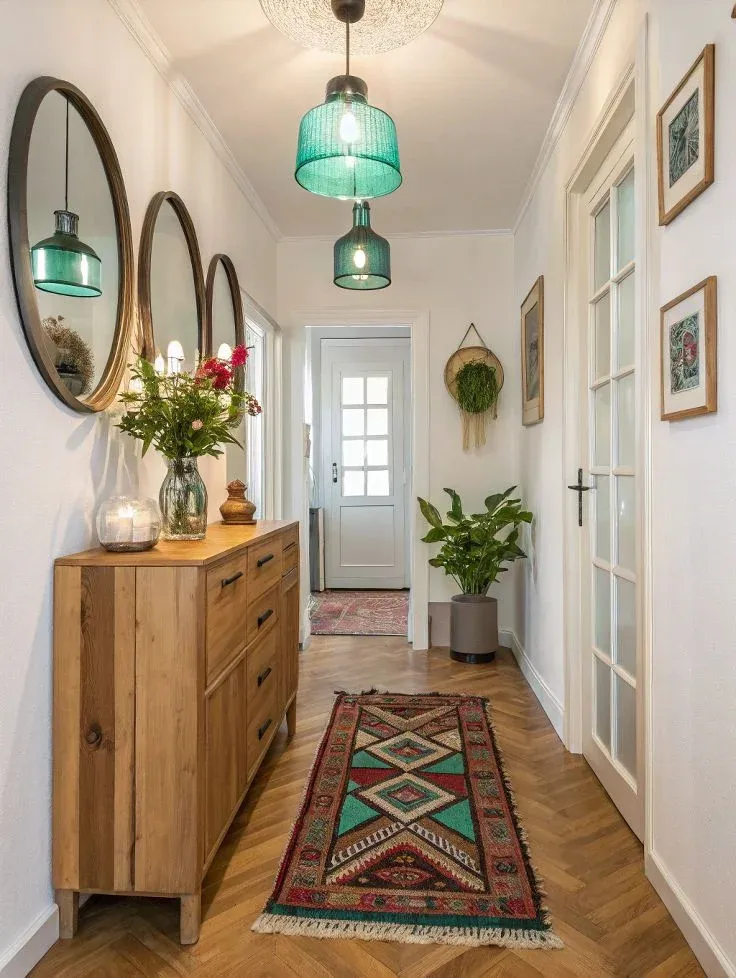
A runner rug is one of the best additions to any narrow hallway. Here’s why: it creates a visual “lane” that actually makes the hallway feel more intentional and slightly wider by contrast.
Sizing matters:
- Leave 4–6 inches of floor visible on each side of the rug.
- Length should cover at least 80% of the hallway’s length.
- Low-pile rugs work better in narrow spaces — they don’t add visual bulk.
Pattern choice: Stripes running lengthwise down the hallway make it feel longer and more spacious. Geometric or small-scale patterns work well too. Avoid large, bold patterns that overwhelm a tight space. If you are stuck between two patterns, always go with the smaller scale option — it gives visual interest without competing with your walls or furniture.
A good rule of thumb is that your rug pattern should whisper, not shout — it is there to support the space, not dominate it. And if your hallway already has busy wallpaper or bold paint, go with a solid colored runner in a warm neutral like sand, ivory, or soft charcoal to keep everything balanced and calm.
Hallway Flooring Ideas
If you’re renovating or replacing flooring:
- Light wood or light-toned tile opens the space up dramatically.
- Diagonal tile laying creates an optical illusion of more width.
- Continuous flooring (same material from the hallway into adjacent rooms) removes visual breaks and makes everything feel larger.
Even without renovation, a good runner rug transforms cheap or dated hallway flooring instantly. It hides scratches, worn patches, and outdated tiles in one simple move — no contractor, no mess, no stress. Think of it as the quickest, most affordable flooring upgrade you can make on a Saturday morning before lunch.
Long Corridor Design: When Your Hallway Feels Like a Tunnel
Some hallways aren’t just narrow — they’re long. This creates a different problem: the tunnel effect, where you’re looking down a long, narrow box with no visual relief.
For long corridor design, the trick is to break up the length visually:
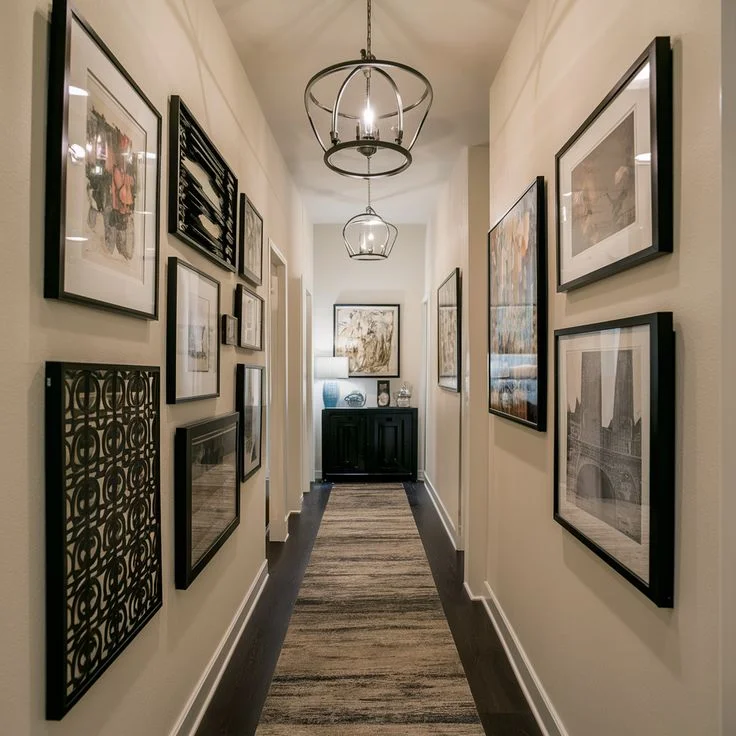
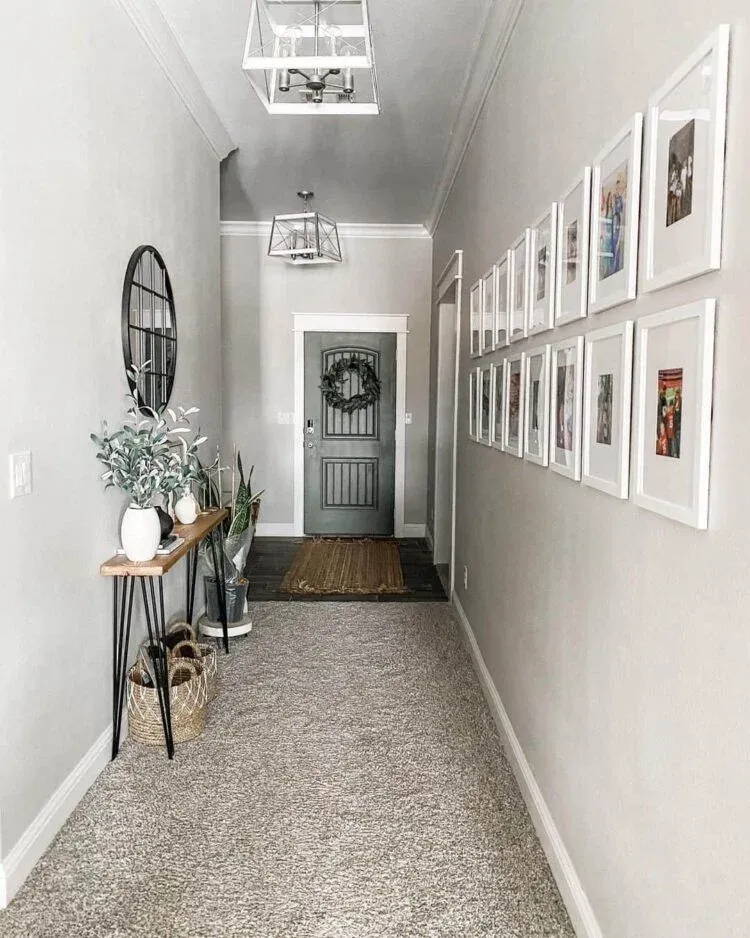
- Art gallery wall on one side — a series of framed photos or prints creates natural “stopping points” for the eye.
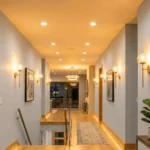
- Alternating lighting — sconces or pendants at regular intervals break the monotony.
- A single focal point at the end — a piece of art, a mirror, or even a plant draws the eye toward a destination rather than into a void.
One thing that works surprisingly well: a small plant or vase of flowers at the end of the hallway. It gives the eye something to land on and makes the space feel lived in.
A trailing pothos or a simple eucalyptus stem in a slim vase works perfectly — low maintenance, affordable, and genuinely beautiful. Plus, a touch of greenery brings life and freshness into a space that could otherwise feel a little cold and forgotten.
Narrow Hallway Decor for Renters: No-Drill Solutions
If you’re renting, most of the advice above still applies — with a few adaptations.
- Command strips and hooks hold significant weight now and are renter-safe for most wall decor.
- Leaning mirrors instead of hung mirrors — no hardware needed.
- Freestanding coat racks (slim profile) instead of wall-mounted hooks.
- Peel-and-stick wallpaper on one accent wall can completely transform a hallway without damaging anything.
- Plug-in wall sconces give you the layered lighting look without any electrical work.
Renters often feel like they can’t do much with narrow hallway decor — but honestly, most of the highest-impact changes (lighting, mirrors, rugs, color) are fully renter-friendly.
FAQs: Narrow Hallway Decor
Q1: What is the best color for a narrow hallway?
Warm whites, soft beiges, and pale grays are the most reliable choices for narrow hallways. They reflect light and create an open feel. If you want something bolder, dark tones like navy or forest green can work beautifully when paired with warm lighting and kept consistent on the ceiling too.
Q2: How do I make my narrow hallway look wider?
The most effective tricks are: hanging a large mirror on a short wall, using stripes on a runner rug that run lengthwise, painting in light colors, and keeping the floor clear of clutter. Layered lighting also makes a dramatic difference in how spacious a narrow hallway decor feels overall.
Q3: What furniture works in a hallway under 36 inches wide?
Skip floor furniture and go wall-mounted instead. Floating shelves, wall-mounted coat hooks, and slimline key holders keep things functional without blocking the path. If you need a surface, look for slim console tables under 10 inches deep — they exist and fit far better than standard options.
Q4: Do mirrors actually make a hallway look bigger?
Yes — genuinely. A well-placed mirror reflects light and creates depth, making the space feel like it continues beyond the wall. Research suggests mirrors can increase perceived room size by 30–40%. Place it at the end of the hallway or opposite a light source for maximum effect.
Q5: Can I decorate a narrow hallway if I’m renting?
Absolutely. Command strips, leaning mirrors, plug-in sconces, peel-and-stick wallpaper, and freestanding coat racks are all renter-safe options. Most of the biggest impact changes in narrow hallway decor — lighting, rugs, and mirrors — don’t require drilling or permanent alterations at all.
Conclusion: Your Narrow Hallway Has More Potential Than You Think
Here’s the honest truth: most narrow hallways are neglected not because they’re hopeless, but because people don’t know where to start. Once you have a plan, it comes together faster than you’d expect.
Start with paint and lighting — those two changes alone will transform how your space feels. Then add a mirror and a runner rug. From there, layer in narrow hallway decor details like wall hooks, slim furniture, and a few pieces of art.
You don’t need to do everything at once. Pick one section this weekend. Maybe it’s just swapping your light bulb to a warmer tone and hanging one vertical piece of art. That’s enough to start seeing what’s possible.
A well-designed hallway sets the tone for your entire home. It’s the first thing you see when you walk in — it should feel good.