Growing strawberries doesn’t require a large garden or a lot of outdoor space. A sunny balcony, a small patio, or even a bright windowsill is enough to get started. If you haven’t tried strawberry bag grow yet, you’re missing one of the most practical and rewarding approaches to home fruit growing available today.
Bag growing has grown steadily popular among home gardeners — not because of trends, but because it works. It’s cost-effective, highly flexible, and when managed well, genuinely productive. This guide walks you through everything you need to know, from selecting the right bag to pulling your first ripe berry off the plant.
Why Strawberry Bag Grow Outperforms Traditional Garden Beds
Many gardeners assume that growing directly in the ground always produces better results. For strawberries specifically, that assumption often doesn’t hold up.
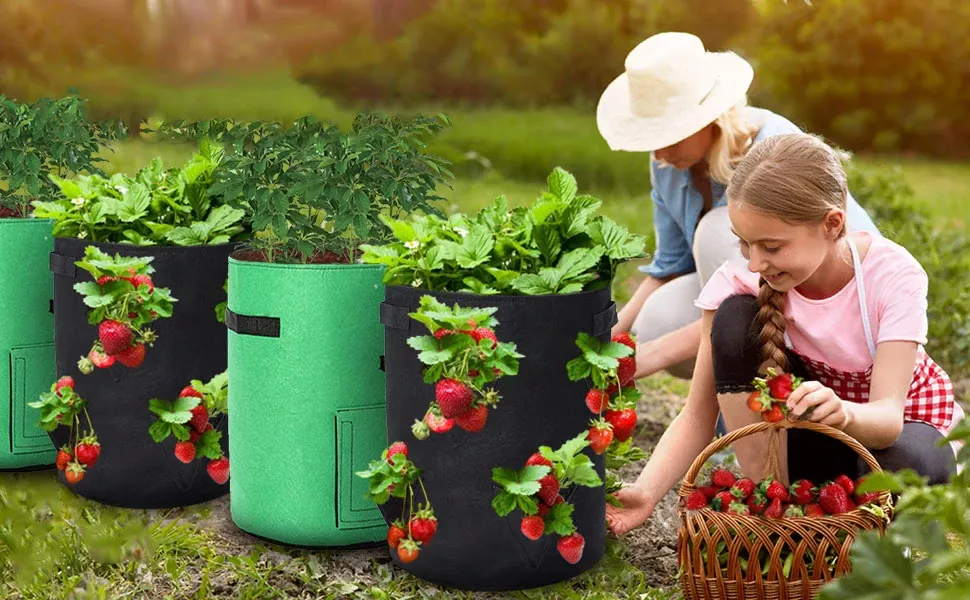
Bag growing gives you a level of control that open garden beds simply can’t match. Here’s why experienced growers are increasingly making the switch:
- Drainage control: Strawberry roots are highly sensitive to waterlogged conditions. A good grow bag drains far more effectively than compacted garden soil, reducing the risk of root stress significantly.
- Pest and disease management: Ground-level slugs, soil-borne pathogens, and persistent fungal problems are noticeably reduced when plants are grown in bags.
- Temperature flexibility: Unlike fixed beds, bags can be moved indoors before a frost arrives or repositioned throughout the day to follow the best light.
- Root health through air pruning: Fabric bags allow roots to reach the bag wall and naturally stop growing — a process called air pruning. This stimulates a denser, more productive root system over time.
- Space efficiency: Bags can be stacked, suspended, or lined along a fence or wall without committing permanent garden space to the crop.
Once you understand what strawberry bag grow offers in terms of control and adaptability, it becomes a natural choice for both beginners and seasoned growers working with any size of outdoor space.
Choosing the Right Strawberry Planter Bag
The bag itself is the foundation of your growing system. Choosing the wrong type wastes time, money, and an entire growing season. The options available vary considerably in material, design, and intended use — so it pays to understand what each type offers before committing.
Felt Grow Bag Strawberries
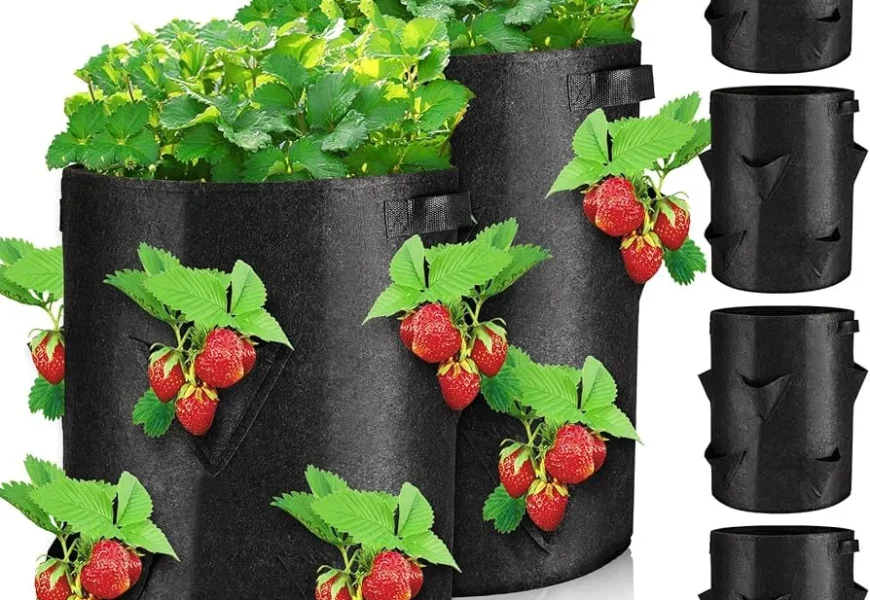
Among all container options, felt grow bag strawberries are widely regarded as the most reliable choice for home growers. These bags are made from non-woven polypropylene fabric — a breathable, permeable material that drains well and allows air to move through the walls naturally.
That airflow matters more than most beginners realize. It’s what enables the air pruning process, preventing roots from becoming root-bound — a problem that plagues strawberries grown in solid plastic pots. A standard felt bag should be at least 8–12 inches deep to give roots adequate room to develop properly.
If you plan to move your bags regularly, look for models with reinforced handles. Wet soil is heavier than it looks, and a bag without sturdy handles quickly becomes impractical to reposition.
Key advantages of felt bags:
- Strong aeration throughout the root zone
- Naturally prevents overwatering
- Regulates soil temperature better than plastic
- Reusable across 3–5 growing seasons
- Easy to clean, fold, and store during winter
Strawberry Pocket Planter
The strawberry pocket planter takes a different approach to space efficiency. These planters feature multiple side openings — usually between 6 and 12 pockets — alongside a top planting area. Each pocket accommodates one to two strawberry plants, making it possible to grow a meaningful number of plants in a very small footprint.
A pocket planter standing around 3 feet tall can house up to 12 plants while occupying less than 1 square foot of floor space. For urban gardeners who need to grow upward rather than outward, this design makes a real practical difference.
The one area that requires extra attention with pocket planters in any strawberry bag grow setup is watering. Lower pockets tend to receive less moisture than those near the top, which creates uneven growing conditions if not managed carefully. This is one of the most common challenges beginners face when they first start their strawberry bag grow journey with pocket-style planters.
Watering slowly from the top — allowing water to trickle down through each level — produces the most even distribution across all pockets. A slow-drip system on a timer removes the guesswork entirely and ensures every plant in your strawberry bag grow container receives consistent moisture, regardless of its position in the planter.
Vertical Strawberry Growing Bag: Making the Most of Limited Space
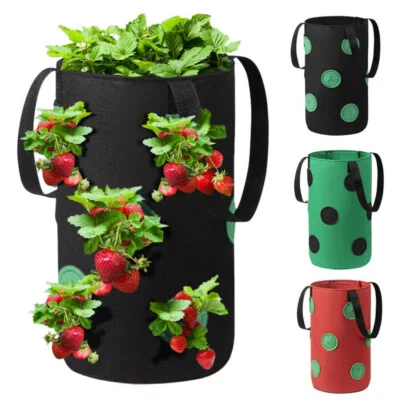
The vertical strawberry growing bag extends the pocket planter concept into a larger, more structured format. These tall, column-style bags are designed to be mounted against walls, fences, or freestanding metal frames. More advanced versions come with a pre-installed irrigation tube running through the center, which distributes moisture evenly from top to bottom — solving the most common challenge with vertical growing.
For anyone working with a small apartment balcony or a narrow outdoor area, a south-facing wall fitted with vertical bags can yield a surprising amount of fruit. The growing surface is maximized vertically rather than horizontally, which opens up possibilities that a conventional garden layout simply can’t offer.
Practical setup tips for vertical bags:
- Always fix them to a solid wall or frame before filling with soil — the weight increases significantly once wet.
- Use a timer-controlled drip system to maintain consistent moisture across all planting levels
- Select ever-bearing strawberry varieties to ensure continuous fruit production throughout the season.
- If only one side of the bag receives direct sunlight, rotate it quarterly for balanced plant development.
Hanging Strawberry Grow Bag
The hanging strawberry grow bag is arguably the most visually appealing option in the bag-growing category. Suspended from pergola beams, balcony railings, or overhead hooks, these bags allow strawberry runners to trail downward naturally — creating a display that’s as attractive as it is productive.
The practical benefit that often goes overlooked is airflow. Because the bag has no contact with the ground, air circulates around its entire surface. This dramatically reduces the humidity conditions that fungal diseases thrive in — a genuine advantage over ground-level or wall-mounted systems.
Weight is an important consideration before you hang anything. A fully watered soil bag can weigh anywhere from 15 to 25 pounds depending on its size. Always confirm that your hanging point is rated for well beyond that load before proceeding.
Strawberry varieties well suited to hanging bags:
- Alpine strawberries — compact plants with strong disease resistance.
- Seascape — ever-bearing, performs well in warmer conditions.
- Albion — excellent fruit flavor with solid resistance to common diseases.
- Ozark Beauty — a reliable heavy producer that handles temperature fluctuations well.
Strawberry Cultivation Container: Why Soil Choice Defines Your Results
This is where many first-time bag growers make a mistake that costs them the entire season. They invest in a quality bag, source healthy plants, and then fill the container with ordinary garden soil dug straight from a border. The result is almost always the same — poor drainage, soil compaction, and plants that never truly thrive.
The growing medium inside any strawberry cultivation container needs to be specifically chosen for container conditions. Garden soil simply doesn’t behave the same way once it’s enclosed in a bag. It compacts, restricts drainage, and creates an environment that works against strawberry roots rather than supporting them.
A custom blend built for container growing makes a significant difference:
| Component | Ratio | Purpose |
|---|---|---|
| Peat-free compost | 50% | Provides a nutrient-rich growing base |
| Perlite | 25% | Improves drainage and aeration |
| Coco coir | 15% | Retains appropriate moisture between waterings |
| Worm castings | 10% | Delivers slow-release natural nutrition |
This combination drains well without drying out too quickly, feeds plants steadily through the season, and resists the compaction that plagues soil-only mixes — making it the ideal growing medium for any strawberry bag grow setup.
Strawberries also prefer a slightly acidic growing environment — a pH between 5.5 and 6.5 is ideal for healthy root function and strong fruit development in a strawberry bag grow container.
If your tap water tends toward alkalinity, a small amount of liquid pH adjuster or collected rainwater helps maintain the right balance and ensures your strawberry bag grow plants can absorb nutrients efficiently without any chemical interference from overly alkaline water.
Strawberry Root Bag Planting: The Details That Make a Difference
The planting process itself is not complicated, but a handful of specific details have a direct impact on how well roots establish in those critical first weeks.
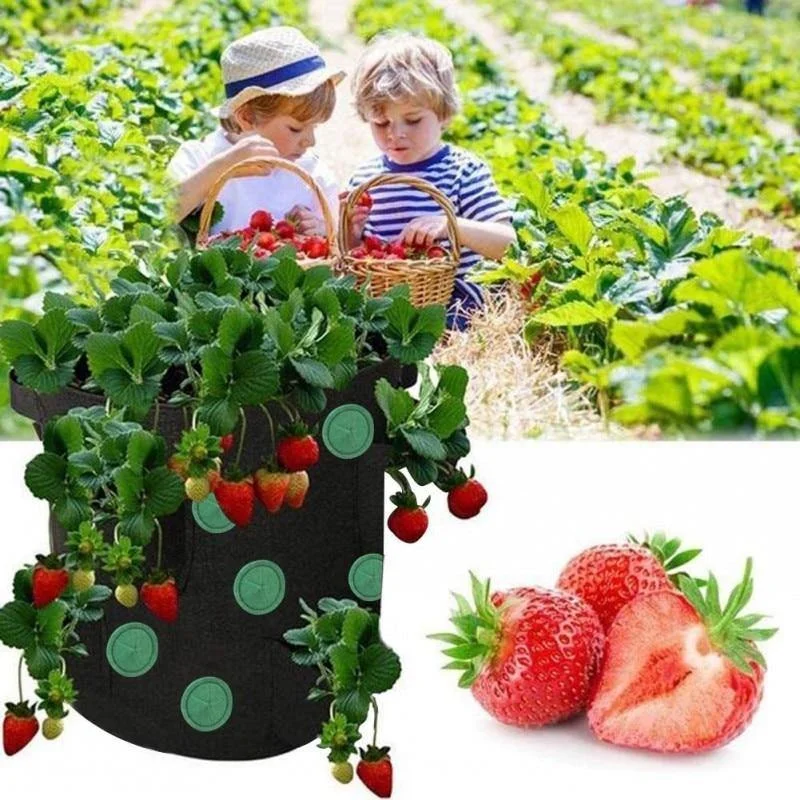
Follow this process for strawberry root bag planting:
- Fill the bag approximately two-thirds full with your growing medium before introducing any plants
- If you’re working with bare-root plants that look dry, soak them in clean water for one hour before planting
- In each planting position, form a small mound of soil — this raised center supports the crown correctly
- Set the crown exactly at soil level — burying it invites rot, leaving it too high causes the crown to dry out
- Allow the roots to spread downward naturally over the mound rather than bending or forcing them
- Fill in around the roots with the remaining medium and firm the soil gently
- Water the bag thoroughly straight after planting
Crown placement is the single most important detail in strawberry root bag planting. It’s a small thing that has a large effect. Get it right at the beginning and the plants will establish quickly and confidently.
Compact Strawberry Garden Bag: The Sensible Starting Point
For anyone new to growing fruit in containers, the compact strawberry garden bag is the most practical place to begin. These smaller bags — typically ranging from 5 to 10 gallons — strike the right balance between productivity and manageability.
A 10-gallon compact bag holds 3 to 4 strawberry plants comfortably, with enough root space for healthy, productive growth. They’re straightforward to water by hand, easy to move as light conditions change, and don’t require a drip system or any additional infrastructure to manage well.
What to look for when selecting a compact bag:
- A minimum depth of 8 inches to accommodate root development
- Permeable fabric or drainage holes at the base
- UV-resistant material if the bag will remain outdoors year-round
- Reinforced handles for repositioning without strain
Starting with two or three compact bags is a far more sensible approach than immediately investing in vertical towers or hanging systems. The basics of strawberry bag grow — soil preparation, watering frequency, and feeding rhythm — are best learned at a manageable scale. Once those fundamentals feel natural, expanding the system becomes straightforward.
Outdoor Strawberry Grow Sack: Caring Through the Seasons
One of the things that makes strawberries particularly rewarding is their perennial nature. Managed well, the same plants can produce across multiple seasons. But that longevity depends on giving your outdoor strawberry grow sack the right care as conditions change throughout the year.
Spring
- Clear away any frost protection or winter mulch once temperatures stabilize.
- Test soil pH and correct it if it has drifted outside the 5.5–6.5 range.
- Apply a balanced slow-release fertilizer to support new growth.
- Begin checking for aphids and vine weevil, which become active early in the season.
Summer
- Water consistently and frequently — bags lose moisture faster than ground soil, particularly during prolonged warm spells.
- Transition to a potassium-rich fertilizer once flowers begin to form, to support fruit development.
- Remove runners as they appear, unless you’re using them to propagate new plants.
- Once berries begin to color, net the bags against birds.
Autumn
- After the last harvest of the season, cut foliage back to around 3 inches above the crown.
- Reduce watering gradually, but avoid letting the growing medium dry out completely.
- In areas with cold winters, move bags to a sheltered position before the first hard frost.
Winter
- Wrap bags in burlap or horticultural fleece to protect roots from freezing temperatures.
- Raise bags slightly off the ground to prevent waterlogging during wet periods.
- An unheated greenhouse or garage provides reliable protection through the coldest months.
Strawberry Hydroponic Grow Bag: For Growers Ready to Go Further
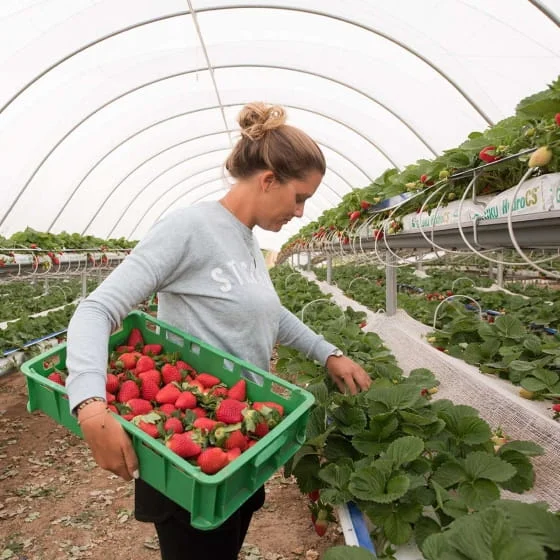
The strawberry hydroponic grow bag represents the most advanced approach in this category — and for growers who are willing to invest some time in learning the system, the results can be exceptional.
In hydroponic bag setups, plants grow in an inert medium such as coco coir, perlite, or rockwool rather than soil. Nutrients are delivered directly to the root zone through a liquid feed solution, giving the plant immediate access to everything it needs without relying on soil chemistry.
Hydroponic strawberries typically yield 30 to 50 percent more fruit than equivalent soil-grown plants in the same space. They also tend to grow faster and experience fewer disease problems, since there is no soil present for pathogens to establish in.
The trade-off is that the system requires more active monitoring. Three variables need regular attention:
- EC (electrical conductivity): Measures the concentration of nutrients in the feed solution
- pH: Should be maintained between 5.8 and 6.2 for optimal nutrient absorption
- Irrigation frequency: Typically 4 to 8 short watering cycles per day, depending on conditions
Common hydroponic configurations for strawberries include Dutch Bucket systems, NFT (Nutrient Film Technique) channels, and drip-to-waste bag setups. For growers new to hydroponics, drip-to-waste into coco coir bags is the most forgiving starting point — it offers solid results without the complexity of recirculating systems.
Fertilization: Feeding Bag-Grown Strawberries Correctly
Container-grown strawberries in a strawberry bag grow system exhaust available nutrients considerably faster than plants in open ground. Watering — which happens more frequently in bags — gradually leaches minerals from the growing medium over time. This is simply the nature of strawberry bag grow container gardening — the closed environment means there is no surrounding soil to draw additional nutrients from between feedings.
Rainfall doesn’t replenish those nutrients the way it might in a traditional garden bed, and unlike open ground, the growing medium in a strawberry bag grow setup has a fixed nutrient capacity that depletes with every watering cycle. This means a consistent feeding plan is not optional — it’s necessary for keeping your plants healthy, productive, and bearing quality fruit season after season.
A practical seasonal feeding schedule:
- Pre-flowering (early season): Apply a high-nitrogen feed to build strong, leafy plant structure
- Flowering stage: Switch to a balanced NPK formula — a 10-10-10 ratio works reliably
- Fruiting stage: Move to a potassium-dominant feed; a quality tomato fertilizer serves this purpose well
- Post-harvest: Return to a light balanced feed to help plants recover and build strength for the following year
Weekly liquid feeds consistently outperform slow-release granules for bag-grown strawberries. Liquid nutrients reach the root zone immediately, and you can adjust concentration based on how the plants look and respond over time.
Common Problems and Straightforward Solutions
Even a well-managed strawberry bag grow setup will encounter issues at some point. Most problems follow recognizable patterns, and understanding the likely cause makes resolving them much faster.
| Problem | Likely Cause | Solution |
|---|---|---|
| Yellow leaves | Overwatering or iron deficiency | Reduce watering frequency; apply chelated iron |
| No fruit forming | Insufficient light or poor pollination | Relocate the bag; hand pollinate flowers with a soft brush |
| Grey mould on fruit | Botrytis fungal infection | Improve airflow around plants; remove affected fruit promptly |
| Wilting despite moist soil | Root rot from poor drainage | Check for drainage blockages; consider repotting into fresh medium |
| Pale, stunted growth | Nitrogen deficiency | Apply a liquid nitrogen-based feed immediately |
| Excessive runner production | Natural growth pattern | Remove runners regularly to redirect plant energy toward fruit |
FAQ Section
Q: How many strawberry plants fit in a standard grow bag?
A: A 10-gallon bag comfortably accommodates 3 to 4 plants. Pocket planters can hold between 6 and 12 plants, depending on the number of side pockets and the overall size of the planter.
Q: Do strawberries grow well in bags compared to garden beds?
A: In many situations, yes — particularly where drainage, pest control, and growing condition management are concerned. A well-managed strawberry bag grow setup consistently produces quality fruit across the season.
Q: How often should I water strawberries in a grow bag?
A: During warm weather, check soil moisture daily. Bags lose moisture faster than ground soil. As a general rule, water when the top inch of the growing medium feels dry — this typically means every one to two days during summer.
Q: Can I reuse the same grow bag next year?
A: Fabric bags remain usable for 3 to 5 growing seasons. The growing medium, however, should be replaced annually — old soil becomes compacted and nutrient-depleted. Clean the bag with a diluted bleach solution between seasons before refilling.
Q: What’s the best strawberry variety for bag growing?
A: Ever-bearing varieties including Albion, Seascape, and Eversweet perform reliably in bags. Alpine strawberries are particularly well suited to hanging bags and pocket planters because of their naturally compact growth habit.
Q: Do grow bags need drainage holes?
A: Fabric grow bags drain through the material itself and don’t require additional holes. Plastic bags or sacks, however, need drainage holes at the base — without them, water accumulates and roots deteriorate quickly.
Q: Can I grow strawberries in bags indoors?
A: Yes, provided there is sufficient light. Position bags near a south-facing window or supplement with a full-spectrum grow light running for at least 8 hours daily. Indoor strawberry bag grow works particularly well with alpine varieties, which are naturally more compact and shade-tolerant than larger cultivars.
Conclusion
Honestly, growing strawberries in bags is one of those things that sounds almost too simple — until you actually try it and realize just how well it works.
Whether you’re working with a tiny apartment balcony, a modest patio, or a full backyard, strawberry bag grow fits into the space you have. You don’t need perfect soil, a large plot, or years of gardening experience to get started. You need the right bag, a decent growing mix, a consistent watering habit, and a little patience.
What makes this method genuinely satisfying is the control it gives you. You decide where the plants sit, how they’re fed, and how the growing environment is managed. That control shows up directly in the quality of the fruit you harvest.
Start small if you’re new to this. Two or three compact bags are enough to learn the rhythm — how the soil feels when it needs water, how the plants look when they’re thriving, when to feed and when to hold back. Once that becomes familiar, scaling up feels natural rather than overwhelming.
Strawberries grown in bags aren’t a compromise. For most home growers, they’re genuinely the better option. And the first time you pick a ripe, sun-warmed berry straight from your own bag-grown plant, that point becomes very easy to appreciate.
Give it a season. The results tend to speak for themselve.